
Businesses in
Alma,
Illinois
Alma, Marion Co., Illinois
(Note: Since there are so many images, these have been divided up into several
books for the website.
Remember that you can also use CTRL-F to find a particular surname within these
pictures when you are on the page.)
We are
looking for photos of people and/or places from around Kinmundy & Alma.
Can you help?
Or maybe you have
stories or memories from the "Good Old Days"? What do YOU remember?
The Kinmundy Historical Society would be honored to preserve your memories and
stories. We also have the
equipment to scan (or copy) your photos so that
they may be enjoyed now as well as for generations yet to come!
We
would love to hear from you! For more information, please contact:
Dolores (Ford) Mobley –
fordmobley@gmail.com
208 Joan Dr.; Divernon, IL 62530;
(217) 494-7527
or
Gladys (Corrie) See –
gsee49@yahoo.com
408 S. Washington
St.; Kinmundy, IL 62854; (618) 547-7731
Click to return to

More Alma orchard and farming
photos can be found in the FARMING section
of this website.

(B-1) Alma
Depot

(BA-2b) C.M.
See Block in Alma, Illinois
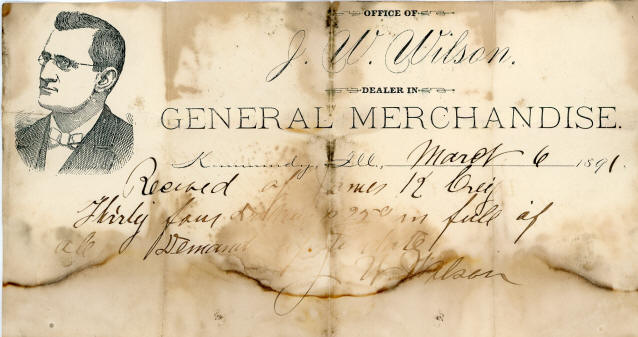
J.W. Wilson General Merchandise in Alma - receipt from March 6,
1891

(BA-3a) Alma Main Street - This scene was described as the J.R.
Clow Block in Alma on the imprinted postcard. In the background on the
left side, was the
W.S. Shrigley company, canner and packer of fruits and
vegetables. On the far right side was the J.F. Boring Livery (with the
horse drawn above the doors.)
%20fix.jpg)
Joseph Telford
- Canner and Packer - Fruits and Vegetables

(BA-6a) W.S. Shrigley, Canner & Packer
of Fruits and Vegetables
The old Alma
canning factory burned down on July 4, 1908 and was never rebuilt.
Pictured are "
Ras" Wright, _________, W.S. Shrigley who owned the company, ____ Freeman Eagan,
and _______________
"Salem
Republican" - Alma column - Sept. 29, 1904 - "Dr. W.S. SHRIGLEY, who is spending
the summer in Alma looking after his immense canning establishment, came down
Monday to spend the day. After the close of the canning season, Dr.
SHRIGLEY will return to Boston."
“Salem Republican”; Salem, IL; - Oct. 5, 1905 - “All Busy in Alma” - “Excellent
Season at the Cannery Make Good Times”
“Work for Everyone” - “The Shrigley Cannery has been Run to Full Capacity”
“Alma citizens are justly proud of the Shrigley canning factory which as been in
full operation there during the season just closing. This enterprise means much
to the citizens of that village and surrounding community. The vast sum of
money that has been put into the channels of trade through the operation of this
concern cannot be fully estimated until the season’s work is finished and there
is a general summing-up of details, which is no easy matter in a plant of such
vast proportions.
Imagine, if you can, a string of wagons extending five or six flocks on a street
in this city; not only that but they are standing two or three abreast, and off
on a nearby vacant lot there is a jam of loaded wagons. The bringing of
tomatoes to the cannery is likened unto a great circus parade for there is a
crush and jam and hurry that always accompany such. Do you wonder that Alma is
prospering when such scenes have been daily occurrences for several weeks. The
tomato growers are jubilant; the thrifty housewife is content for there is ample
funds for the children’s schooling. This has been a wonderful season for Alma
and the citizens round about have recovered from the effects of last year’s
failure.
Dr.
W.S. SHRIGLEY, the proprietor and general manager of the cannery, is responsible
in a great measure for the abundantly prosperous times at Alma. He has provided
a market for the products of the farm and given labor a chance to earn a weekly
stipend. Every one desiring work was given a chance, the amount of their earning
depending entirely upon their own effects.
A
trip through a plant of this kind is well worth going miles to see and it can
scarcely be pictured. The first scene which greets a visitor is the weighing-in
and unloading of the tomatoes. The vegetable is contracted for by the bushel
and 20 cents is the contract price. The grower who neglected to contract is not
so fortunate as he receives only 18 cents per bushel. From the store room, the
tomatoes are put through the scalding process and then carried to the peelers.
For peeling the price is 3 cents per bucket and many of the ladies who do this
work earn $1.50 per day. The fruit is then taken to the filler and then the
remaining part of the work is done by the perfected machinery. The can is
filled with the proper amount and then it is passed on to the capping and
soldering process after which the can passes through a vat of hot water to
ascertain if there be any leaks. If one is discovered the can is taken out,
resoldered and again tested. It is next placed in the processing tubs where the
vegetable is subjected to cooking for thirty minutes, then removed to the
wareroom and ricked for ten days before label and shipping.
The
great ware room is already filled to over-flowing but a few more ricks of
shining cans are put in and this continues until a car is loaded for shipment.
The immense amount of work, the untiring energy necessary to the successful
operation of such an extensive concern cannot be appreciated. During the
present run 120 person were employed daily and each one had a place to fill to
make complete the full operation of the plant.
The
cannery has a capacity of 15,000 cans daily and nearly every day for three weeks
for 1000 to 1500 bushels were consumed. Ten cars, with a capacity of 24,000
cans to each car have already been shipped to market and yet the amount of stock
on hands seems scarcely touched. The season has been an exceptionally good one
and the plant will certainly be made to realize handsomely for the proprietor.
The great burden of the work in this plant necessarily must fall on
the superintendent and Dr. SHRIGLEY is fortunate in securing the services of
Freeman EAGAN for the place. He understands the management of affairs quite
thoroughly and he has been tireless in his efforts to keep the machinery moving
so there would be no waste of time or material. The cannery is certainly a boon
to Alma and citizen of other places that cause to look upon it with envious
eyes.”
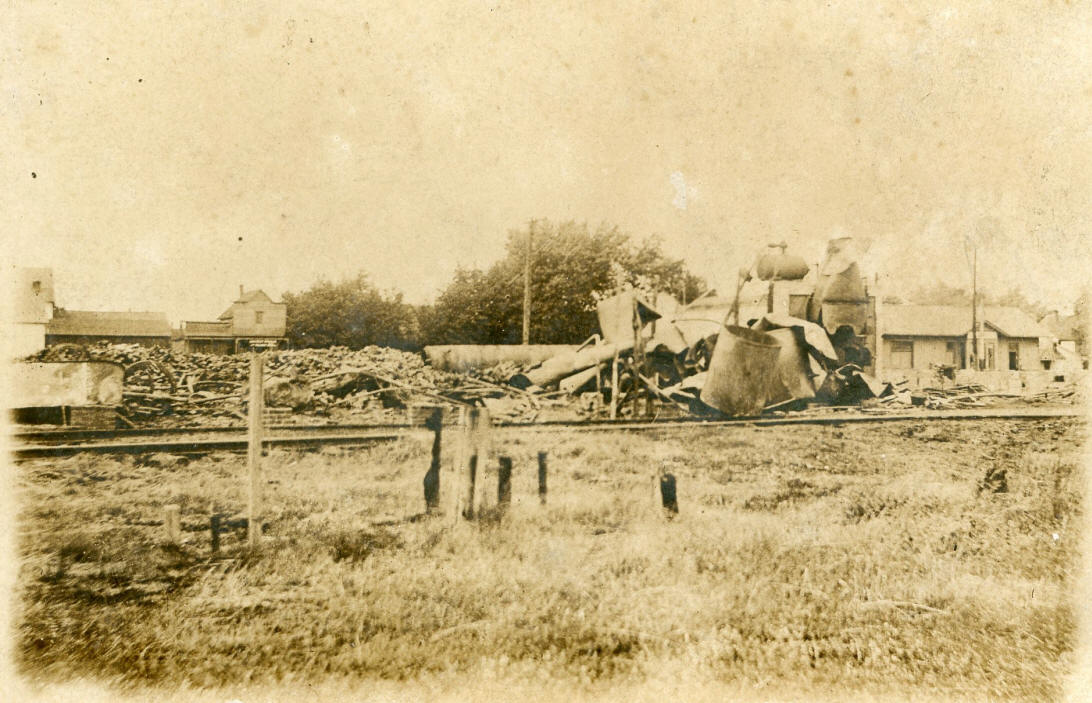
Alma Cannery Fire (The
building on the far right is the Alma ICRR Depot.) - July 1908

(B-77) W.S. Shrigley's Cannery in ruins after the July 1908 fire. The
Alma Depot is standing in the background.
"The Republican"; Salem, IL; July 9,
1908 - "Fire Loss at Alma; Immense Cannery Burned as Result of Fireworks
Display"
"The celebration
of the Fourth of July at Alma was without doubt the most expensive thing of the
kind ever before attempted in Southern Illinois. To be sure all of the fireworks
that took place that evening were not on the bills or there would have been
careful watching to see that it did not occur. Sometime after midnight of that
day, the immense cannery belonging to Dr. W.S. Shrigley caught fire and burned
to the ground. While it is not known positively, it is believed that the fire
resulted from the display of fireworks given in the village that evening. It is
presumed that the stick from a sky rocket carried sparks to the building where
they smouldered for several hours before igniting and causing blaze sufficiently
to be noticed.
About two o’clock, one of the
nearby residents was awakened by the light from the burning building and even
though the flames had gained such head-way that the total destruction of the
building was foreseen, especially when then there were no facilities at hand
with which to fight. The residents were absolutely helpless and they watched the
destruction of their chief industry with saddened hearts.
This property passed to the
control of Dr. W.S. Shrigley several years ago and he at once put it in
condition for successful operation, and every season since that time it has
increased in importance until it was reckoned as one the best enterprises of the
kind in Illinois, and through it thousands of dollars found their way annually
into the pockets of the producers and the workers of that vicinity. Dr. Shrigley
carried insurance on the building and equipment to the extent of $10,000 and
$250 on the stock on hand.
Hours before the fire had ceased
burning the proprietor had decided on the immediate rebuilding and word to that
effect had passed along the line. It is a remarkable spirit of thrift that is
not daunted by such a disaster and Dr. Shrigley is insistent that the new plant
will be completed in ample time to care for the present years crop. That is the
spirit that will net down and Alma citizens are to be congratulated upon the
possession of such a citizen."
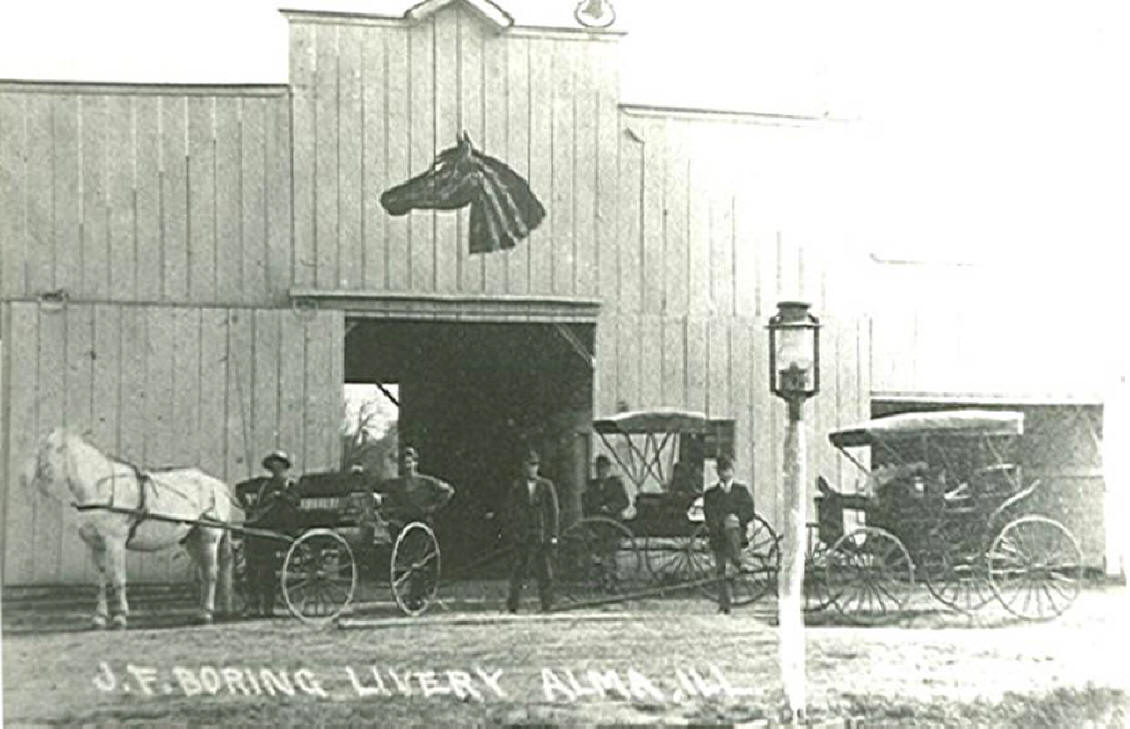
(BA-17a) J.F. Boring Livery in Alma, Ill.
(This is the building across the tracks and south of the canning factory.)

(BA-5g) Business
Section of Alma, Illinois

(BA-7a) Public
School in Alma, Illinois. This was the former Alma Christian College
building prior to being purchased for use of the Alma public school. It
burned down in 1913.
“Alma Industrial
College” -
“The
thought of an industrial school at Alma originated with Mr. W.S. ROSS, a
graduate of Abingdon College, and pastor of the Alma Christian Church. The
proposition was heartily favored by the community. Subscriptions were secured.
Four acres of land were bought, and a good two-story, eight-room frame building
was erected thereon. The title to this property was vested in a Board of
Trustees. The school opened in September, 1896. It was coeducational and aimed
to help worthy young people to start well in life. An option on 420 acres of
land was secured, and a printing-office was bought and installed in the
building. The aim was to have the boys work part of the time on the farm and
the girls in the printing-office, and thus pay part of their expenses. In
addition to this labor, every pupil paid $120 per annum. This work and cash
secured for each and every pupil during the school year board and lodging,
instruction and books. Experience proved that the school could not be maintained
on this financial basis. Appeals for assistance in localities from which the
school was easily accessible met with meager responses. Debt accumulated;
hence, in 1900, the school was discontinued. The property was sold, for public
uses, for $3,000, which was said to have been one-half of its value. All debts
were settled. The averaged attendance during the four years was about one
hundred per year. The men who served as head of the school or president were
H.Y. KELLER, W.H. BOLES, A.A. HIBNER, Clark BRADEN, W.B. BEDELL, P.J. DICKERSON
and Thomas MUNNELL. Mr. MUNNELL died just before the final closing of the
institution. His body is buried at Alma. This enterprise was most
commendable.” (“History
of the Disciples of Christ in Illinois – 1915”)
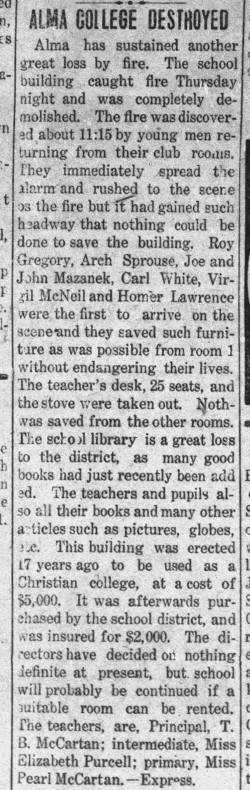
"Salem
Herald-Advocate" - March 14, 1913 - "Alma College Destroyed"
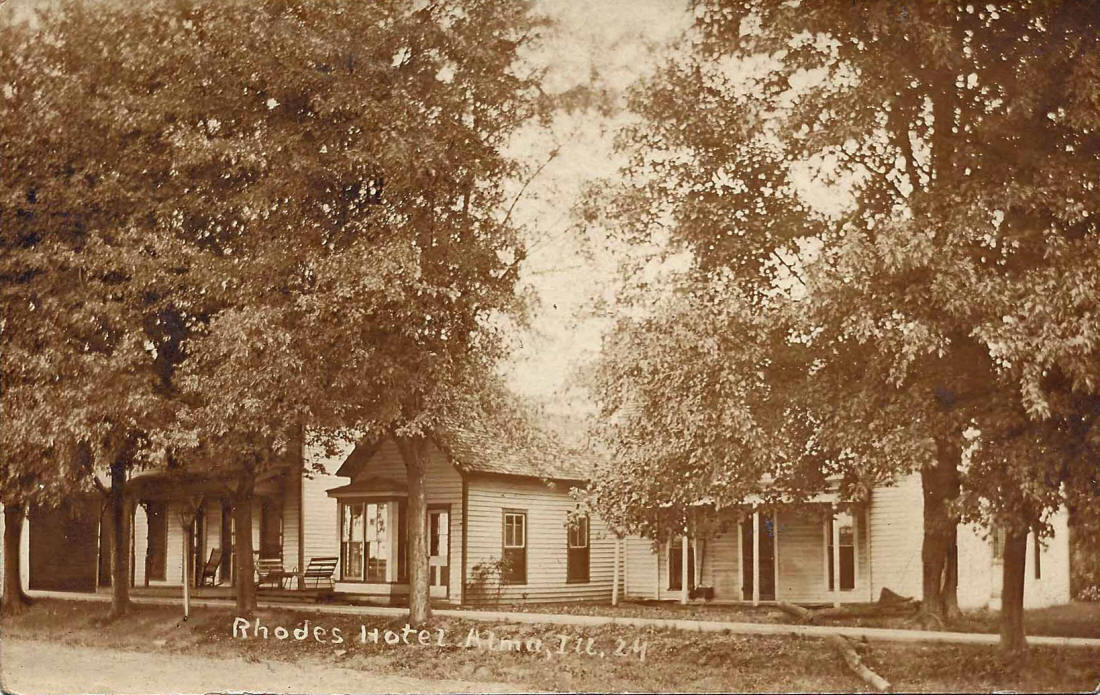
(BA-8b) Rhodes Hotel in Alma

(BA-9) Ernest
“Hump” Harris (father of Ruth Harris Brimberry) and 1910 Ford. He
posed in this picture postcard for his sister.

(BA-10a) Alma
Basket Factory

( BA-11a)
Alma Basket Factory – Close-up (Part A)

(BA-12a0 Alma
Basket Factory – Close-up (Part B)
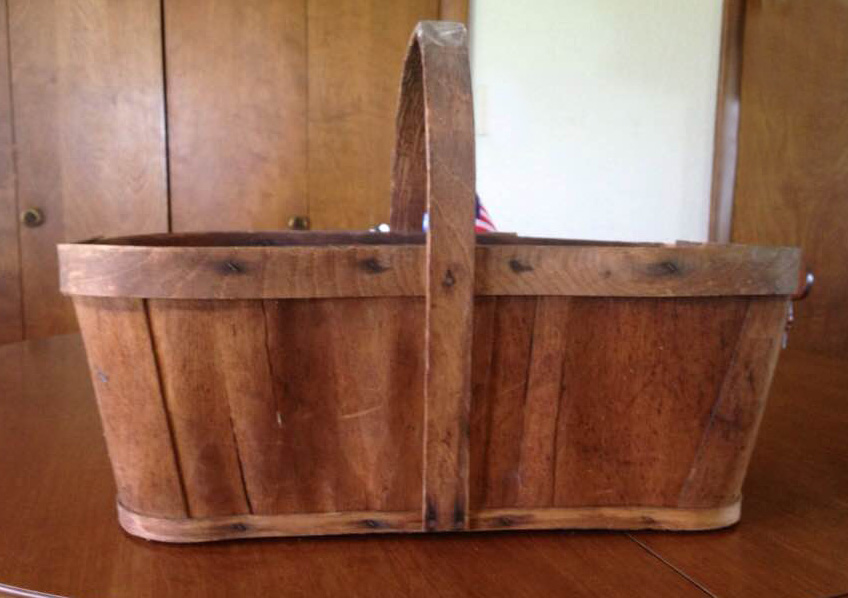
Basket made at the Alma Basket
Factory (owned by Joyce Wilkins)
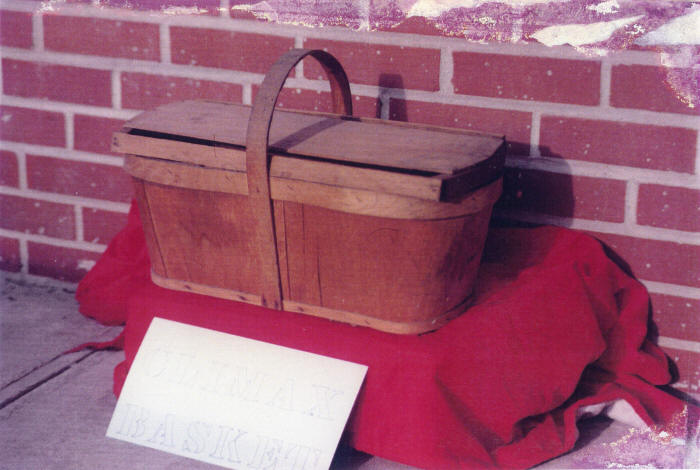
Basket made at the Alma Basket Factory at an Alma estate sale
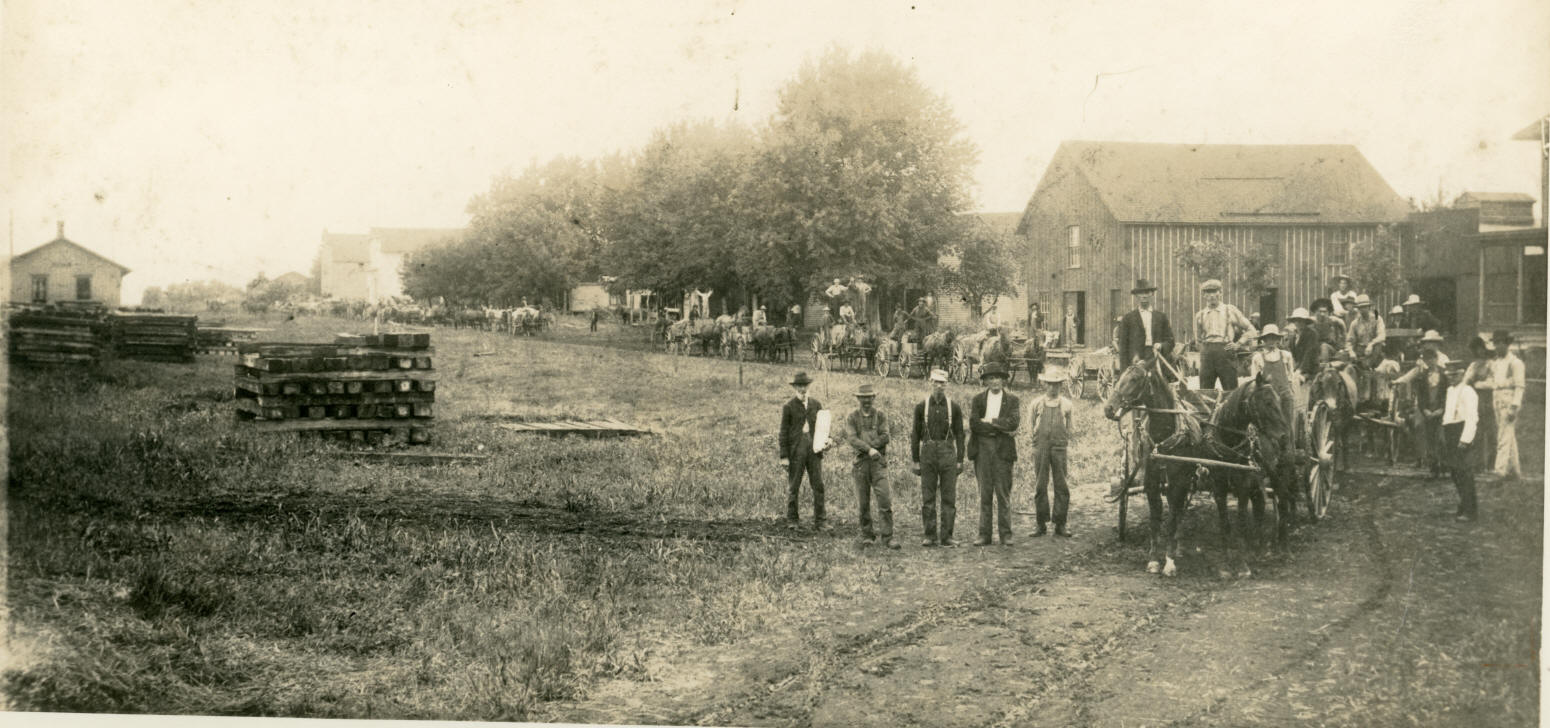
(BA-13f) Wagons lined
up to unload Alma Gems
1898 Melon Harvest - In the
days when the Alma Gem melon was in its glory, farm wagons like these hauled
the crop to the Alma depot.
From left to
right in the foreground are a Mr. Wyatt, Tom Campbell, MV. Hefton, H.P.
(Hillary) Smith, Billy Caldwell, Charles Wyatt, driver, Roy Wyatt, C.M. See -
station agent, and J.W. Ross. This picture was taken in 1898 by a St.
Louis
photographer.
Wagons were
filled with fruit waaiting to load onto railroad cars at the Jake Poole
Crossing. View is looking South on Railroad St.
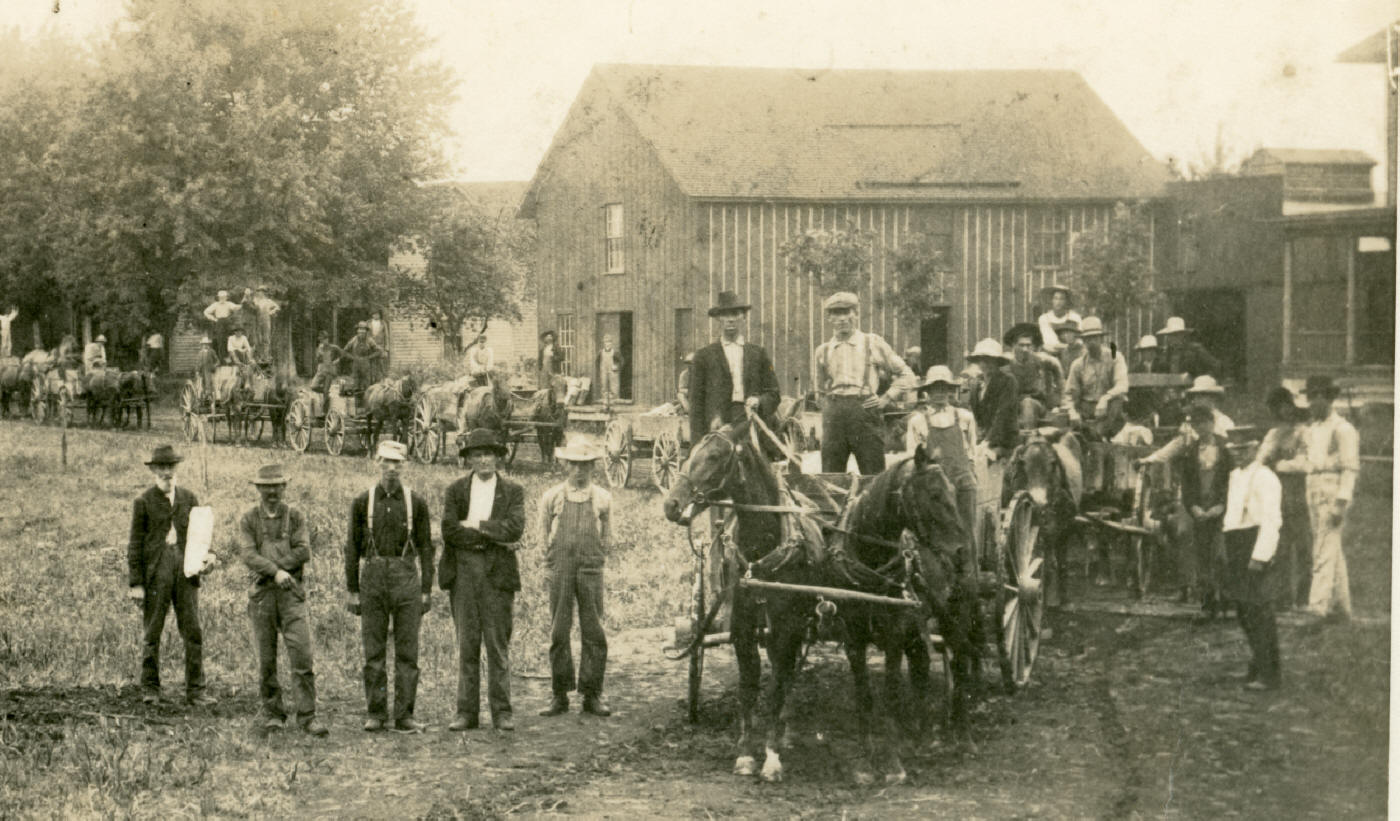
(BA-13e) Wagons
lined up to unload Alma Gems before 1909 (Close-up, Part A)
From left to
right in the foreground are a Mr. Wyatt, Tom Campbell, MV. Hefton, H.P.
(Hillary) Smith, Billy Caldwell, Charles Wyatt, driver, Roy Wyatt, C.M. See -
station agent, and J.W. Ross.
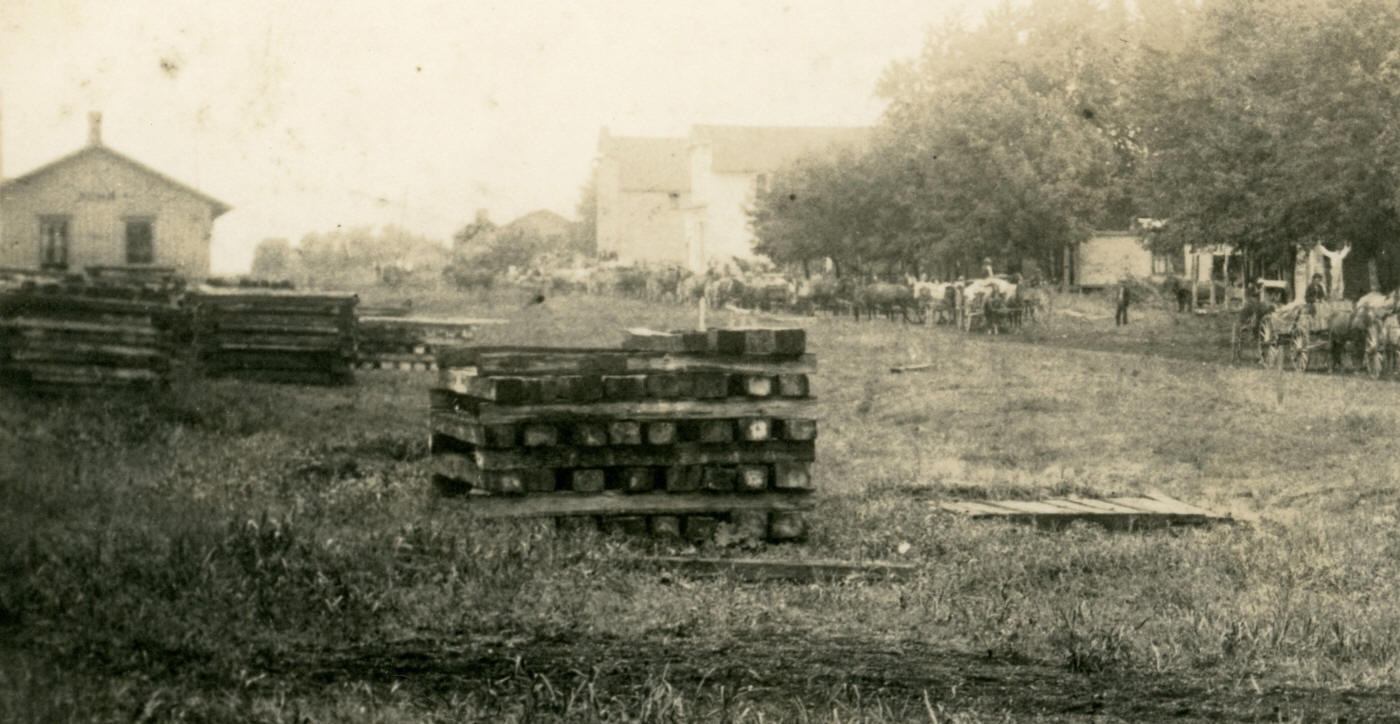
(BA-15a) Wagons
lined up to unload Alma Gems before 1909 (Close-up, Part B)
.jpg)
.jpg)
These melons grown in 2022 by Mary
Cessna, are possibly similar to the Alma Gem melon.
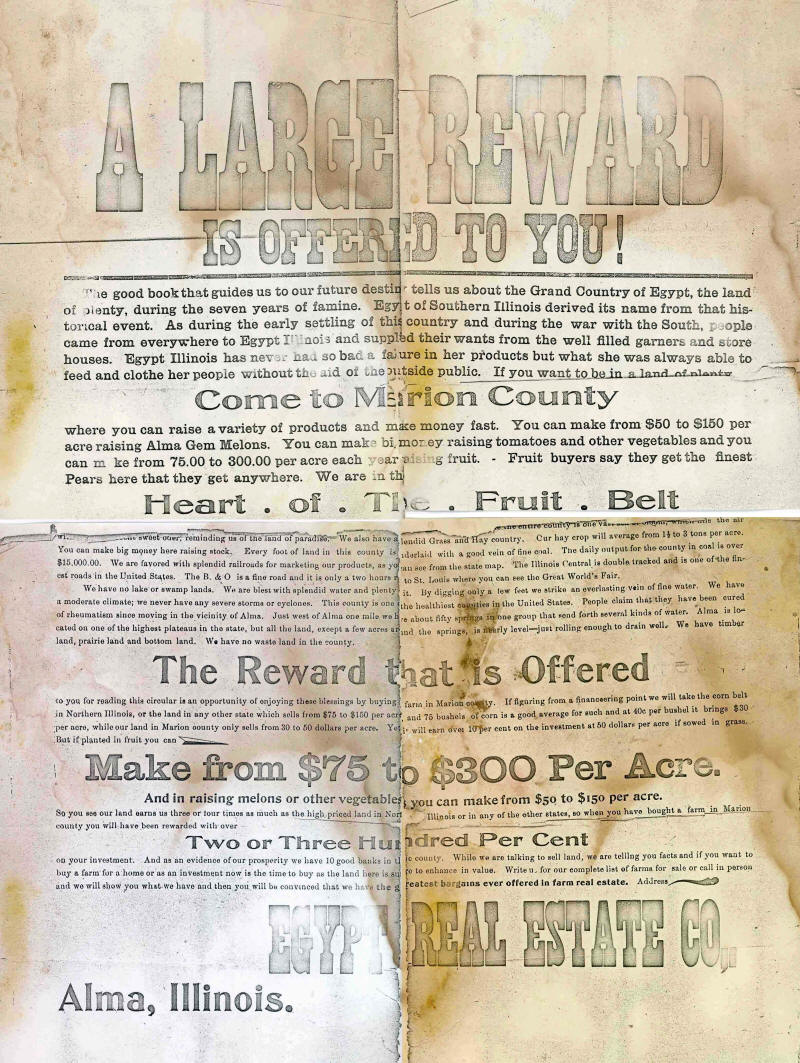
"Egypt Real Estate Co." in Alma advertising land to grow the Alma Gem melons
and other fruit farming
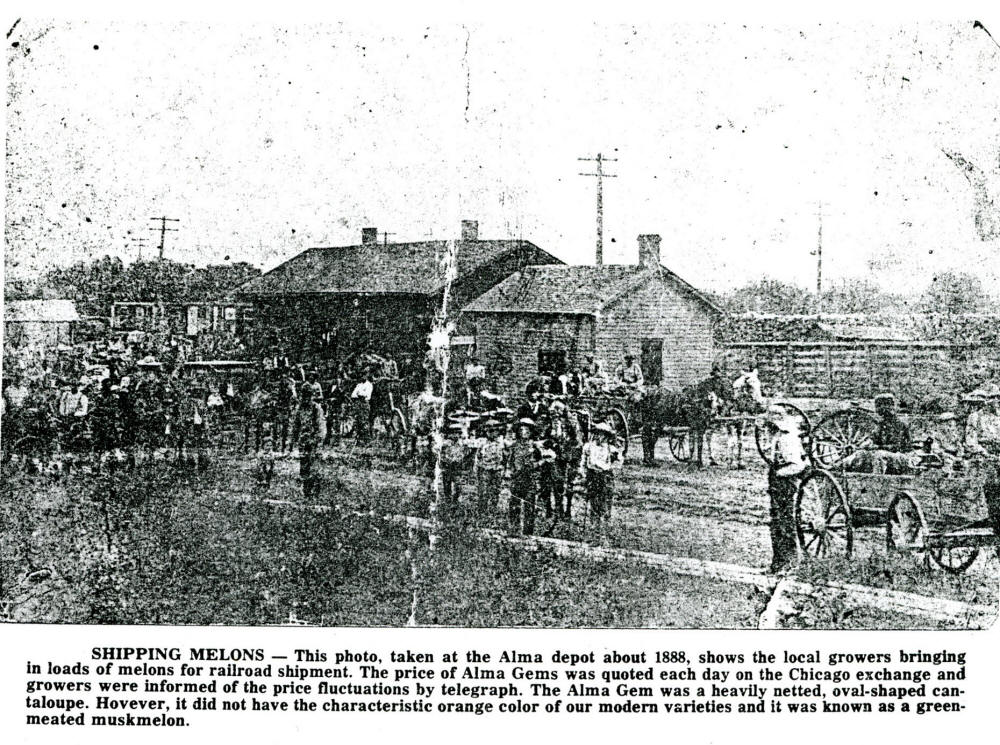
Shipping Melons - This photo, taken
at the Alma depot about 1888, shows the local growers bringing in loads of
melons for railroad shipment.
The price of Alma Gems was quoted
each day on the Chicago exchange and growers were informed of the price
fluctuations by telegraph.
The Alma Gem was a heavily netted,
oval-shaped cantaloupe. However, it did not have the characteristic orange
color of our modern varieties and it was known as a green-meated muskmelon.

(BA-18) Alma
Melons - Noah Rhodes (Ruth Brimberry’s grandfather) is sitting against a wagon
second from left.
One
photo mentioned this is an orchard crew, but might be several farmers who
brought in loads of melons. The photo was taken on Railroad Street in
front of Rhodes Hotel.
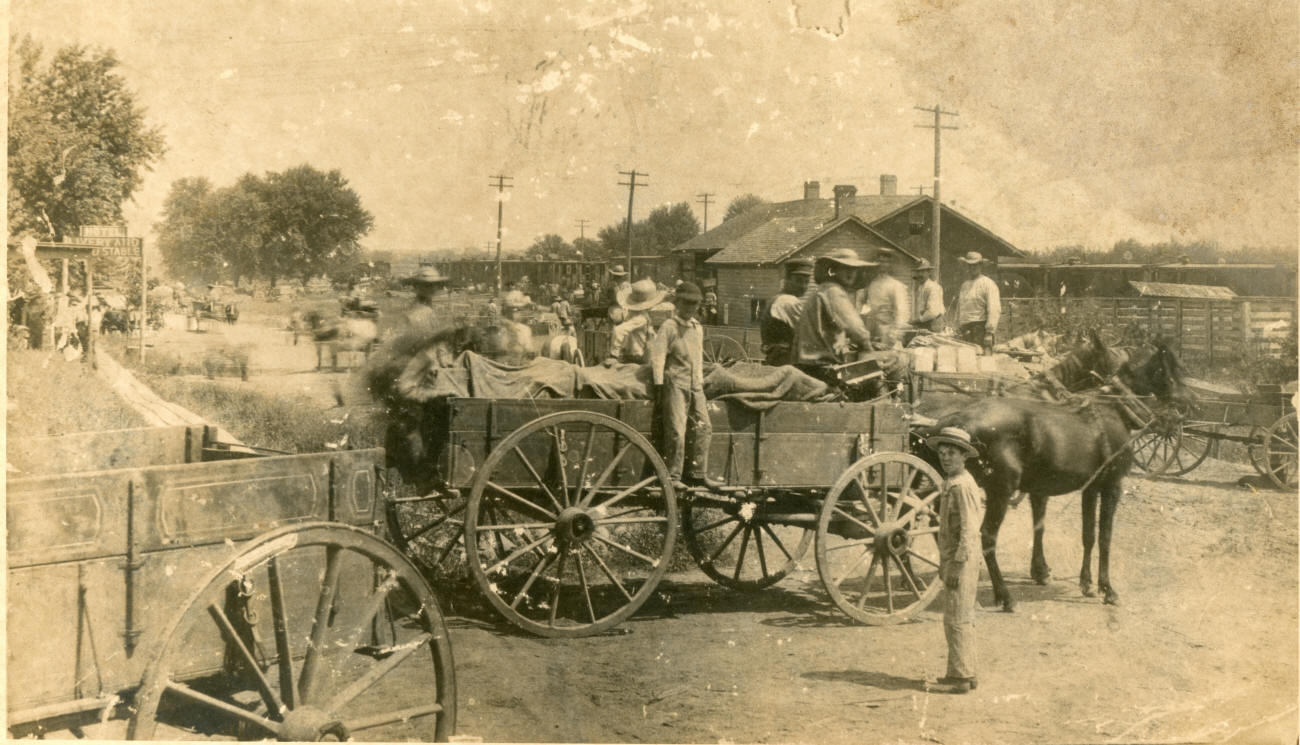
(BA-19b) Alma
Gems going to Chicago - tracks and
depot on right. Hotel, Livery & Stable is on the far left.
This was at the intersection of 7th and Railroad St. The view is looking
north.

(BA-55)
Dan Purcell coming to town with a wagon load of fruit

(BA-16a) Loading the
Illinois
Central Train

(BA-40)
William Manns' store in Alma in 1895. He was married to Ella Mae Sullens.
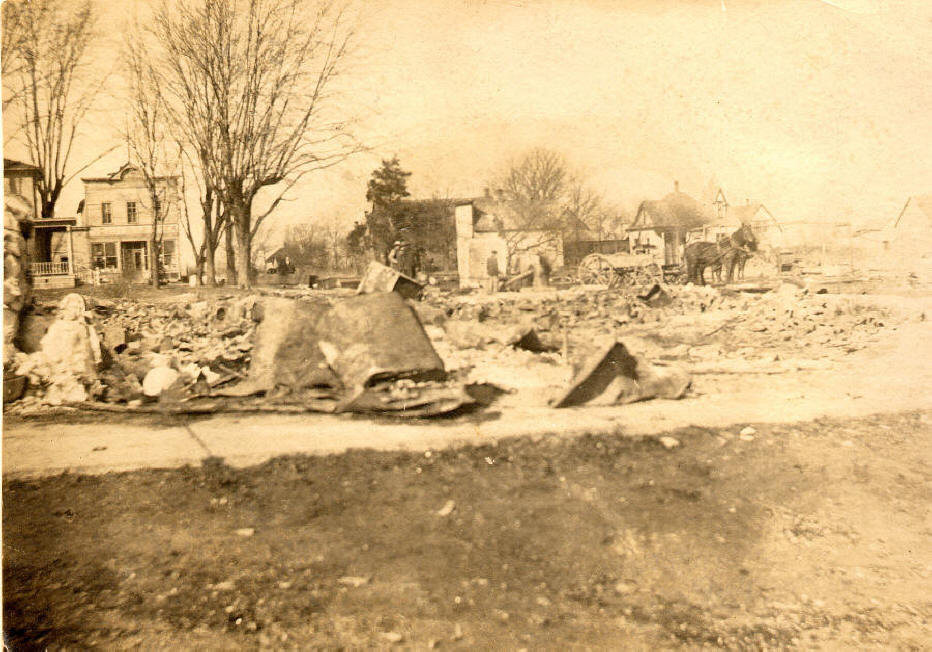
After the 1908
Alma Main Street (7th Street) after the December 1908 fire looking towards the west from about where the Standard Station would
later stand years later (and most recently Billie Jo's store).
The Mazanek store is the building still standing on the left side of the photo.
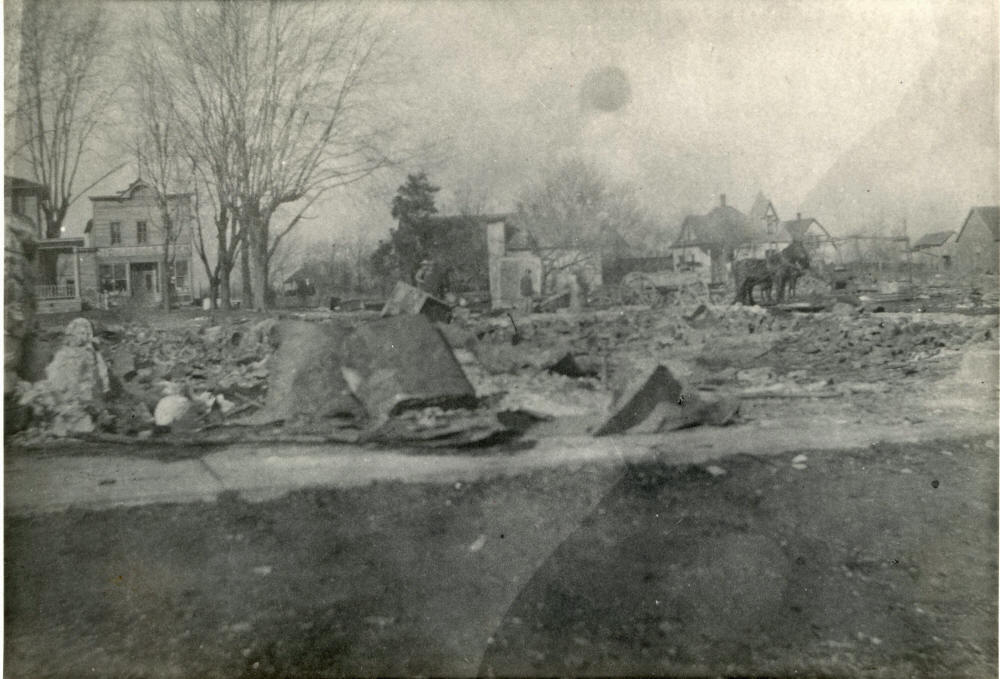
Dec. 31, 1908:
Big Fire at Alma: On Monday afternoon about three o’clock, fire was discovered
in the large barn of J.R. CLOW at Alma. The barn contained a large quantity of
baled hay, 50 tons belonging to Mr. CLOW, 53 tons to E.G. FORD, and 20 tons to
John POWELL. From the barn, the flames soon spread to the CLOW business block
and in a few minutes these buildings were in flames. The wind was from the
southwest and the fire soon crossed the street and consumed six business houses
and a portion of the contents. The telephones were but in immediate use and the
Kinmundy Fire Dept. responded to the call and in about thirty or forty minutes
after the call for help was received, the engine was in Alma. When the fire
company arrived the flames had reached the business house of C.M. SEE & Co., and
by hard work the fire spread no farther. By the use of the engine the Baptist
church, the Tomlinson Hotel, the Henry YOST meat market and probably several
other buildings were saved. If the engine had been on the scene at the beginning
the fire could have been confined to the barn where the fire originated. The
value of buildings and contents are as follows:
J.R. CLOW, barn
and contents, $3,500; insurance $1,600. Store buildings $5,500; insured for
about half their value.
J.W. BROOM,
stock of merchandise, estimated value $7000; insurance $3000.
Mrs. Jennie
DEAN, restaurant stock, value $1000, insurance $400.
E.G. FORD, 53
tons of hay, no insurance.
John POWELL, 20
tons of hay, no insurance.
Citizens Bank,
building and fixtures, value $1730; insurance, $400.
I.O.O.F. Lodge
room and contents, value $800; insurance $300.
C.D. TOMLINSON,
two business rooms, loss $500, insurance, $300.
Roy GREGORY,
restaurant stock, value $400, insurance, $250.
C.M. SEE & Co.,
store building and stock of merchandise, value $8500; insurance, $2500.
BEECH & FULLER
Basket Co., fruit packages, loss $4000, no insurance.
J.W. WALKER,
harness shop, contents nearly all saved.
B.G. PULLEN,
building and contents, hardware and groceries, value $4500; insurance $1100.
H. CLARK, store
building, loss $2000, insurance $800.
In many of
these stock of merchandise, a large quantity of the goods were saved, but badly
damaged in removing them from the buildings. This fire leaves only one general
store in the village of Alma, and the loss is great for a town of that size.
"The
Republican"; Salem, IL; Dec. 31, 1908;
ALMA IS BURNED;
Business Section of Village Swept Away; ONE STORE REMAINS;
Loss Will Reach
Several Thousand Dollars and is Severe One
"The little
Village of Alma, seven miles north of this city, was visited by a disastrous
fire Monday afternoon and nearly the entire business section of the town was
swept away by the flames. A total of fourteen business houses were destroyed
including the Post Office building. The fire is believed to have originated in
the hay barn of J.R. Clow which stood at the rear of his property on the street
leading south along the Illinois Central Railroad. A large quantity of hay was
stored in the barn and it is thought to have ignited by spontaneous combustion.
The flames spread quickly to the large store building owned by Mr. Clow and then
swept up the street running west from the Illinois Central depot. The large
implement warehouse of B.G. Pullen, which stood south of the Clow hay barn, was
also burned together with the contents. The losses as were given out Monday
night are as follows:
B.G. Pullen, building and stock, $4500, insurance, $1100. I.O.O.F.P. Lodge, loss
$600, insurance, $300; Citizens’ Bank building and Square, $1750, insurance,
$400; J.R. Clow, large hay barn and contents, $3300, insurance and contents,
$1600; J.R. Clow, store and buildings, $5500, insurance $2250; E.G. Ford, fifty
tons hay, no insurance; Mrs. Jennie Dean, restaurant, loss $400, insurance,
$400; J.W. Broom, merchandise, loss $7000, insurance $3000; Roy Gregory,
restaurant, loss $400, insurance $250; C.M. See & Co., merchandise and building,
loss $8500, insurance $2500; Berch & Fuller, Basket Company, loss $4000, no
insurance; C.D. Tomlinson, barber shop, loss $500, insurance $300.
The post office building was entirely destroyed but Postmaster Winks succeeded
in saving all the mail and equipment including stamps and money order forms.
After the fire
had been under headway for some time, the Kinmundy fire department was appealed
to for aid and they hastened to the scene of the disaster. The timely arrival
doubtless saved the residence portion from destruction as the flying embers
fired the roof of the Baptist church and other buildings were carefully watched
until the flames burned out.
This is the second disastrous fire the little village has suffered within six
months. On the night of July 4, the large cannery of W.S. Shrigley’s was burned
to the ground. This was Alma’s chief industry and the loss was felt very heavily
during the season. The fire Monday was even worse than the destruction of the
cannery for the reason that very few of the owners of the establishments are
prepared to stand such losses. Coming in midwinter as it did, the work of
rebuilding is likely to be retarded owing to the probability of bad weather.
Several of the persons were suffered in the recent fire have announced the
determination to rebuild at the earliest possible day. They are an enterprising
set of fellows in Alma and the little city will rise from it’s ashes, and will
be the busy little mart that it was before."

(BA-23d) Mazanek Store on the southwest corner of 7th and Illinois. Laura
Mazanek is standing in the foreground in July 1915. (The Eastland Boat
Disaster in Lake Michigan happed in late July 1915.)
“J.R. Clow moved
to his property west of town during the inclement weather last week. John
Mazanek has moved into the Clow residence and has gone into the dry goods and
grocery business with Mr. Noah Warner. The new firm will be known as Warner and
Mazanek.”
“Salem
Herald-Advocate” – March 13, 1891
“Warner &
Mazanek, merchants at Alma, will adopt the strictly cash system the first of
next month.”
“Marion County
Democrat” – Salem, IL – Dec. 23, 1892
“Mr. John
Mazanek will build a new store with opera house above on his lots north of the
M.E. church.”
“Salem
Republican” – March 21, 1895
“Mr. J. Mazanek
is now ready to wait on customers in his new store, one block west of where he
was formerly located.”
“Salem
Republican” – Aug. 1, 1895
“The hope given
at Mazanek’s hall Thursday night was a very enjoyable affair; everything went
quietly and gentlemanly, which bespeaks much credit in behalf of Bird Pullen,
manager.”
“Marion County
Democrat” – Salem, IL – Nov. 29, 1895
“A dance at
Mazanek’s Hall Friday night”
“Salem
Republican” – Aug. 15, 1895
“The band supper
at Mazanek’s hall was largely attended and a good time was had by all present.”
“Salem
Republican” – June 4, 1896
“Dick Winchester
of Carbondale, spent two days here last week installing a lighting system in the
stores of John Mazanek and B.G. Pullen. The lights are manufactured by a
Cincinnati firm and are all that could be desired in the way of light.”
“Salem
Republican” – June 24, 1909
“Alma – John
Somerville of Odin, was a business visitor in Alma Tuesday. He is putting down
300 feet of concrete walk for John Mazanek.”
“Salem
Republican” – July 1, 1909
“John Mazanek’s
store presents a very attractive appearance as a result of a fresh coat of
paint.”
“Salem
Republican” – July 15, 1909
“The young folks
enjoyed a dance at Mazaneks Hall Saturday night.”
“Salem
Republican” – Jan. 15, 1914
“A number of
young people entertained their friends to a Halloween party Tuesday night at the
Mazanek Hall. It was in the nature of a masquerade party and some of the
costumes were quite original and evoke considerable laughter. At a late hour
dainty refreshments were served and the rest of the evening was passed playing
games.”
“The Kinmundy
Express” – Nov. 14, 1916

(BA-22a) Main
Street - Alma, Illinois
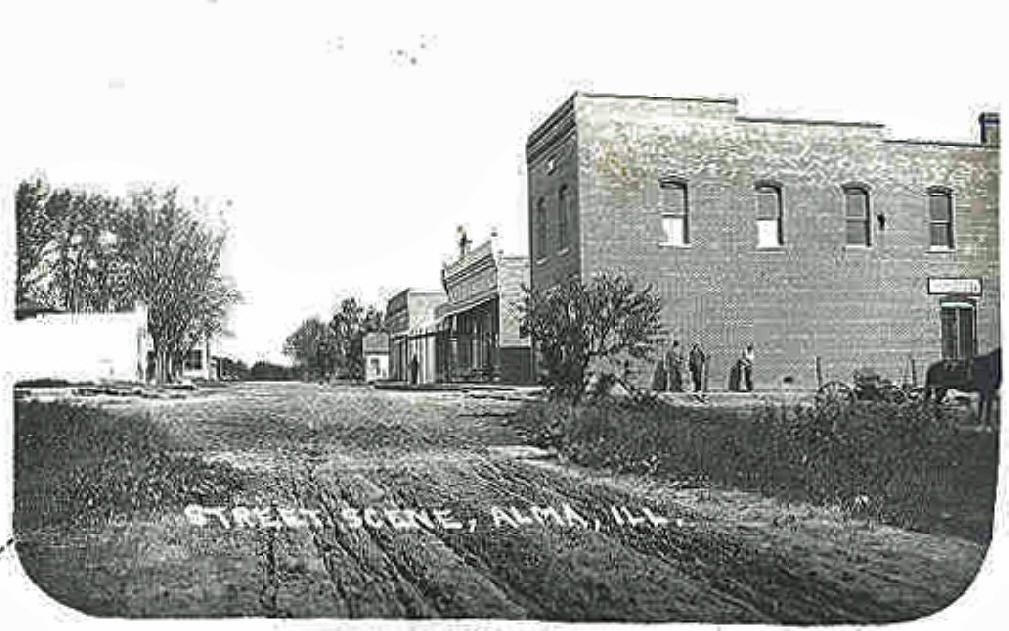
1909 Alma Main Street
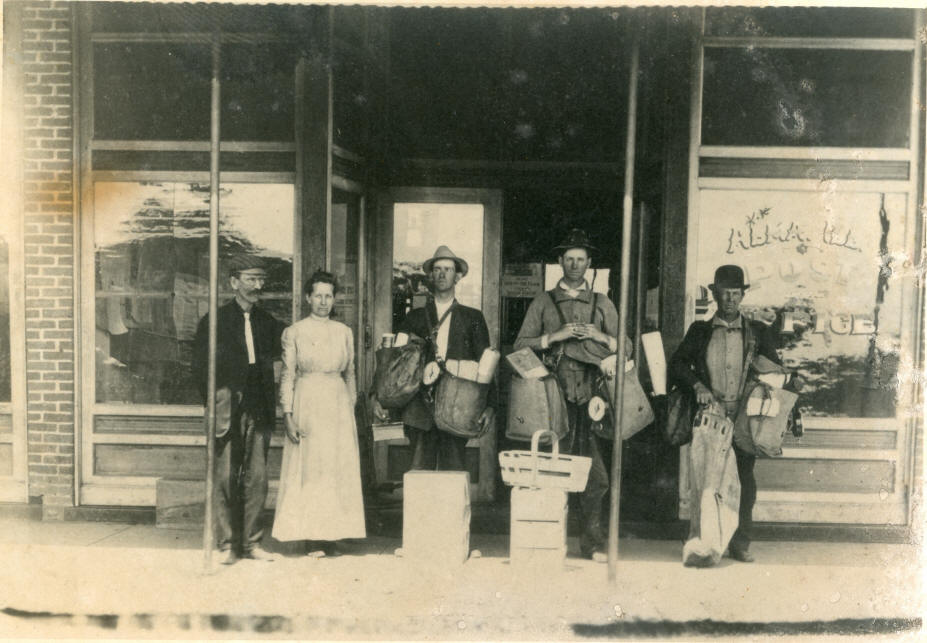
(BA-25a) Alma Post
Office and employees - From Left to Right: Charlie and May Pollock, and
possibly “Hap” Lawrence one of the
mail carriers
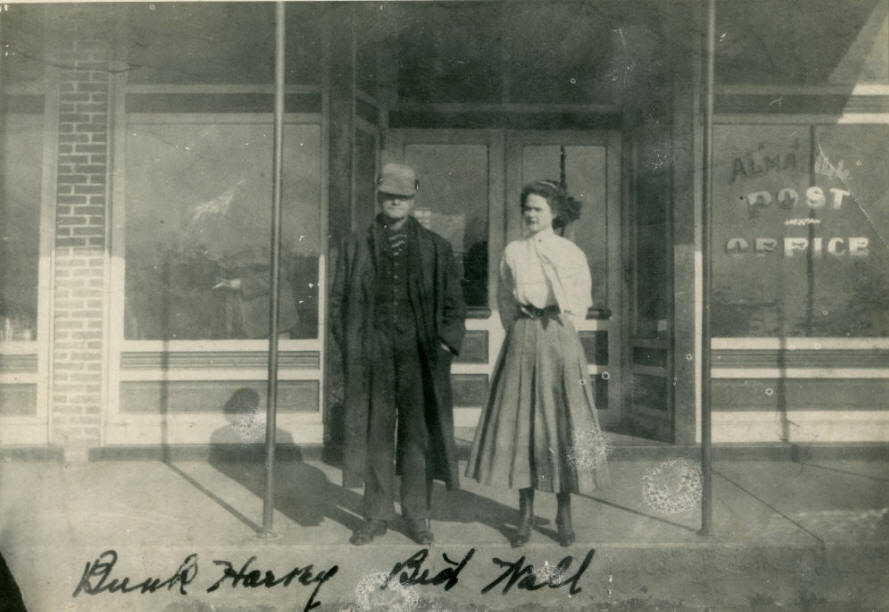
Alma Post
Office - Bunk Harvey and Beth Wall

(B-71) Doc Laswell's Office
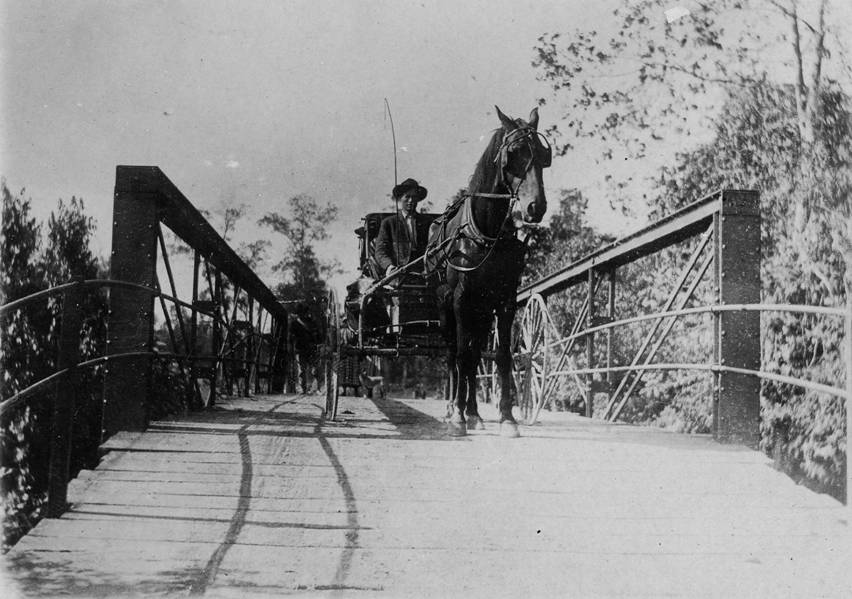
(BA-34) R. F. Wyatt, Mail Carrier, (Belicks Bottoms)

(BA-26a) William Hester Pear Shed #2. The woman on the far left is Nora Clow. This
picture was taken behind the Hester house in Alma.
The barn and shed are still there, and west of the old family home.

William Hester Pear Orchards - Alma, Illinois - Sept. 16, 1929
William P.
Hester, son of William Hester, is standing in the middle row, 5th from the
right.
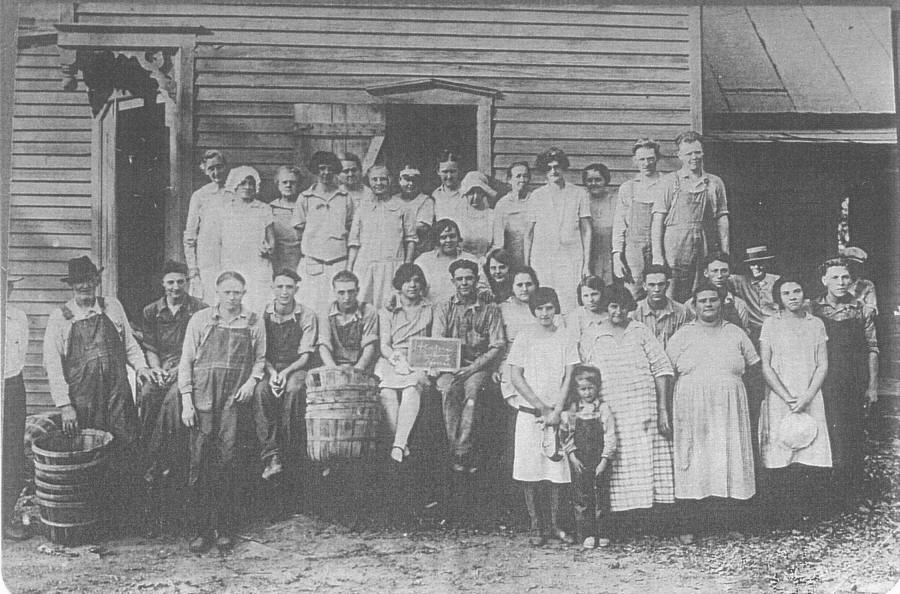
Hester Orchard
workers

(B-59a)
Gillium Wilson and Mattie Purcell in Alma

(BA-27d) J.W. Broom Store named “The Square Deal” in Alma,
Illinois – (also printed in a Square Deal Ad
in “The Kinmundy Express” - Oct. 12, 1911)
Pictured are LaVinia (Broom) Shufeldt, Carrie (Broom) Purcell, Clara Tucker and
sister, and Roy Broom.
The store was owned by John W. "Bill Broom and Thelia Belle (Crown) Broom.
"The Kinmundy Express" - Aug. 10,
1910
"J.W. Broom - General Merchandise
Motto - Quick Sales and Small Profits"
"This store is better known as the
SQUARE DEAL. Starting in a small way, Mr. Broom has grown to be one of the
leading, if not the leading store in Alma. While he has only been in the
mercantile business four years, he had a varied experience of twelve years on
the road and this fact coupled with his unusual foresight as a business man and
trader has made his success very rapid. He was burned out December 28, 1908,
during the big fire at Alma, and after that the I.O.O.F. put up a big brick
building which is the pride of the town and is now occupied by Mr. Broom. His
greatest asset in business is his daughter, Miss Carrie, who is very frequently
left in full charge of the business for many days at a time. Mr. Broom deserves
your patronage."

(BA-52a)
Square Deal Store - J.W. Broom - Alma, IL - 1911

(B-673) Alma's Main Street
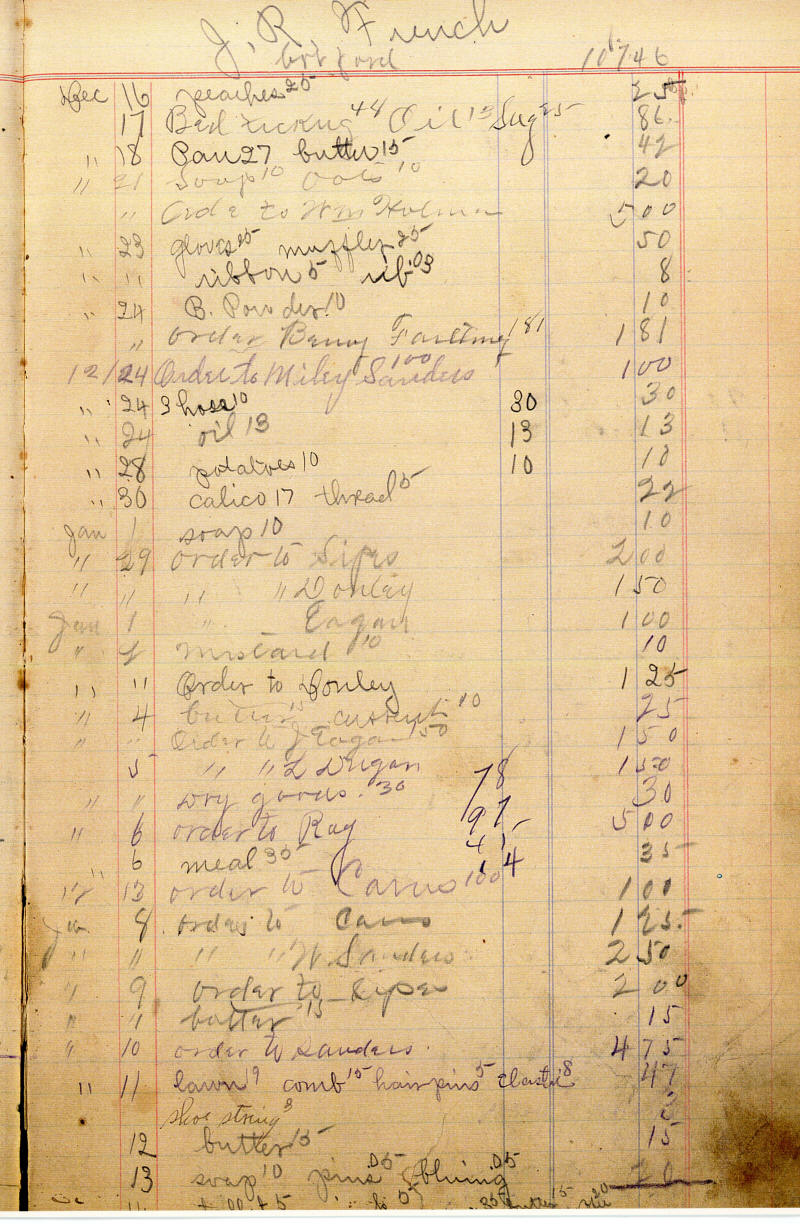
Winks Store ledger sheets from 1906 - J.R. French account
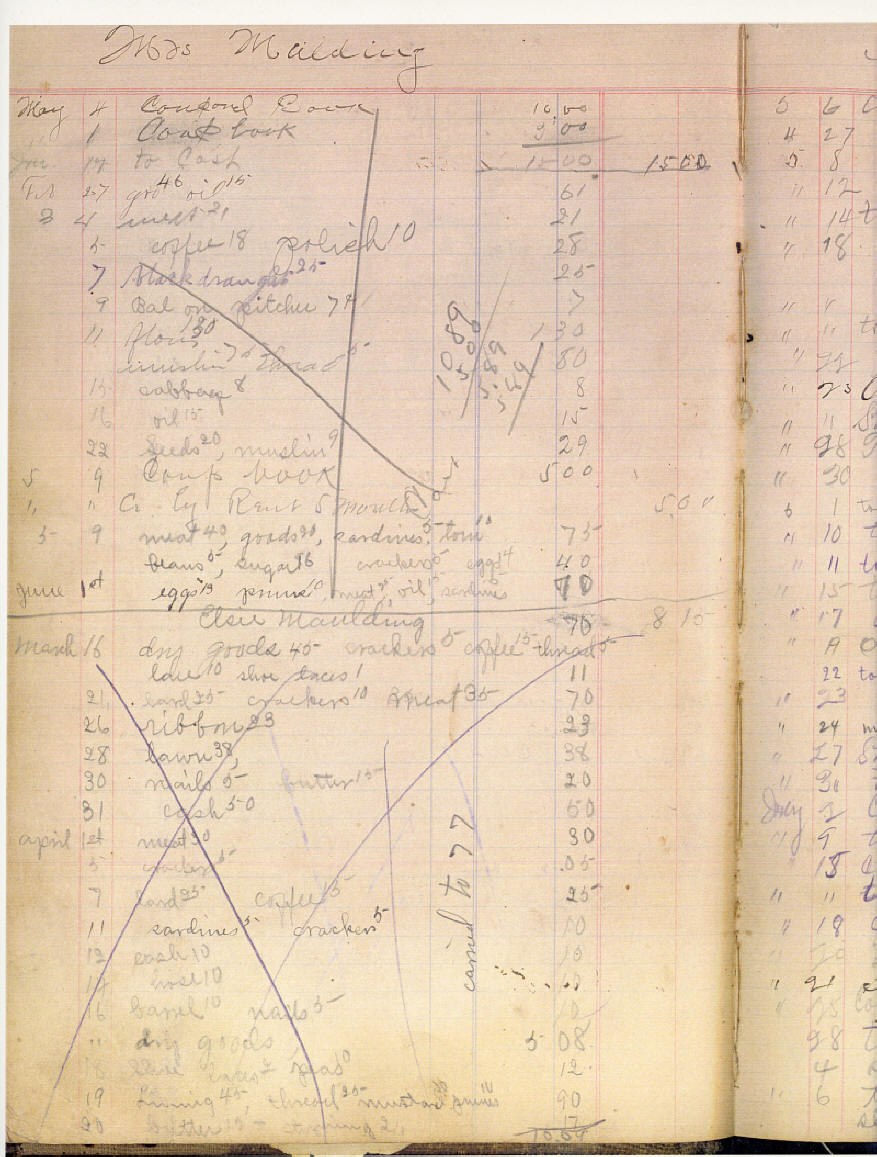
Winks Store ledger sheets from 1906 - Thos. Maulding
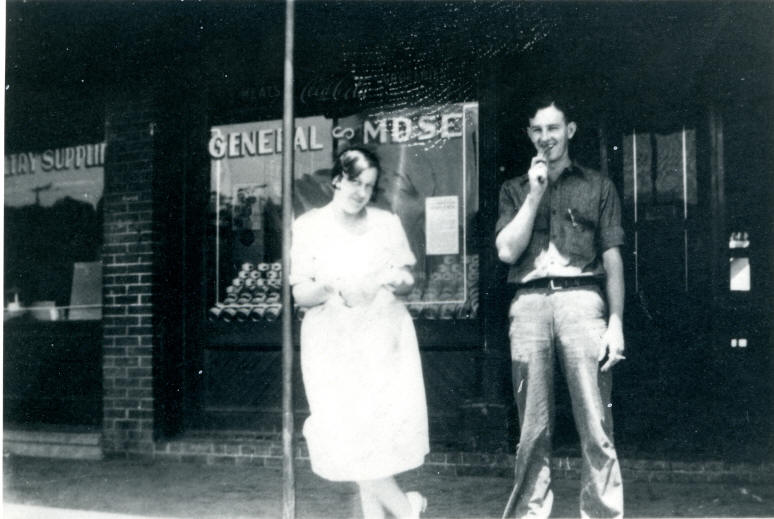
Lottie (Gregory) Williams and Andy Winks on Main Street in front of a general
merchandise store.
%20BA-63.jpg)
(BA-63) Alma Main Street in 1929 featuring "C.L. Rainey's General
Merchandise" and the "Alma State Bank"
Alma Building and Loan
“Decatur
Herald” – July 4, 1903 - “Buildings and Loans Grow. Fourteen New
Associations have been Organized This Year So Far.” “Springfield, Ill., July 3
– The state auditor today authorized the commencement of business by the Alma
Building and Loan Association of Alma, incorporated July 3, 1903. The
incorporators are John MAZANEK, F.M. MARSHALL, N.T. STONER, J.W. HARVEY, C.G.
POLLOCK, L.C. PULLEN, and C.M. SEE and the capital, $150,000. The duration is
ninety-nine years. This is the fourteenth new building and loan association
which ahs been organized this year. The record is considered good, the number
being larger for the given length of time than any previous number in late
years. During this time a few weak associations have been dropped. The
department this morning explained that the building and loan associations of the
state are now on better footing than any time in their history. When the law
went into effect giving the auditor supervisory powers over them the business
was in chaotic condition and many associations were unfit to continue. Ever
since that law went into force the auditor has been working to get the
associations on a systematic basis of operation and to weed out those unfit to
do business tis process has reached its results in a strong building and loan
system in Illinois.”
.jpg)
Click on the book cover above to open the
Alma Building
& Loan - Secretary's Book - 1903-1912 (pdf)
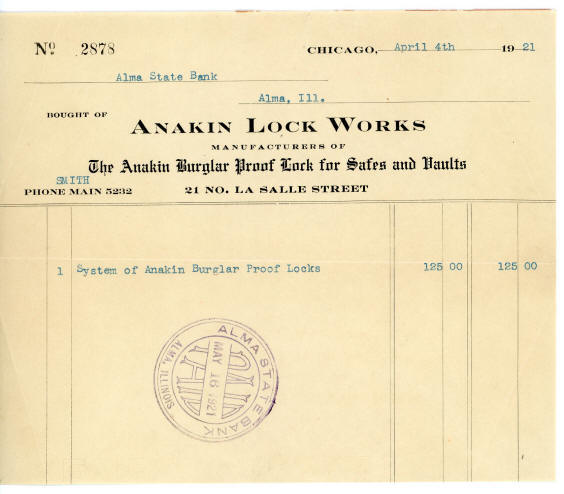
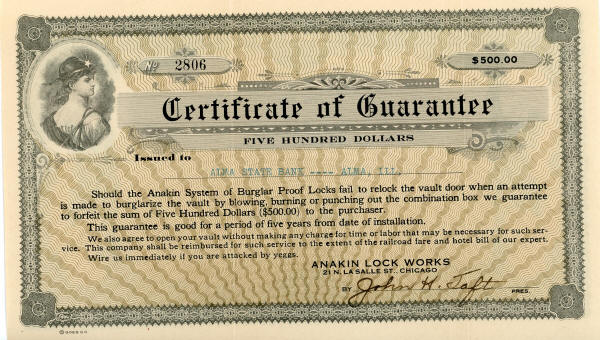
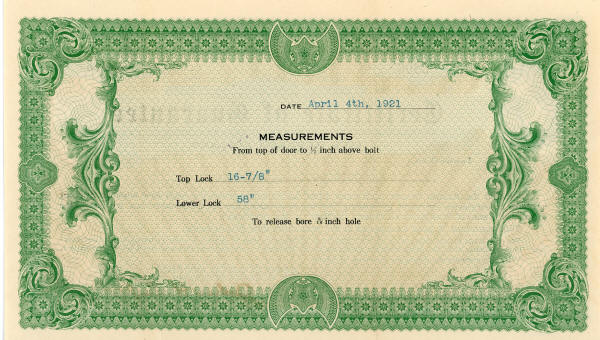
Alma State
Bank - installation of burglar proof locks - Apr. 4, 1921
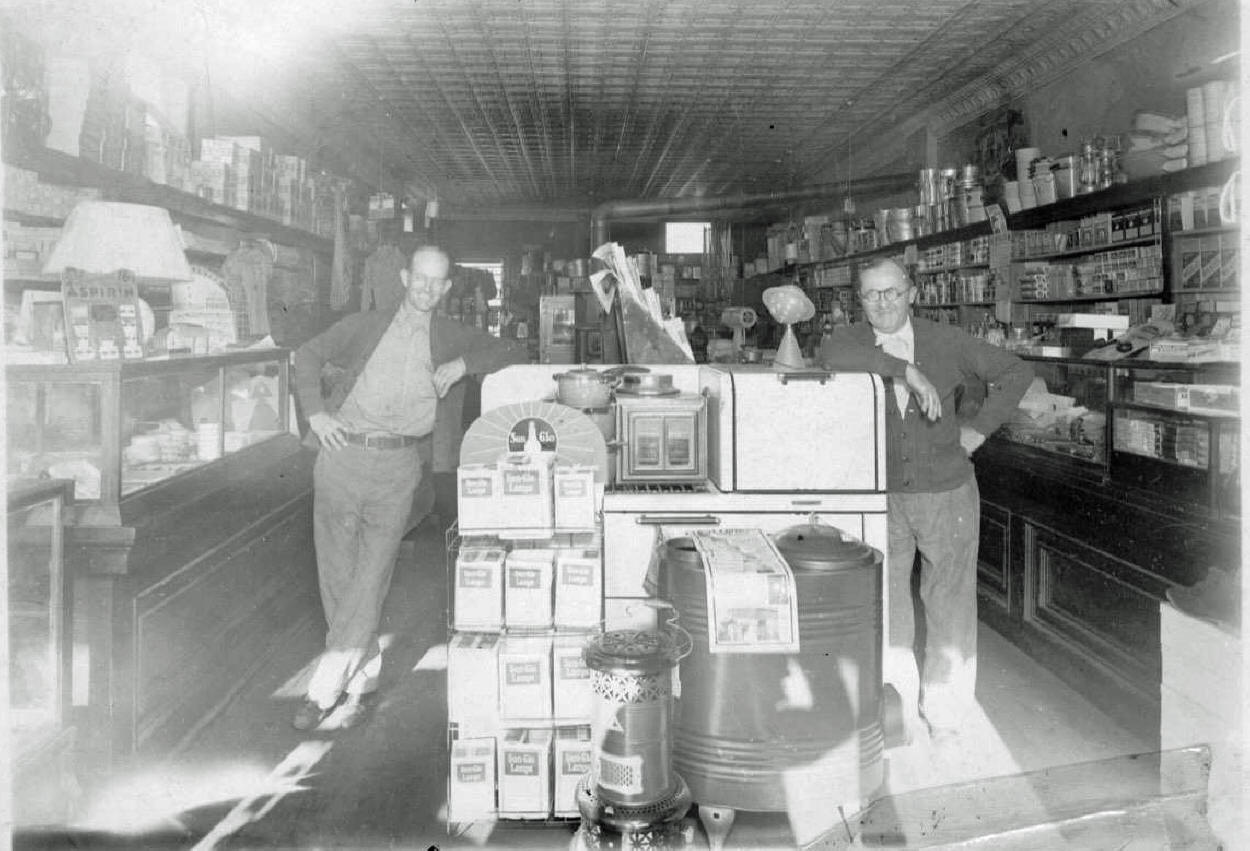
(BA-70)
Rainey's Store
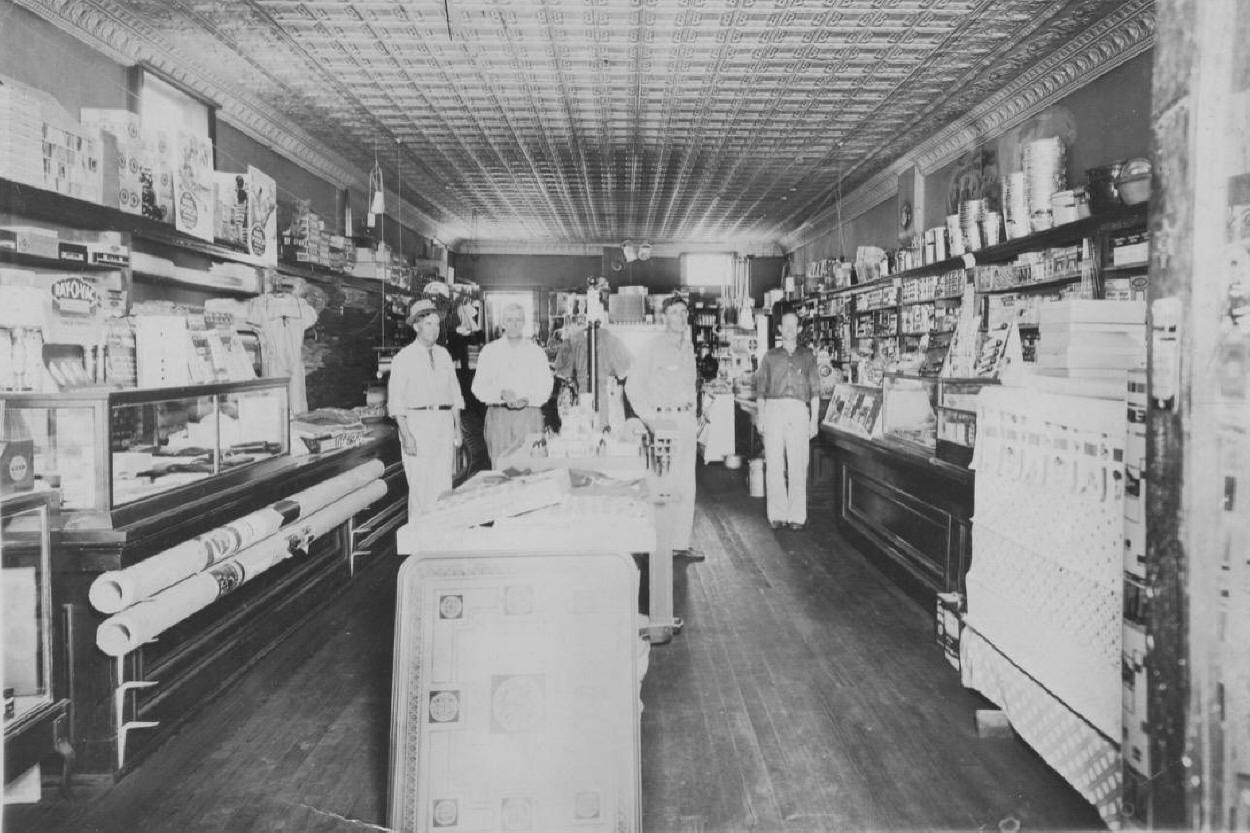
(BA-69)
Rainey's Store
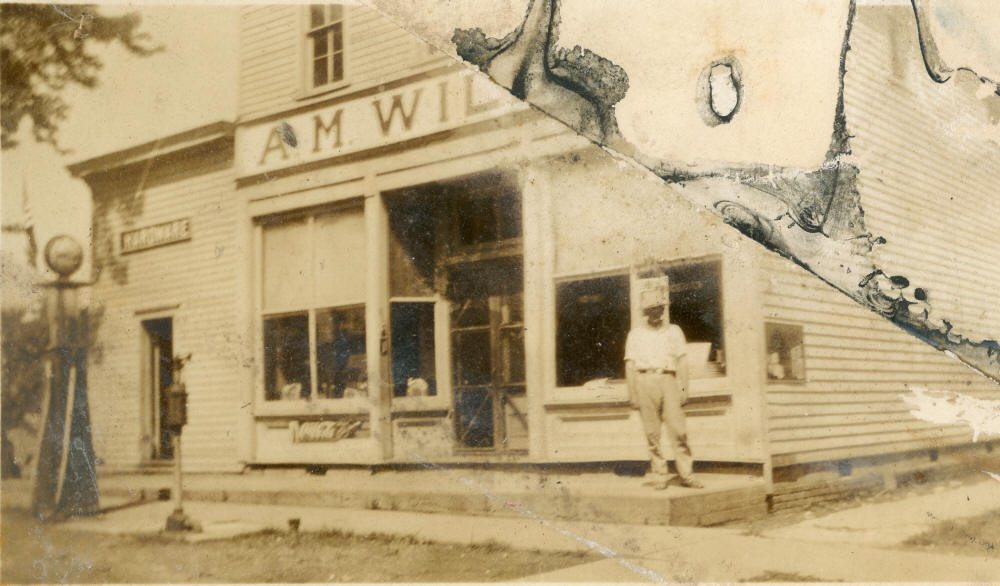
A.M. Wilson
store in Alma - photo processing date - June 1, 1929
%20BA-64.jpg)
(BA-64)
A.M Wilson Store (formerly Mazanek Store building) in 1929. Notice the gas
pump out front.
(This building sits where John and Lelia Ford built their brick home on the
corner in about 1960, and that home is where Herb & June Williams live in 2013.)
%20BA-65.jpg)
(BA-65)
Roy E. "Tubby" Gregory's Orchard Spray Material Manufacturing Company
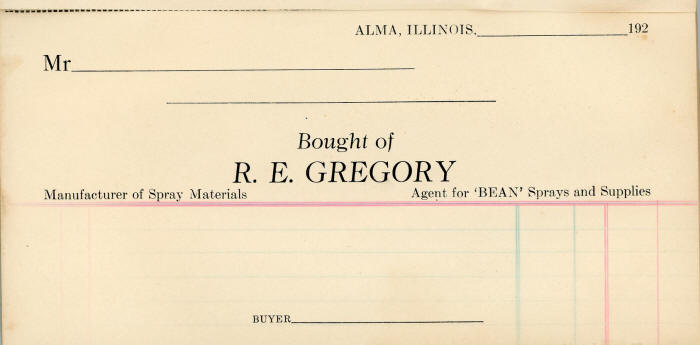
Roy E. "Tubby" Gregory receipt pad for Orchard Spray material business
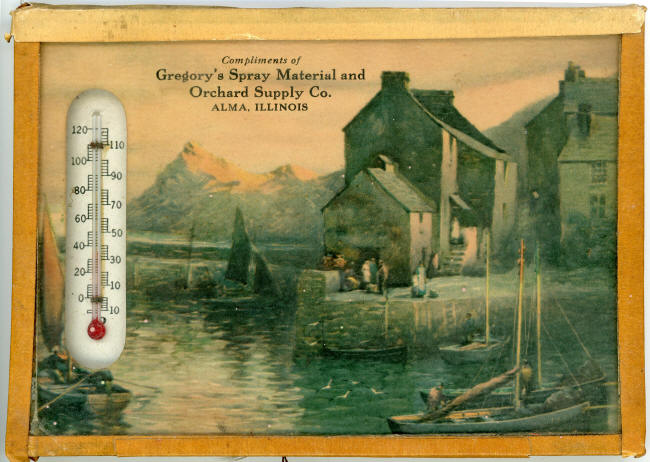
Advertising
Thermometer - Roy E. "Tubby" Gregory's Spray Material and Orchard Supply Co. -
Alma, IL
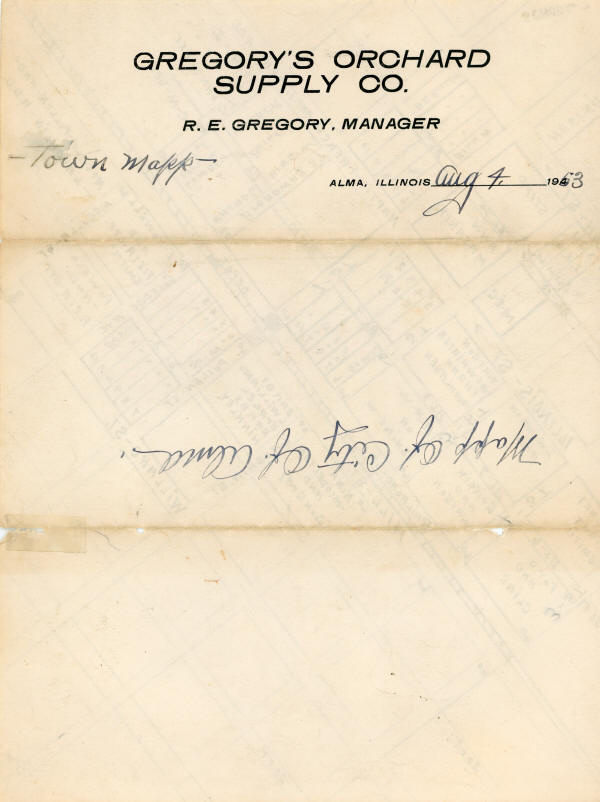
Map of the
Town of Alma - Aug. 4, 1953 on Roy E. "Tubby" Gregory Orchard supply business
stationery
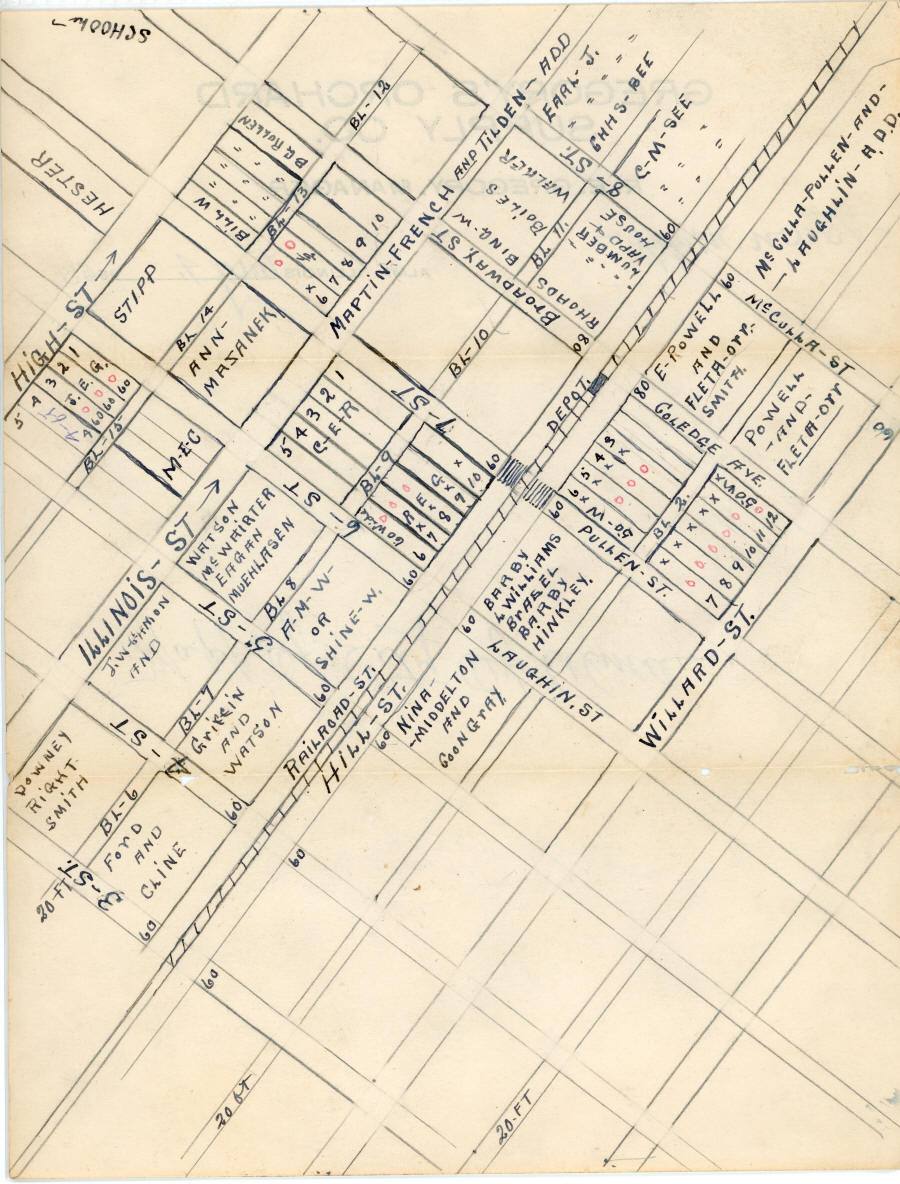
Map of the
Town of Alma - Aug. 4, 1953 on Roy E. "Tubby" Gregory Orchard supply business
stationery
%20BA-66.jpg)
(BA-66)
Tomlinson Hotel in Alma in 1929 just north along what is now Rt. 37..
%20BA-67.jpg)
(BA-67) Alma
Depot in 1929
%20BA-68.jpg)
(BA-68)
Alma Depot in 1929
%20BA-61.jpg)
(BA-61) Alma
Methodist Church and parsonage in 1929
%20BA-62.jpg)
(BA-62) Alma
Methodist Church in 1929
%20street%20looking%20west%20toward%20the%20hotel%20(left)%20and%202%20other%20buildings%20c.jpg)
Rhodes Hotel
in Alma. This is a view from the Railroad Street (along Rt. 37 highway)
looking west toward the hotel,
which is on the
left side of the photo, next to two other buildings
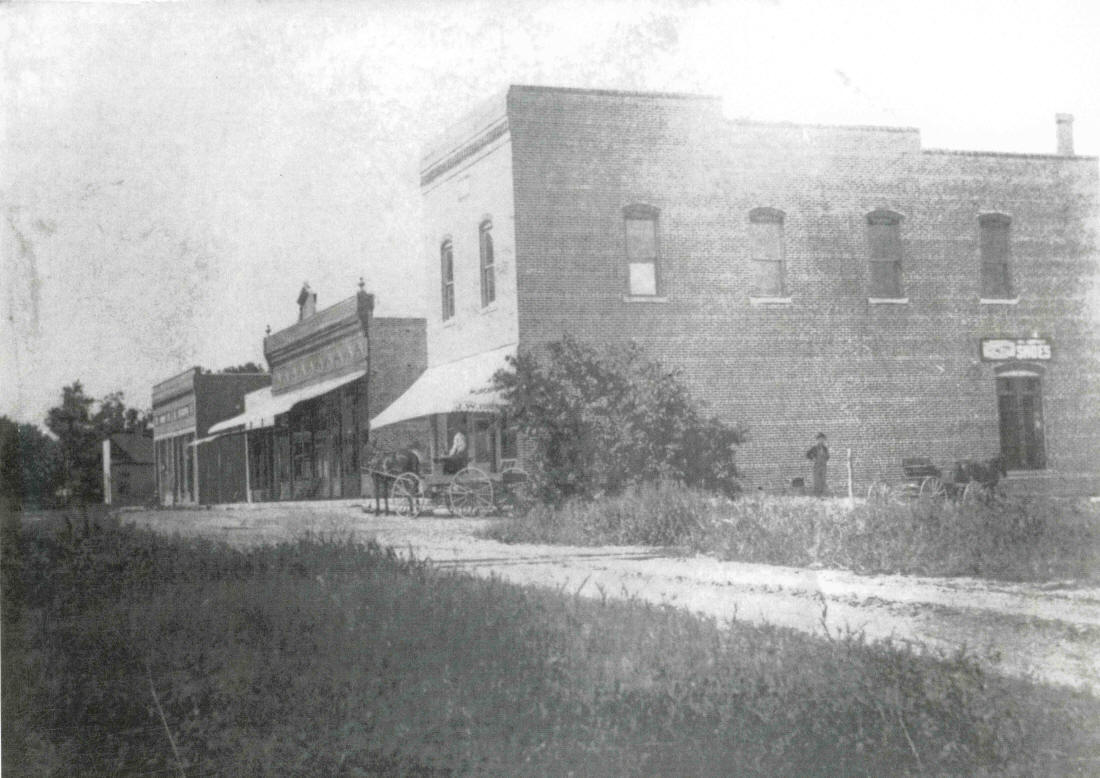
(BA-53a) Alma Main Street

(BA-29a) Main
Street in Alma, Illinois

(BA-54b) Main Street in Alma - 1933
 (BA-30a) Alma
Main Street – 1938
(BA-30a) Alma
Main Street – 1938
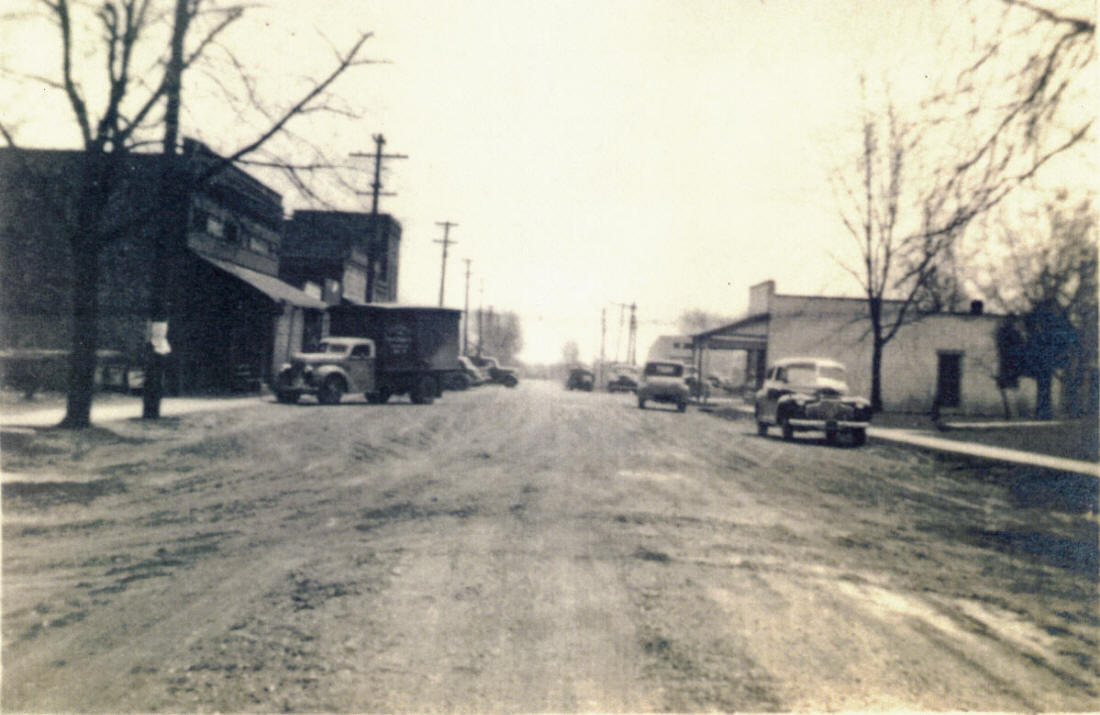
Alma Main Street (7th Street) - circa 1941
Looking east from the corner of "Main Street" (7th Street) and Illinois Street
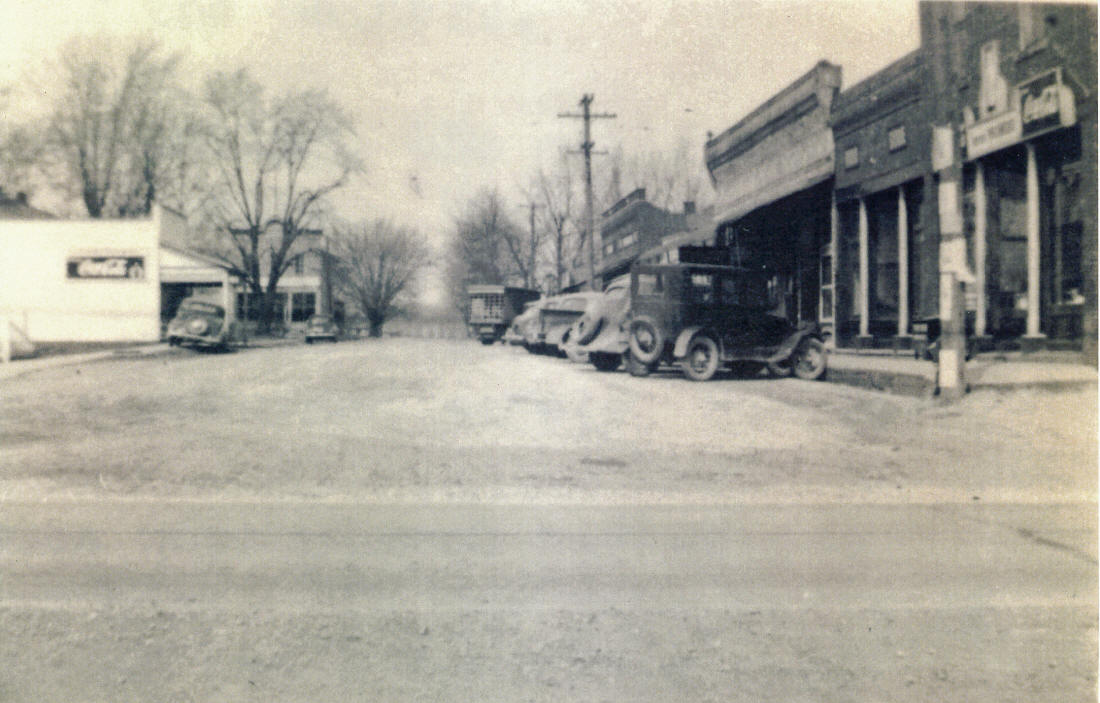
Alma Main Street (7th Street) - circa 1941
Looking west from the corner of "Main Street" from Rt. 37
.jpg)
Alma Main Street - 1946 (from Alma school yearbook)
.jpg)
Alma Main Street - 1946 (from Alma school yearbook)

(BA-31a) Jabe
Johnson on Main Street (7th Street)
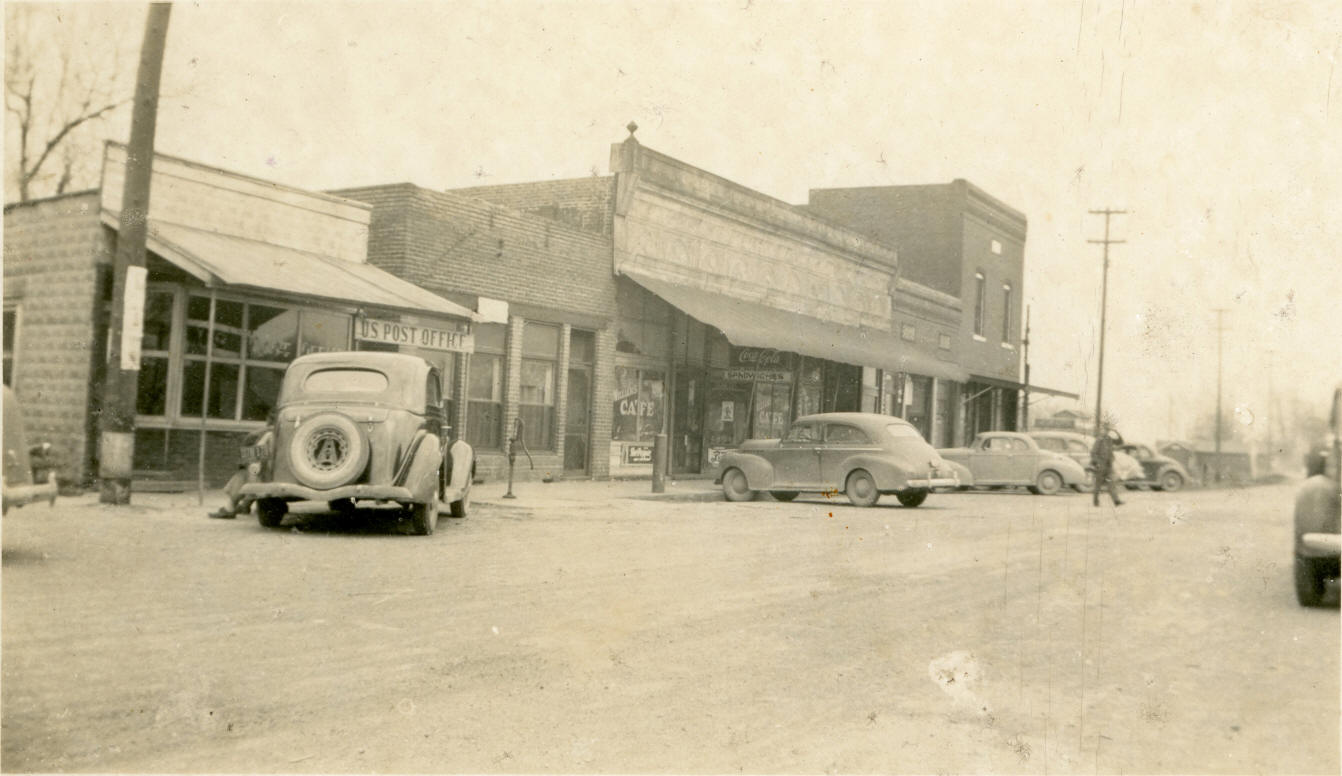
Alma's Main Street (7th Street)

(BA-75) Lottie Williams standing in
front of Williams Cafe in Alma, around the late 1930s.

(BA-20a)
"Tubby’s Restaurant" which was owned by Roy E. "Tubby"
Gregory in Alma.
This photo was taken ca 1910 after the Alma town fire.
(In
later years, this building was used as the Alma Post Office, and then finally
the Alma Town Hall, until it was torn down and a new Alma Town Hall built in
it's place.)
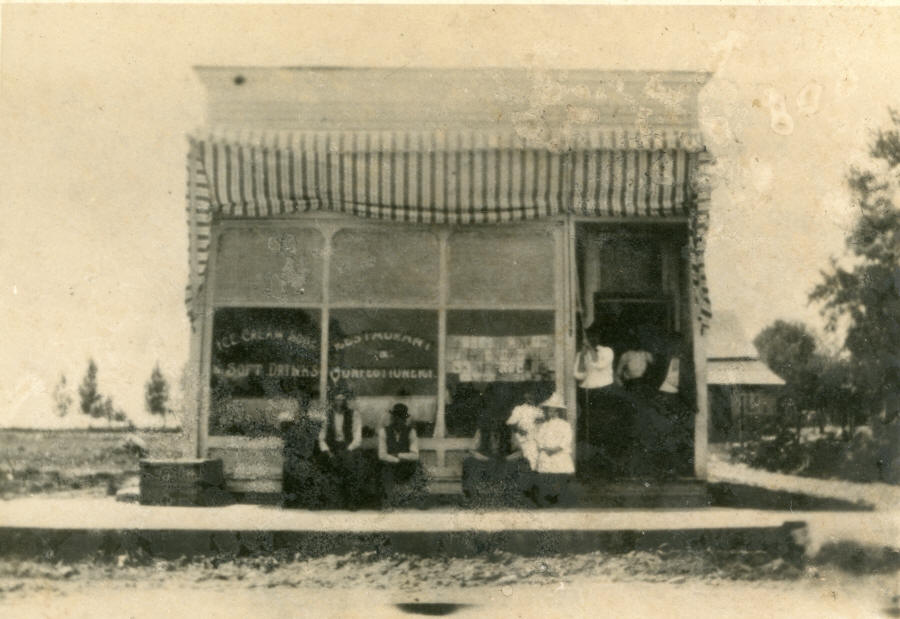
.jpg)
.jpg)
Token from R.E. Gregory's Cafe - Good
for One Loaf of Bread

(B-58a) Along the
main street in Alma - they are facing Roy "Tubby" Gregory's Restaurant - Relza Sullens and Dwight Day
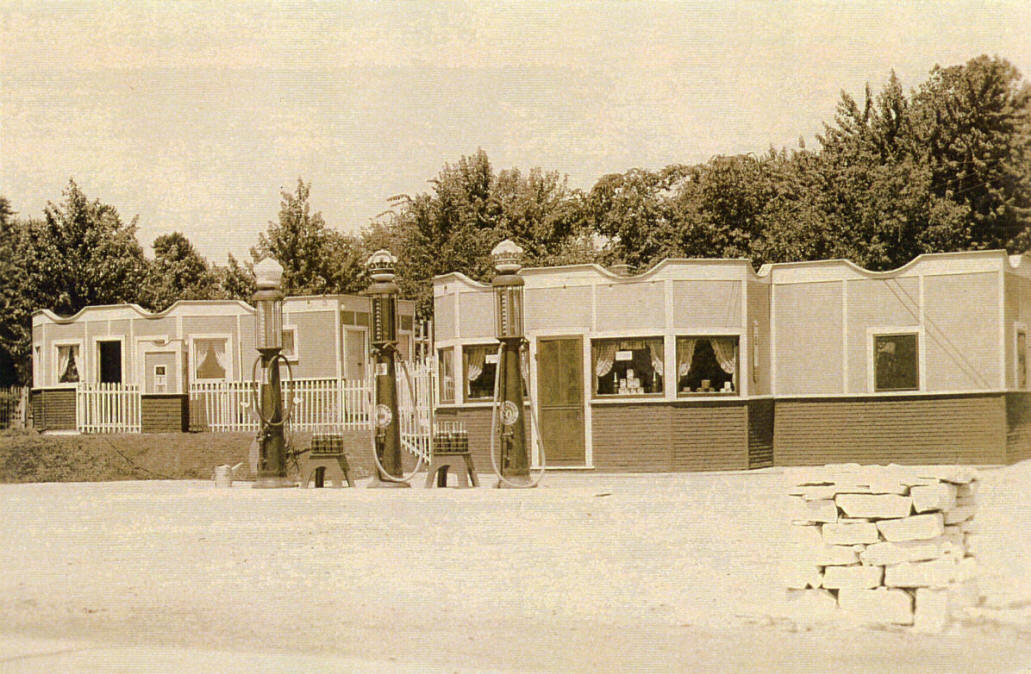
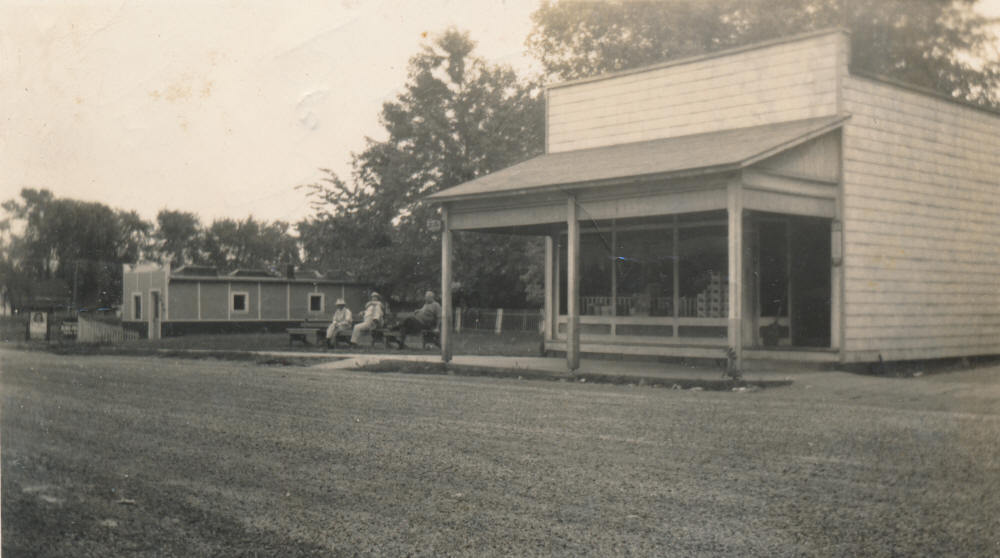
Roy "Tubby" Gregory's Service Station in
Alma (this was in later years the remodeled Standard Service Station building
that sat along Rt. 37 at 7th Street (Main Street) corner.
The Billie Jo's building sits on that
lot in 2022.
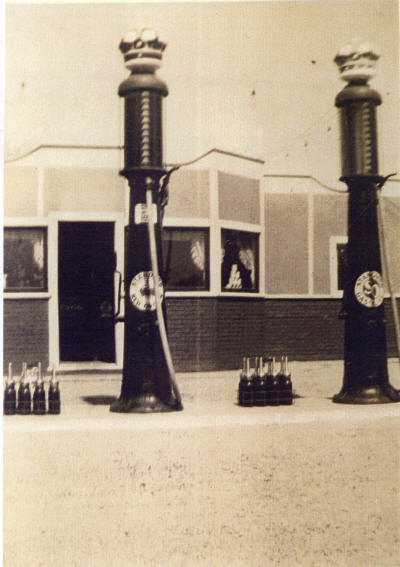
Fuel pumps at Roy "Tubby" Gregory's Service
Station in Alma (this was in later years the remodeled Standard Service Station
building that sat along Rt. 37 at 7th Street (Main Street) corner.
The Billie Jo's building sits on that
lot in 2022.
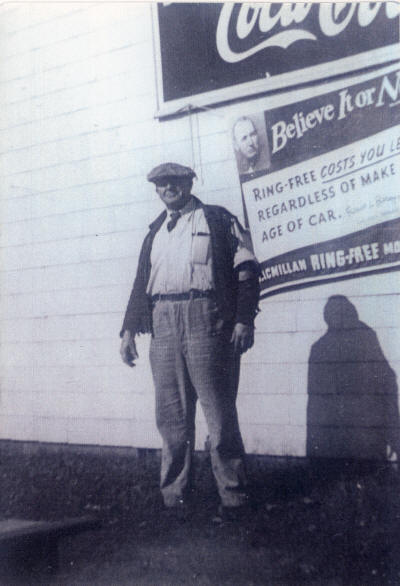
Loren Williams at Tubby Gregory's
Service Station in Alma.
Along Alma's Main Street looking
southeast sits Doc Slagley, Tom Garrett, and Roy Gregory.
They are sitting between Roy "Tubby"
Gregory's Service Station (which sat along Rt. 37)
and his Restaurant (which later
served Alma as the Village Hall for many years.)
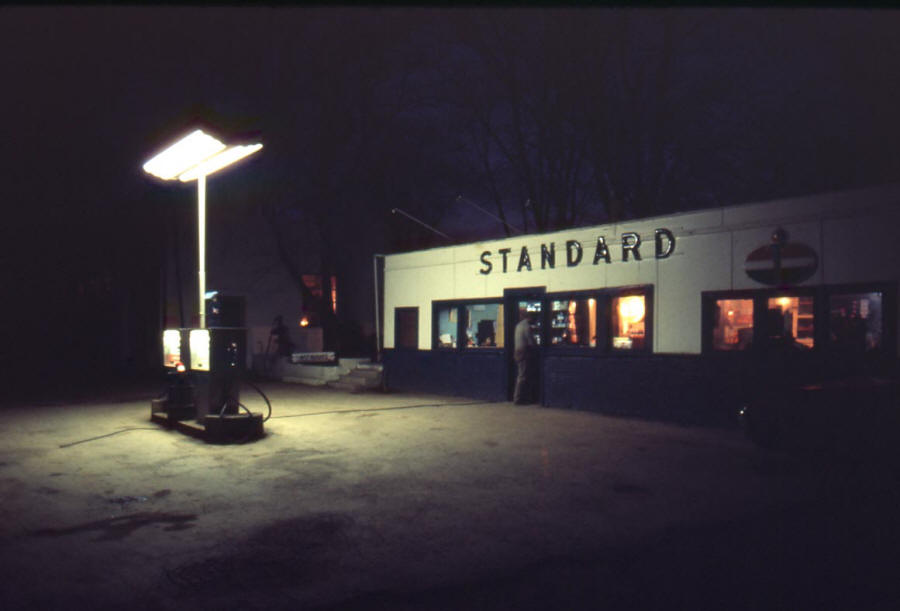
Alma Standard Service Station.
This was previously the old Tubby
Gregory's Service Station in Alma that sat along Rt. 37 at 7th Street (Main
Street) corner.
The Billie Jo's building sits on that
lot in 2022.
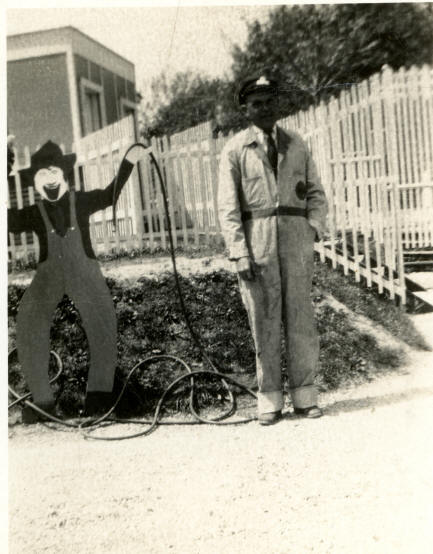
Roy "Tubby" Gregory on the east side of his restaurant on 7th St. (Main St.) in
Alma
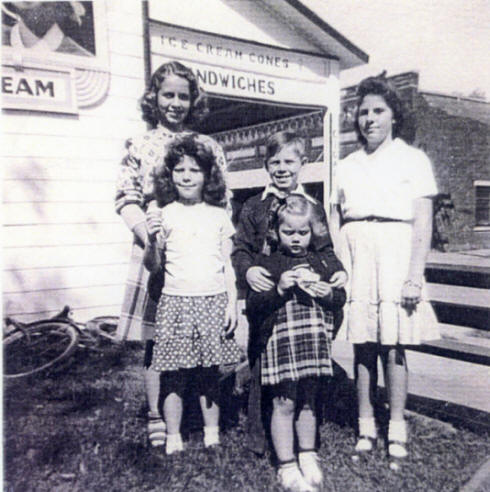
Children standing on the east side of Roy "Tubby" Gregory's Restaurant
Sue (Hester) Hulsey & Jim Hester in back row

Alma
Cannery
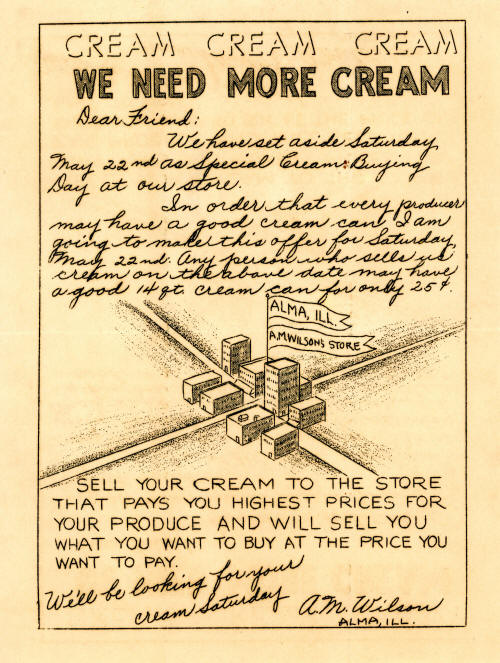
A.M. WILSON
Store - Buying Cream
b.jpg)
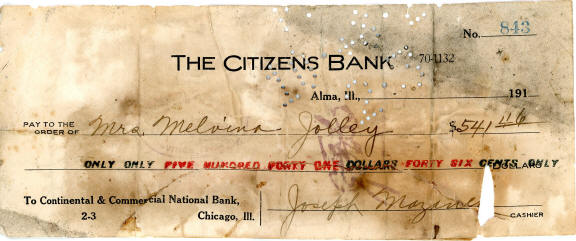
Alma business account book from early 1900's
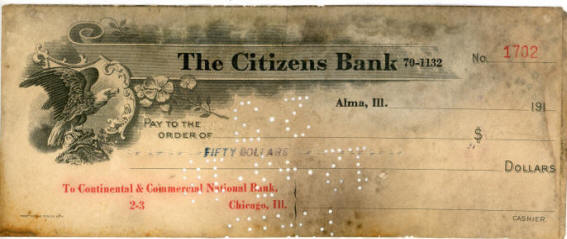
Checks from an
account at "The Citizens Bank" in Alma

(BA-35a) I.C.
Freight at Alma, Illinois
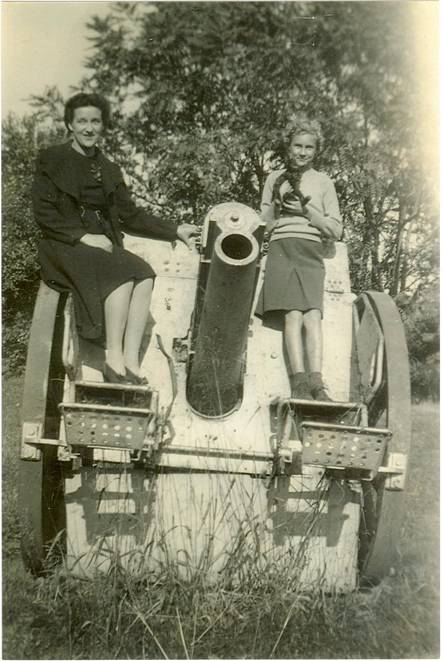

(BA-36a) Alma
cannon in 1944 with Marie Gray and daughter Patsy
(BA-60) The restored canon sits in Alma once again - 2006
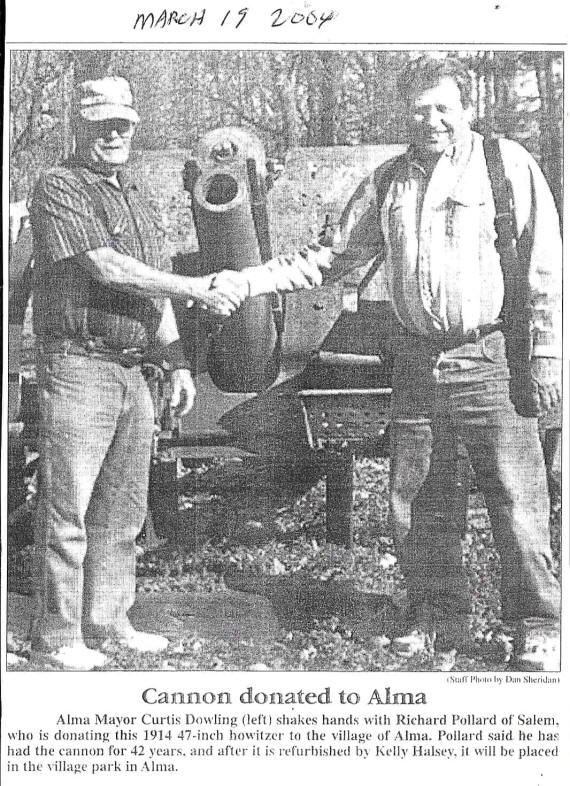
Alma Mayor
Curtis Dowling and Richard Pollard of Salem with Alma Cannon - March 19, 2004


(BA-37a) Alma
Post Office -
__________ and
the Alma Postmaster, Frances (Parker) Ott

(BA-38d) Postmaster
Frances Parker in front of “Doc” Slagley at the Alma Post
Office
.jpg)
.jpg)
Alma Post
Office - Last stamp of Alma cancellation stamp made by Hazel Craig after 6 p.m.

(BA-57a)
Pickle Factory in Alma - "Midwest Products Co."
“The Kinmundy Express” – Oct. 19, 1916 -
“Alma's Thriving Enterprise”
“H.E. LAWRENCE, an enterprising citizen of Alma, is prepared to buy and make
into cider all the apples that come to his mill, but not withstanding his 90
barrel capacity he has been running night and day. He is paid so much per
gallon by Spillman Bros. & Co. of Chicago, and by pressure he forces the cider
through pipes 1000 feet to tank cars on the canning factory switch. Last year
it cost him $300 to have the cider hauled to the cars. For several years he has
had much expense in removing the pumice, also had more or less trouble in
securing a place to dump it. Happily that question has been solved by him. He
has leased space and power to the Midwest Product Co. of Milwaukee, who have
installed a pumice dryer that is capable of handling the product of 1250 bushels
of apples every ten hours. Later on this Company will install plants in Olney,
Newton, Flora, Dubais, Benton and Centralia. The pumice is sack shipped to
Chicago and submitted to a process removing the saccharine, pectine and other
ingredients and the balance is mixed with cotton seed to make stock food. Mr.
LAWRENCE says the only thing lost is the rattle of the machinery which could be
saved on the graphaphone record. He employs nine men and by next year he
expects to double his capacity.”
“The Kinmundy Express” – March 11, 1920 -
“Alma Growing”
“In the thriving little village of Alma in the northern part of the
Marion co., there has quietly but surely grown an industry which has been more
for reaching for general prosperity in this neighborhood than is generally known
outside of this community, and indeed hardly appreciated by some of our
citizens. This is the cider factory of the Midwest Products Co. with
headquarters at Milwaukee, Wisconsin. The history of the development of this
industry is quite interesting within itself.
In 1914, H.E. LAWRENCE installed a Cider Mill at Alma, it was
considerably better equipped than the ordinary custom mill. It represented a
capital of about $2000 and a capacity of 50 barrel per day with facilities for
cooking apple butter by steam and employing from three to five men during the
apple and pear season. It was situated several blocks from the loading switch
necessitating heavy dragage bills and the pummies were not utilized at all.
This being one of the largest pear and apple growing districts in the country,
this mill was unable to handle near all the cider stock.
Mr. LAWRENCE at this time having become acquainted with some of the
Midwest officers in a business way, he completed a deal with them whereby they
acquired his mill and fixtures and retained him as superintendent. This was a
rare combination for a successful business venture of this kind, the Midwest
Products Co. with their unlimited capital and large business experience. Mr.
LAWRENCE with his wide acquaintance among the fruit growers of this vicinity his
practical experience as a cider maker and a thorough knowledge of the machinery
connected therewith and above all a tireless and energetic worker for the best
interests of the business.
The Midwest then bought ground on which a loading switch was already
located and proceeded to erect a large two story up to date cider mill, fully
equipped with all the latest and best machinery including their own electric
light plant and special machinery for drying all the pummies and utilized them
for commercial purposes. Also a number of large wooden vats holding thousands
gallons of cider and bins providing for the storage of thousands of bushels of
cider stock.
Every apple is thoroughly washed and cleaned by machinery before it
goes to the crushers and then the juice is clearfied by the special process
until the clear amber color of the finished product bears no more resemblance to
the old fashioned mudcolored cider than the clear sparkling waters of the
roadside ditch. All in all this cider factory represents an invested capital of
$60,000 and this company paid out last year at this place $100,000 for fruit and
labor.
They employ from twenty to thirty men all through the fruit season
and four men the entire year and pay from forty to sixty cents per hour. They
have a capacity of one hundred bushels per hour after that continuously day and
night during the heat of season. One orchard in this community has averaged
$4000 per year on their cider stock for the last two years.
Last year we had a severe wind storm early in the season and
seventy-five percent of the fruit was blown off. The fall and winter
varieties of apples and pears were not over_____ grown and of course were not
suitable on the open market even as windfalls. But every bushel was marketed as
the local cider mill at the regular price. When one stops to consider
that cider stock is practically a waste product, you can very readily see what a
local market at a fair price means to a large fruit growing center. Every
practical fruit grower knows that in this time of close competition and high
cost handling, it is folly to ship a poor grade of fruit in the open market.
And even in the best cared for orchards there are quite a per cent of inferior
fruit.
It is true that occasionally some “Wandering Jew” will drop into a
neighborhood buy a few cars of cider stock and leave but that is only a “drop in
the bucket” and not dependable. But if some party could be found who was
financially able and mentally willing to buy every bushel of cider stock in the
country.
It would be impossible to dispose of it without a local mill for the
very good reason that owing to the large volume of business in other grades of
fruit and other products of different kinds at that season of the year it would
be impossible to obtain a sufficient number of cars to handle all ciderstock
before it would perish.
Many towns have paid thousands of dollars in bonuses to acquire
industries which have been of less benefit to the general public than the
Midwest Products Co. have been to Alma by their honest dealing fair treatment
and gentlemanly conduct this company has gained the goodwill and respect of this
section of country to a very high degree. The fruit industry of this community
is constantly growing and acres of new orchards coming into bearing every year.
And in order to keep pace with this growth the Midwest Co. is
contemplating improvements in buildings and machinery for the coming season to
the extent of $30,000 additional capital and more than doubling their capacity.
But immediately following this announcement comes the report that the officers
entrusted with the enforcement of the new prohibition laws are not uniform in
their ruling. Some even going so far as to claim it prohibits the making of all
fruit juices fermented or otherwise in any form. You can very readily see what
that would do for the cider industry.
The great majority of people in this community are in full sympathy
with prohibition laws and wish to see them enforced. But they do not want to
see it handled in such a way that it will defeat the very purposes which it is
intended to promote. The rulings in this matter should be uniform in all the
states and should not interfere with legitimate industries that are not handling
intoxicating goods nor of a higher percent of alcohol than the law provides.
The Midwest Co. at Alma do not handle intoxicating goods. Part of
their cider is run direct from the press into the vinegar vats and left there
undisturbed until it is loaded out direct to the vinegar factory. The remainder
goes direct from the press to the cookers and is concentrated or treated so that
it never ferments but remains perfectly sweet as the day it was made and is used
as a soft drink and they do no custom work.
Fruit growers should wake up on this question and take steps to
protect their interests. Not through any disposition to thwart the prohibition
law but against the ignorant interpretation of it in some districts.
We trust the
time will never come when some Ignoramus from the desert will drive us from the
shade of the old apple tree or deny us the privilege of gathering its blossoms
to strew the graves of our loved ones.”
Alma
Cider Factory falling down
"A reminder of bustling days in Alma collapsed
Friday morning. It was the old cider factory building. Unused except
for storage for many years, the building gradually got decrepit. During
the last several days - maybe it was all the rain - the old structure developed
a sway that was more noticeable day by day. Thursday night's rain
must have finished it off. About 9:45 the next morning, the old building
shuddered and fell. The pictures above were taken about 15 minutes later.
Alma was a busy fruit center from the earliest days after the railroad opened up
southern Illinois. According to Joe Mazanek, who used to
own it, the factory was built in 1912, as a branch of Midwest Products Co. of
Milwaukee.
There were three buildings, the cider factory, a
pickle factory behind it, and then the engine building, still standing
(background of bottom photo), which produced power for the other two. A
railroad siding still runs up to the door of the now-shattered building, though
it is almost covered. According to John Broom, who now owns it, or
what's left of it, the factory had huge vats and condensers to make cider sirup
which was shipped by tank car to vinegar factories. The waste
products were dried and sold to make cattle feed. For some years after the
cessation of cider-making, a St. Louis company made baskets there. At
one time, M.J. Laux owned the factory and made pickles in the center building,
now gone. Broom bought the property about 20 years ago and used it
to store orchard equipment. It also for a time had bunks for the transient
workers who came to pick fruit.

(BA-39)

(BA-41)

(BA-42)

(BA-43)

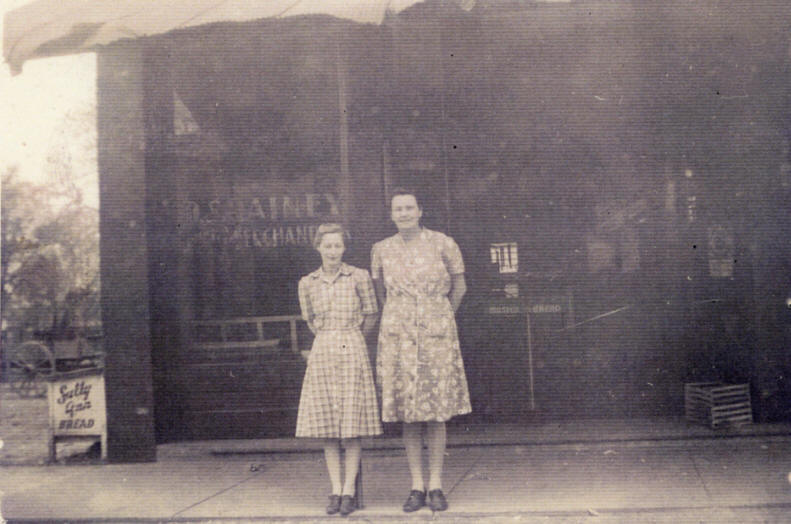
(BA-45a) Emma
(Kern) Rainey & Leota Harris in front of Rainey Merchandise - June 15, 1944
Dan & Emma Rainey owned this store.
Wagon at hitching rack visible on left side of building

(BA-46a) The Rainey family in front of the Rainey
Store in Alma

(BA-47a) The Rainey family in front of the Rainey
Store in Alma
%20Beards%20grocery%20in%20Alma.jpg)
Beard's Store
in Alma (where Rainey's Store once was) and Bill Beard (1961)
%20Beards%20grocery%20in%20Alma.jpg)
Beard's Store
in Alma, and Richard Winks carving (1960)
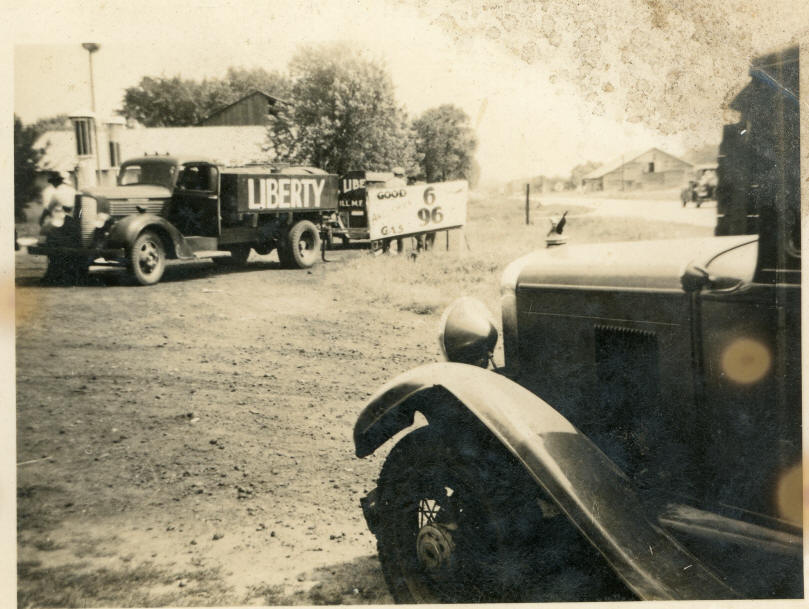
Liberty Gas
Station parking lot in Alma - looking Rt. 37 on the right side of the photo.
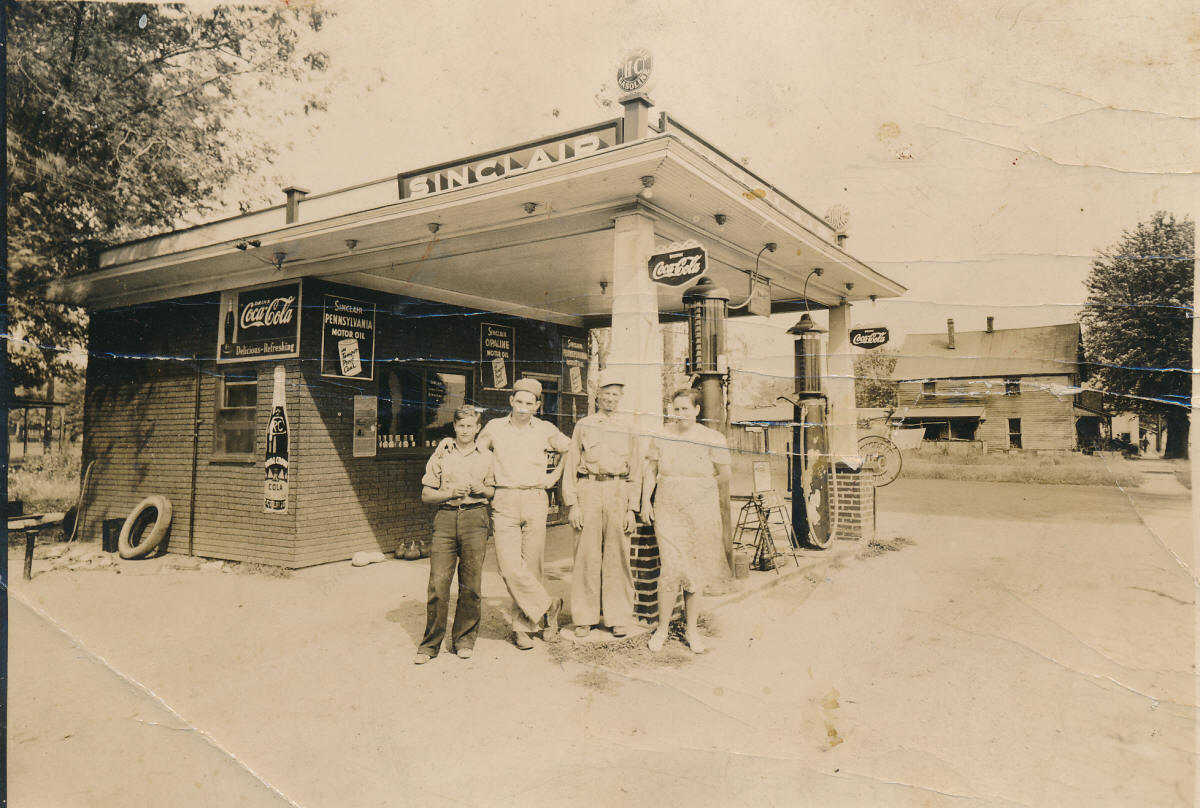
Sinclair Gas
Station in Alma (where Allis Chalmers Implement business sat years later, and
most recently Power Techniques)
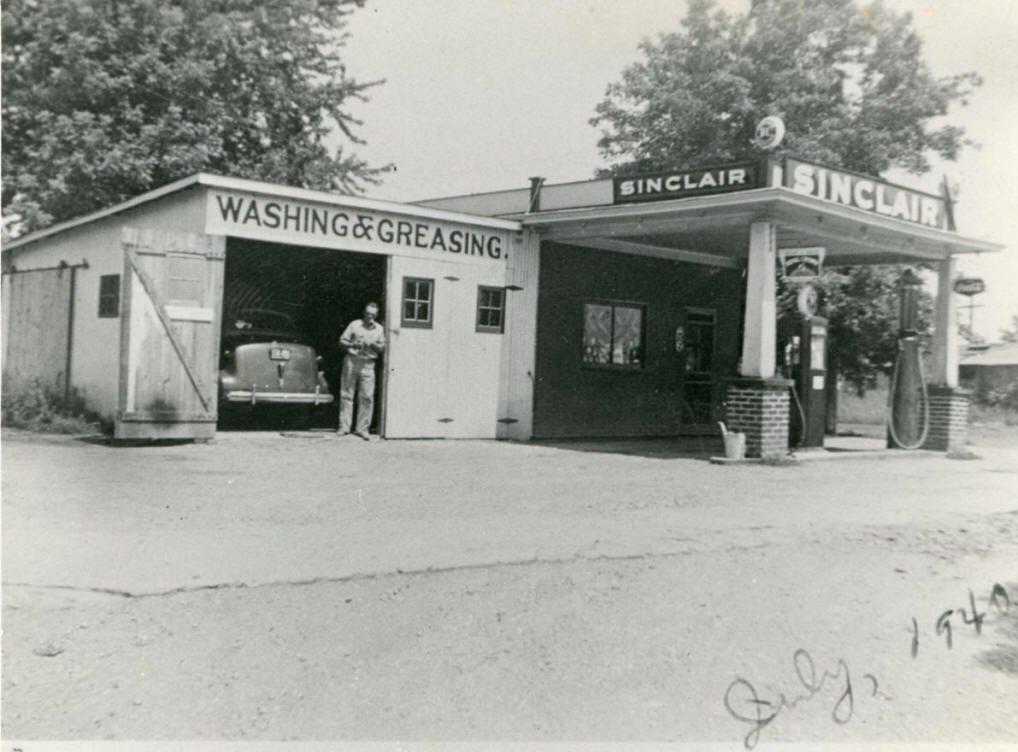
(B-70)
Sinclair Gas
Station in Alma in July 1940. This was located on Rt. 37
between 5th & 6th streets. Loren Williams is standing in front of the building.
Dale Broom
found this photo and gave it to Bob Williams, who later owned the Allis Chamlers
building that sat on the lot.
Gas was 13
cents a gallon. (Uncle Sam Williams had a barber shop and home was right
behind the station. Hair cuts 25 cents and shaves 10 cents, and he made a
line for 4.)
O. Vernon "Pete" Gragg built onto
the Sinclair station building for his new Allis Chalmers farm equipment business.
(Later it
was where Williams
Implement later stood, and more recently that of Cary Henken's Power Techniques.)
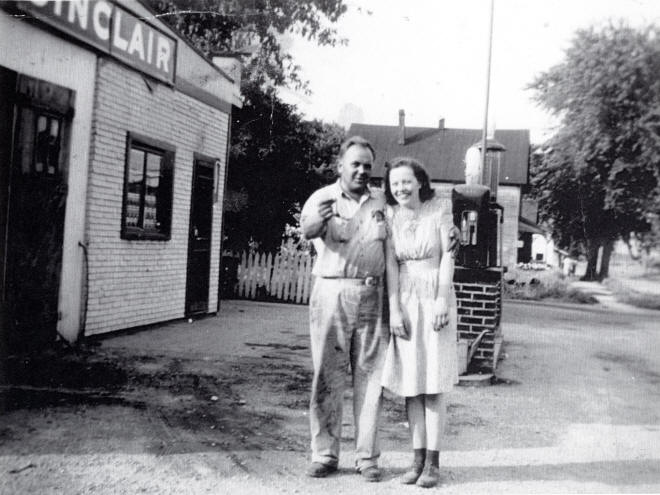
Loren Williams and _________ in front of Sinclair station.

(BA-74) Allis Chalmers station in Alma owned by Vernon Gragg - 1949

(BA-73B) Vernon Gragg with Cecil Shreffer & Hartzel Powell at Allis Chalmers store

Pocket knife from O.V. Gragg Allis
Chalmers Farm Equipment business
.jpg)
.jpg)
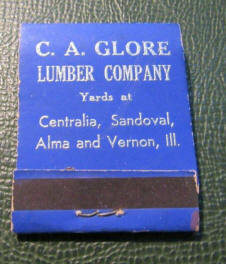
C.A. Glore Lumber Company

(BA-77) Tom Garrett on Main Street in Alma
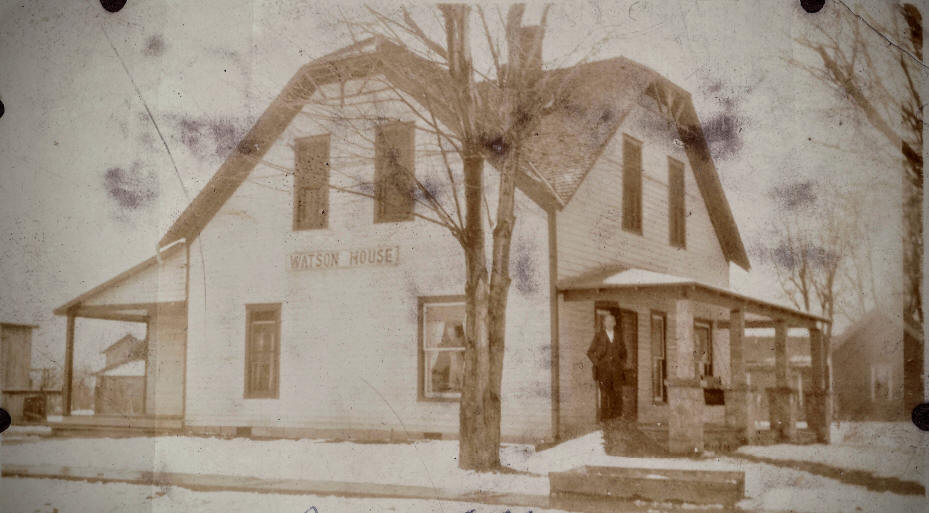
Watson House - 518 Illinois St. in
Alma. Preacher Watson stands on the porch. ca 1920's.
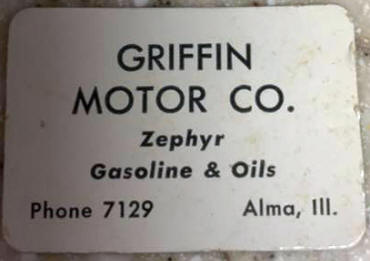
Griffin Motor Co. business card
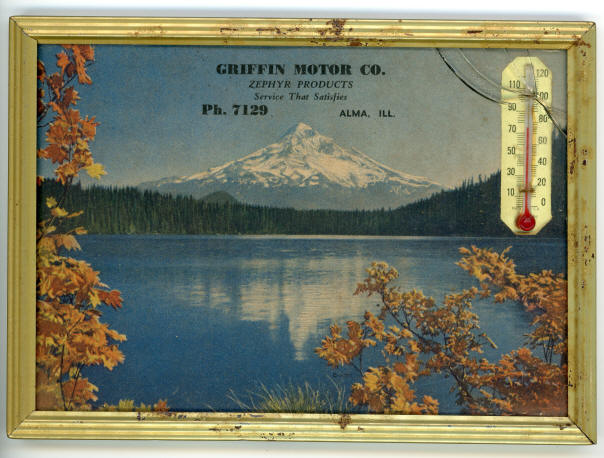
Griffin Motor Co. advertising
thermometer - Alma, IL - "Froggy Griffin's" along Rt. 37
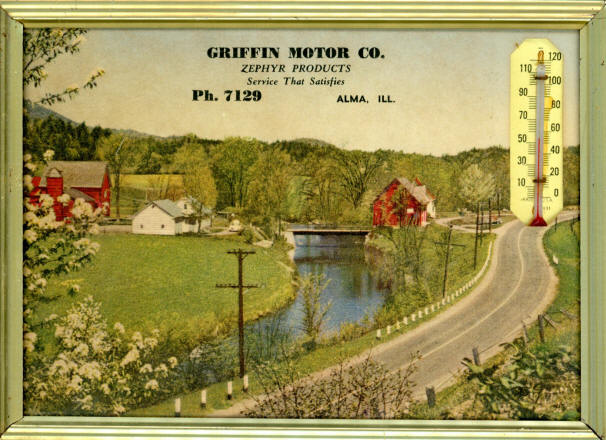
%20Pats%20Beauty%20Shop.jpg)
Pat’s Beauty Shop
%20Pams%20Beauty%20shop.jpg)
Pam's Beauty Shop - Pam Hawkins,
owner - 1974
%20Pams%20Beauty%20Shop.jpg)
Pam's Beauty Shop - Pam Hawkins,
owner - 1975
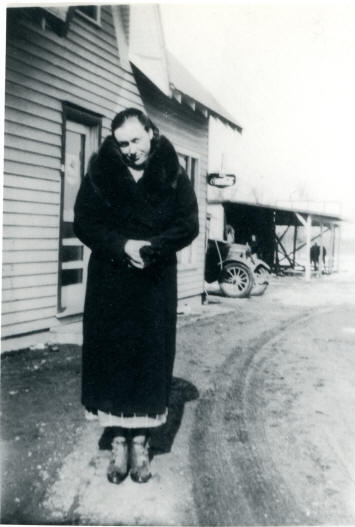
Lottie (Gregory) Williams standing
outside the building in Alma. Later this was the Alma Truck Stop.
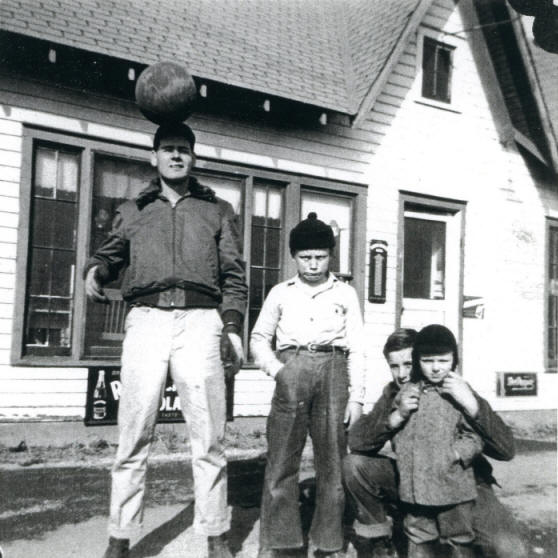
Alma Truck Stop in the 1940's with
____________, ______________, Robert Gammon, Denny Gammon
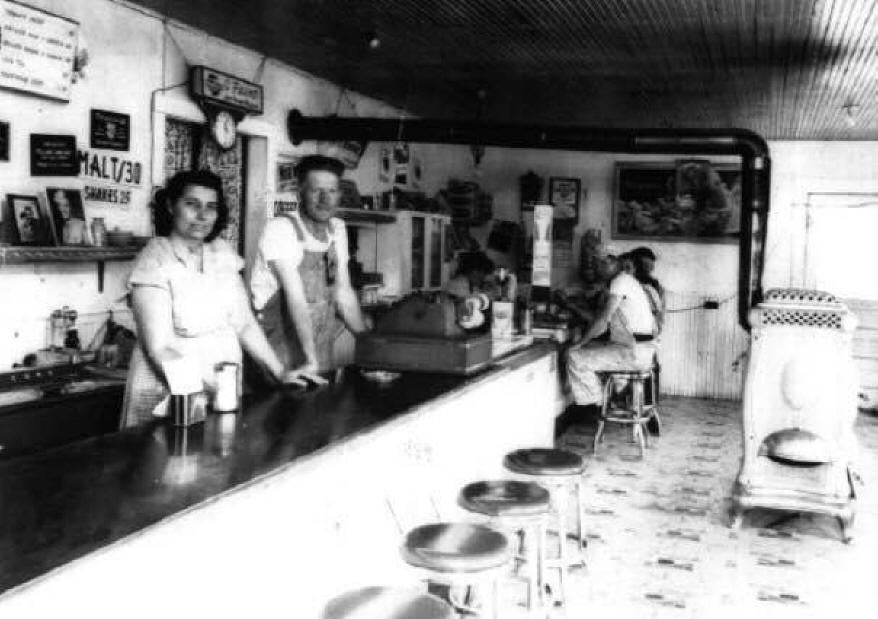
Alma Truck Stop with Ethel and
William Butts behind the counter. (1950-51)
%20.jpg)
Alma Truck Stop - 1964
%20Johnsons%20Standard%20in%20Alma.jpg)
Johnson's Standard - 1975
%20Terry%20Walsh.jpg)
Terry's Hiperformance Center - 1975
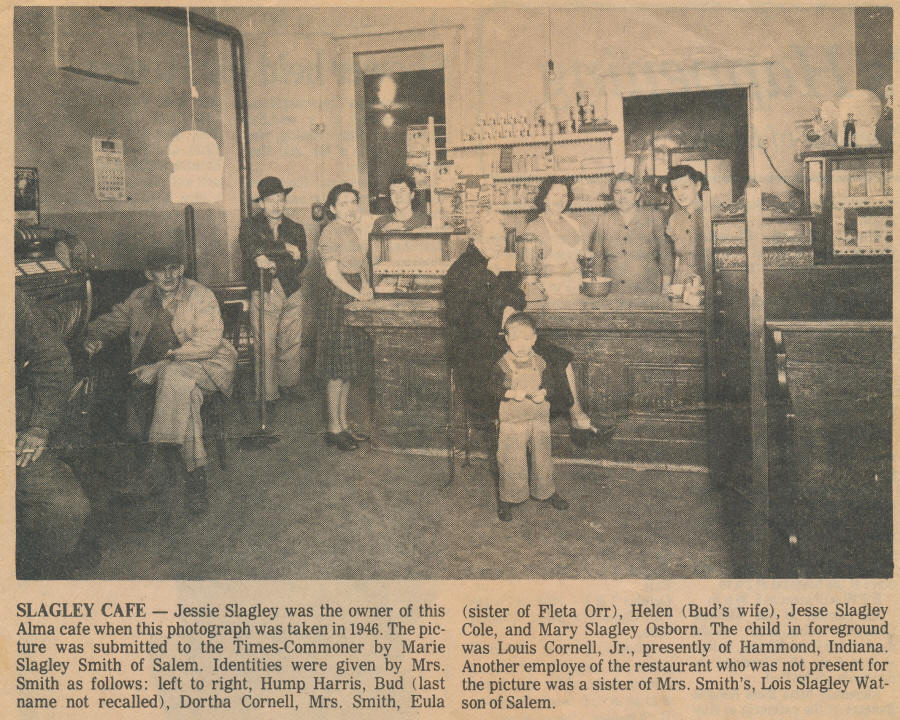
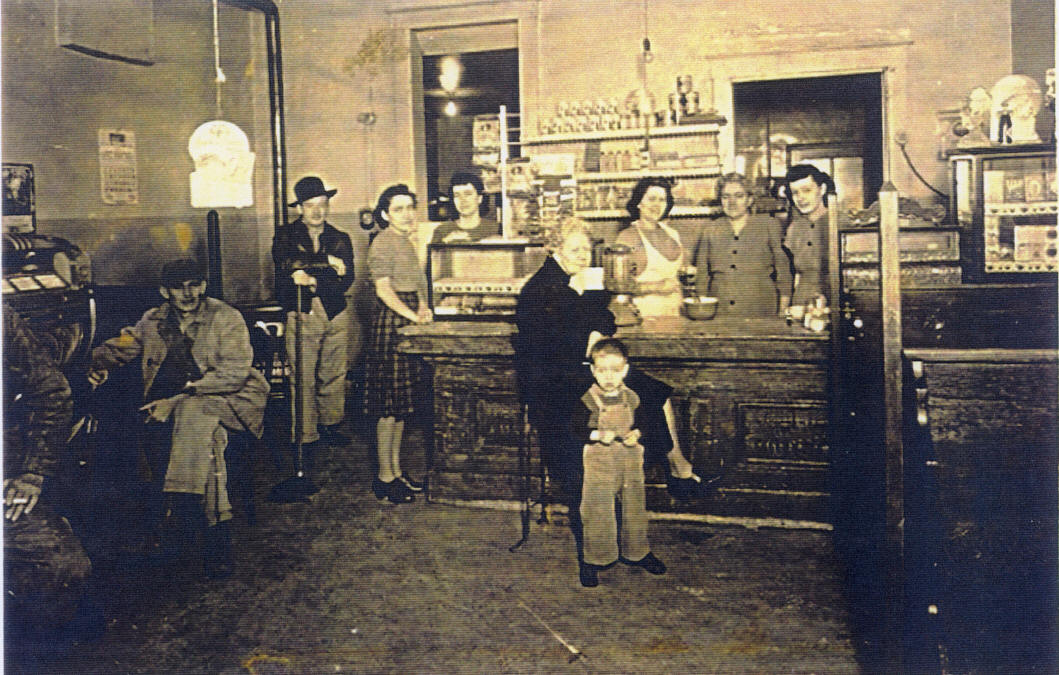
(BA-84) Slagley's Cafe in Alma, IL -
1946
On left side of photo: Hump Harris
and Bud __________
Behind counter: Dorthy (Slagley)
Cornell, Marie (Slagley) Smith, Helen ______ (Bud's wife), Jessie
(Russell) Slagley Wiggins Cole, Mary (Slagley) Osborn.
In front of counter: Eula (Smith)
_______ and Lewis "Bud" Cornell, Jr.
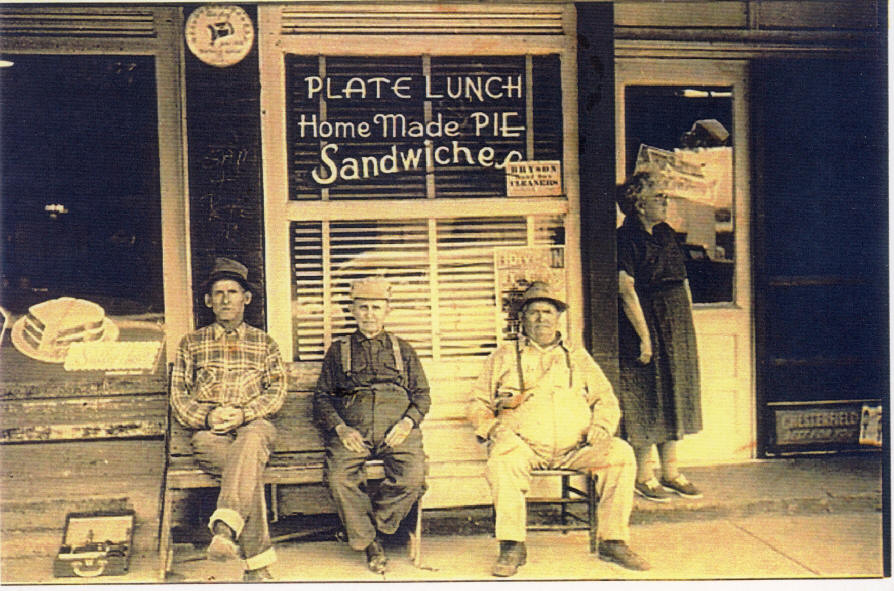
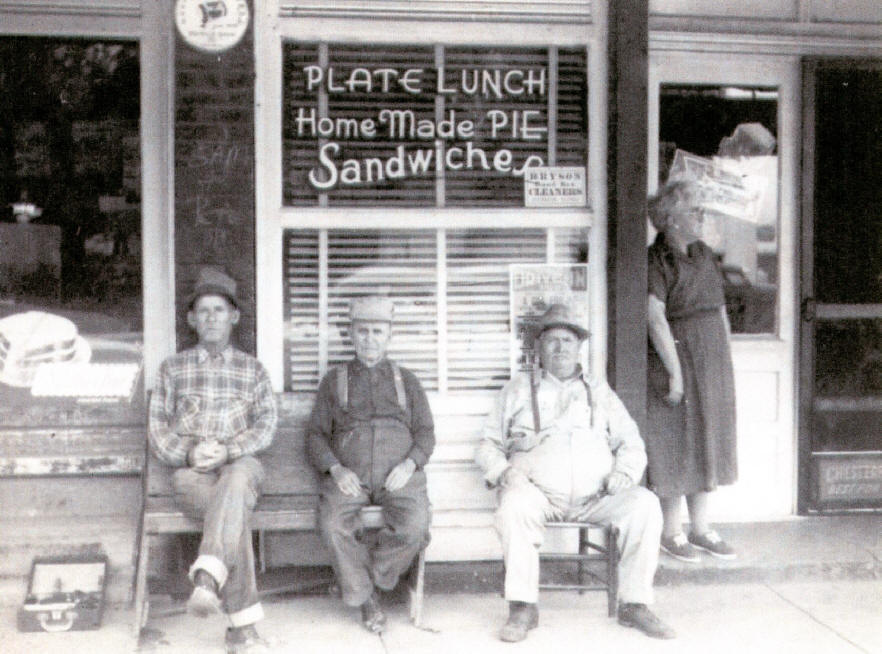
(BA-85) Arthur Cherry, Doc Slagley,
Elmer Powell, and Jessie (Russell) Slagley Cole in front of Slagley's Cafe

This
photo
was
taken
in
"Slagley's
Cafe"
- in
the
early
1950's.
Bobbie
Shreffler
thinks
it
was
when
Bob
Phillips
was
about
to
leave
for
the
service,
and
several
got
together
before
he
left.
Back
row
standing
-
Harriet
Middleton,
____________,
Betty
(Sullens)
Rubin,
Ruth
(Harris)
Brimberry,
Jean
(Ford)
Krutsinger,
_________,
__________,
________,
Bill
Beard
(sitting
in
back),
Pud
Middleton,
Virgil
Powell
(...under
Cocacola
sign)
Front section: Jim Shreffler, ________,, Eleanor Williams, Bernadine Shanafelt (very front), Mrs. Slagley,(Mike Bee behind her), Bessie Phillips,
Bob Phillips, Dale Hulsey (behind Bob), Bill Wilson (on stool in front), Martha (Tredway) Phillips
%20Alma%20Cafe.jpg)
Alma Cafe - 1980 - Owners: Richard
& Phyllis Schoreck
%20Alma%20cafe%20and%20Diss%20garage.jpg)
Alma Cafe and Diss Garage - Leroy and
Paulene Diss, owners - 1982

(AB-63) Alma Main Street - circa 1972

(AB-64) Alma Main Street - circa 1972
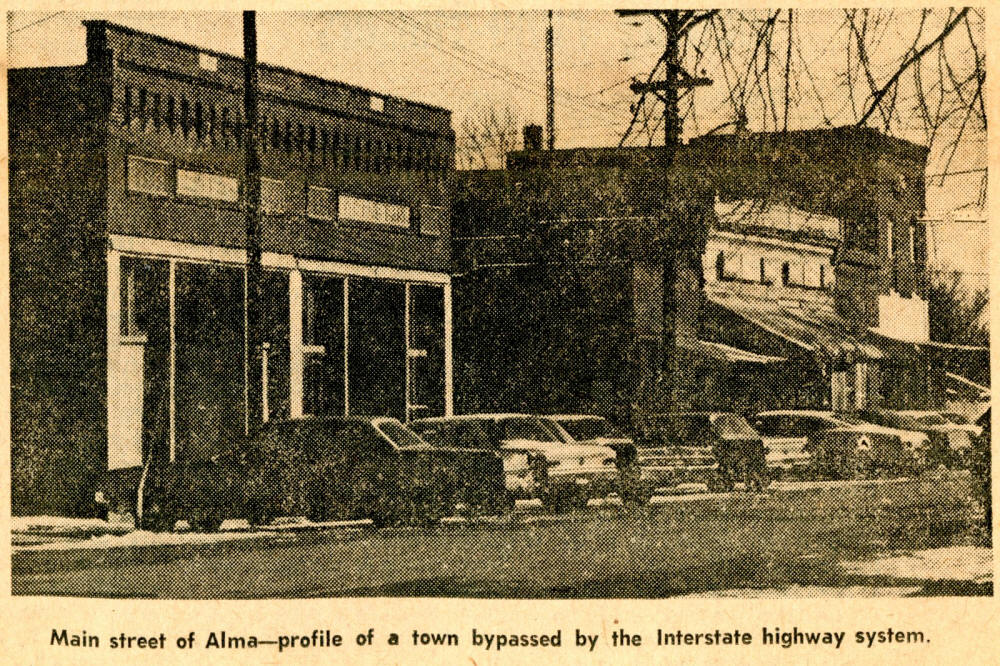
Alma Main Street - February 1973

(AB-65) Alma Main Street - circa 1972
%20-%20.jpg)
Alma Main Street - September 1980


Judy Mulvany in the Alma Cafe
Judy Shuler in the Alma Store
.jpg)
a.jpg)
Les & Bud's Grocery in Alma (1962)
- pictured are Delila (McWhirter) Caldwell and her son-in-law, Bob Kerley
Bud & Delilia Caldwell and Les &
Mildred McWhirter were the owners of this store.
%20Alma%20Grocery.jpg)
Alma Grocery - 1980
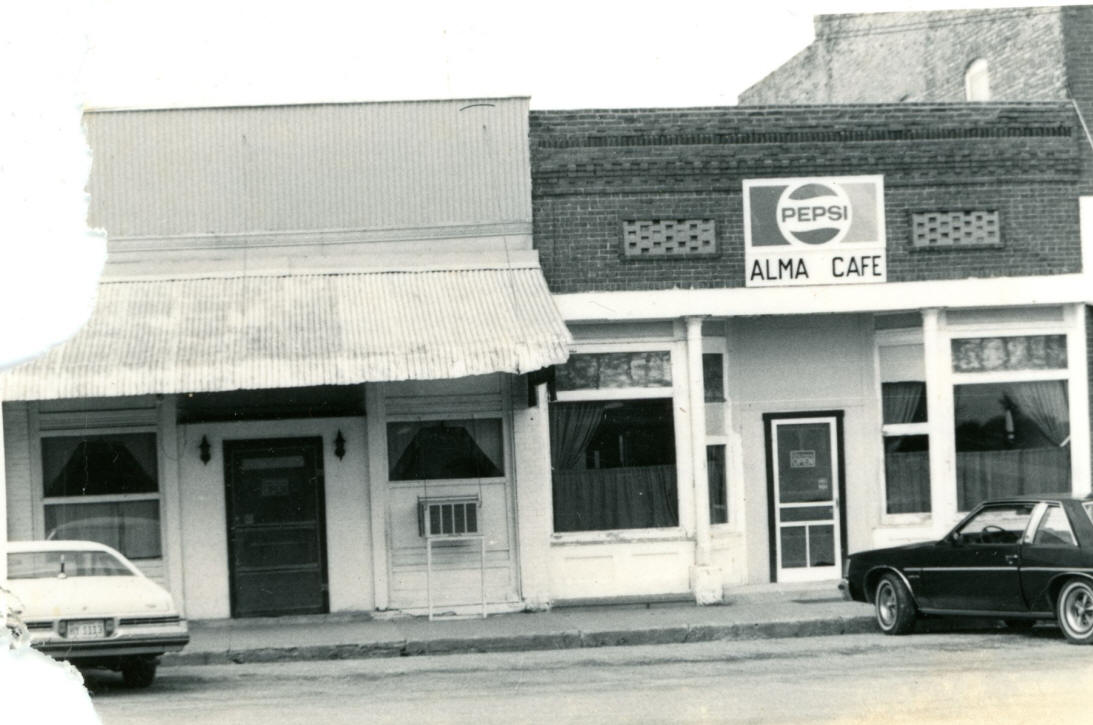
Ama Store and Alma Cafe
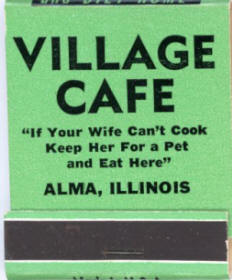
Alma's Village Cafe matchbook
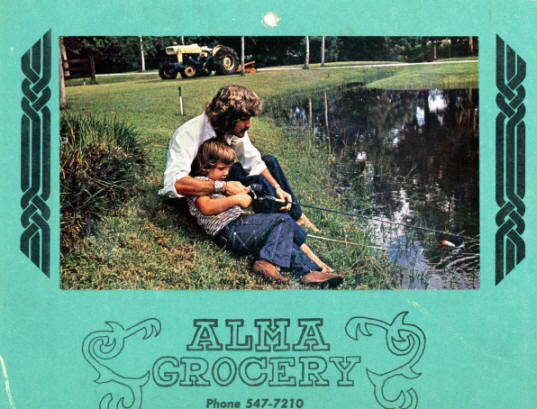
Alma Grocery Store 1982 calendar
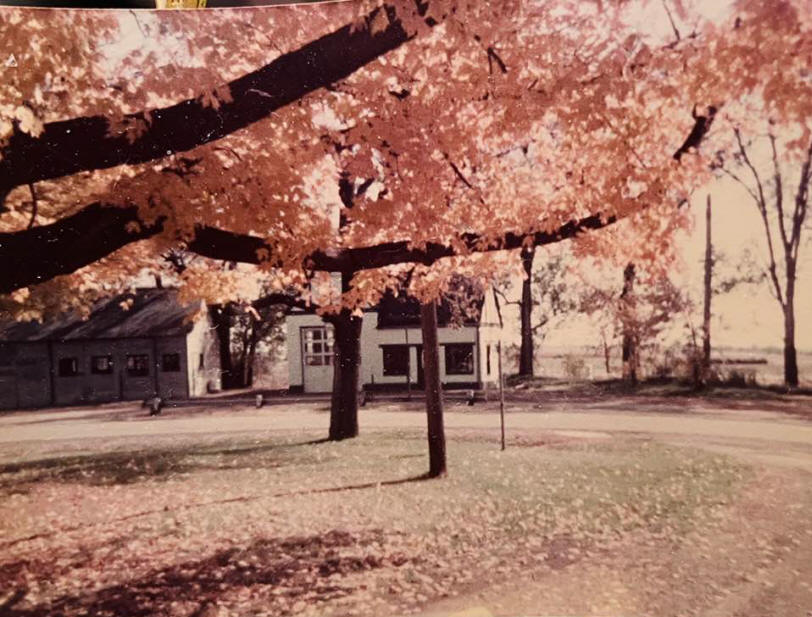
Ed Hall's Texaco Service Station
in Alma located on the east side of Rt. 37 across from Winks Fruit Market.
From Leona (Hall) Tutt: "My
dad, Ed Hall, ran a Texaco Gas Station from this building from about 1955 thru
1960. The larger building was at one time used as a car repair shop.
There was also another building south on that property where my mom, Martha
(Keen) Hall (Ed Hall's wife), had a fruit stand. On the other side of Rt.
37 was Shine Wilson's fruit market, another gas station, Mr. Kline's basket
shop, and Gene Wink's Fruit Market."
From Glenna Bragg: "Later my
dad, George Hall, ran the station and my grandmother, Susie Crutchfield, ran a
Custard Stand there."
.jpg)
Winks' Flower & Garden Center -
1964
.jpg)
Winks' Market - 1967
.jpg)
Winks' Market - 1969
.jpg)
Winks' Market - 1970

(BA-69) Gene Winks and Max King
in front of the Alma business
%20Alma%20Market.jpg)
Alma Market - 1965
%20Alma%20Market.jpg)
Alma Market - 1967
%20Krutsingers%20Market.jpg)
Krutsinger's Market - 1969
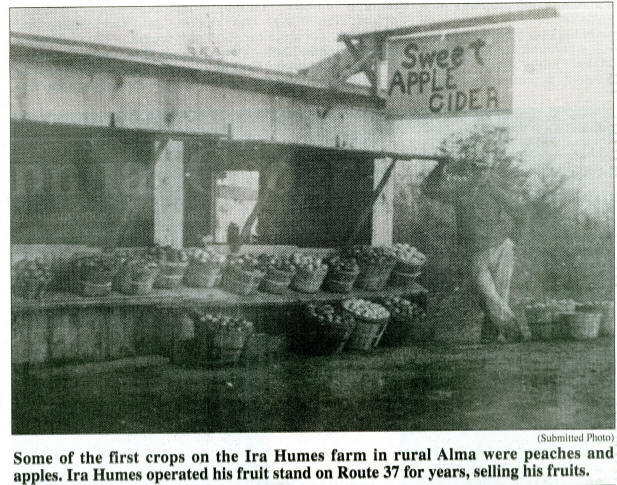
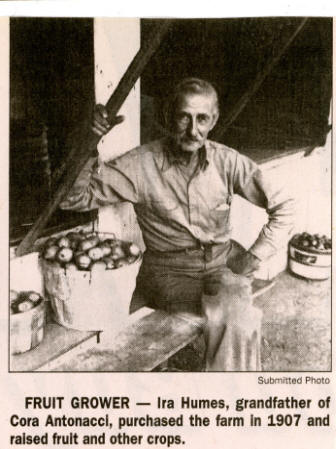
Ira Humes fruit stand in Alma
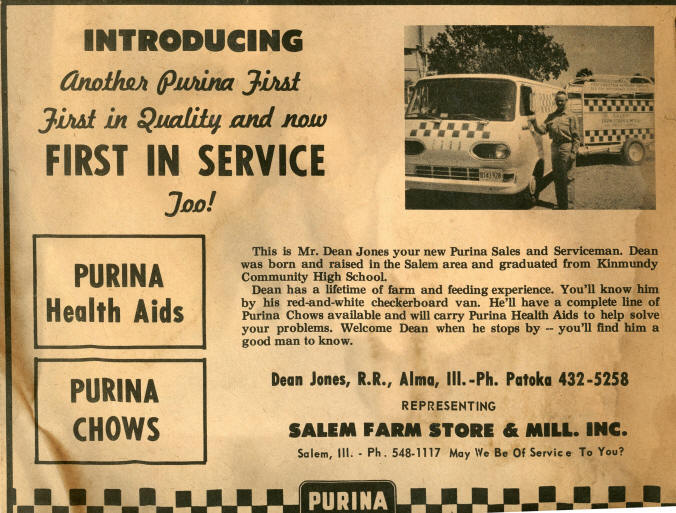
Dean Jones from Alma working with Salem Farm Store & Mill, Inc.
%20Alig.jpg)
Alig Dozer Service -
1961
%20Deadmond%20TV%20in%20Alma.jpg)
Deadmonds TV - 1962
%20Deadmonds%20TV%20in%20Alma%20crop.jpg)
Deadmonds T.V. - 1961
Yarn%20Barn.jpg)
Yarn Barn - 1978
%20Alma%20Emporium.jpg)
Alma Emporium - 1984

D.L.M. Sharp
Shop
Dan & Lillie
(Olden) Mangner

(BA-51a) Wilson
Bros.General Store plate from Alma, IL

(BA-35a) Cider
Ola from Alma
“In 1911, for example, there were 600 acres in apples, 400
in pears, 175 in peaches, plus additional acres of daffodils and tomatoes.
During Prohibition, a man by the name of Laux came from St.
Louis and purchased the cider mill.
so the government closed them down because it could be made
into hard cider.@
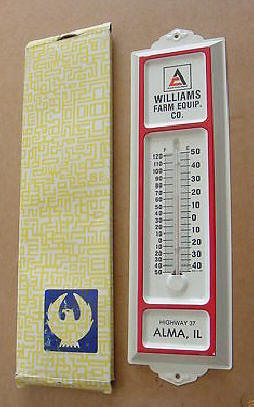
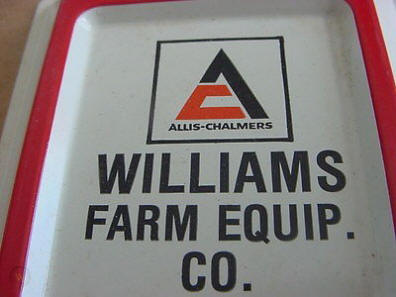
Williams Farm Equipment (early 1960s)
- Bob Ford, Howard Downey, Robert W. "Bob" Williams
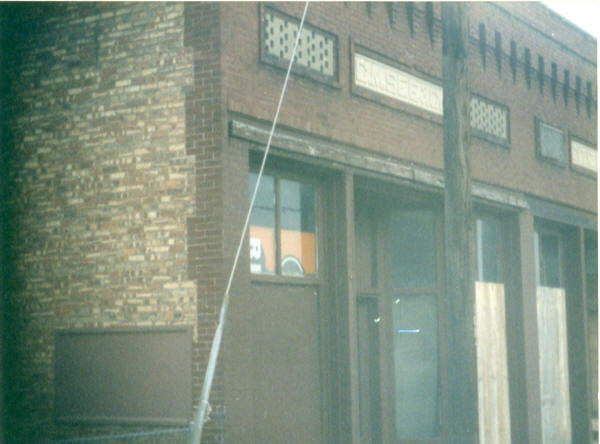
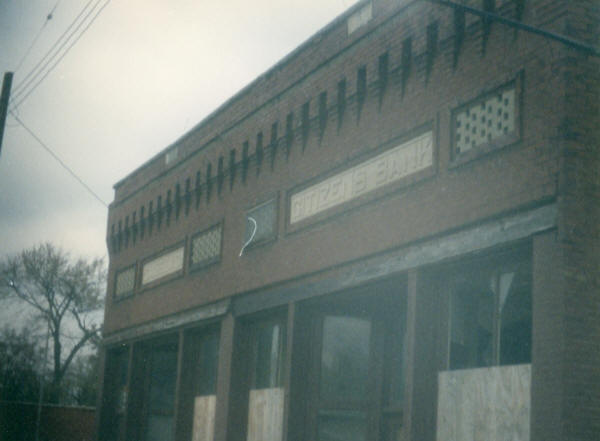
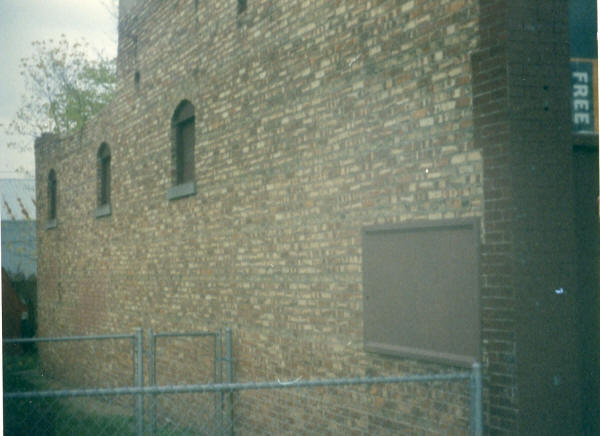
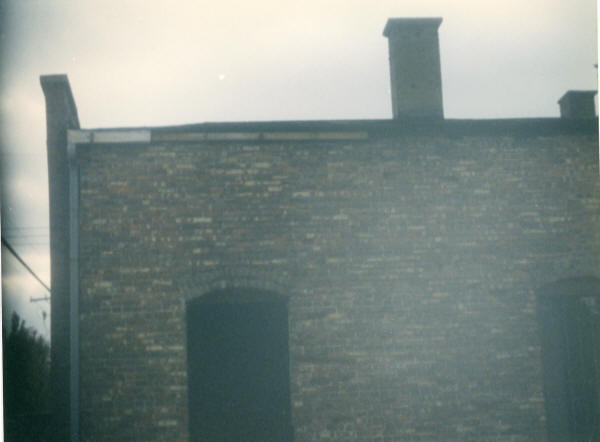
Old Alma Bank and Store torn down. This was Hester Real Estate the last
few years.
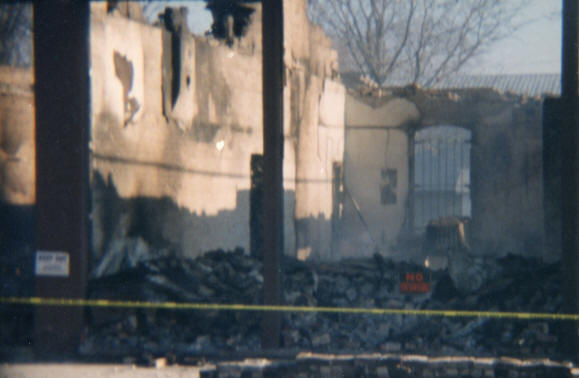
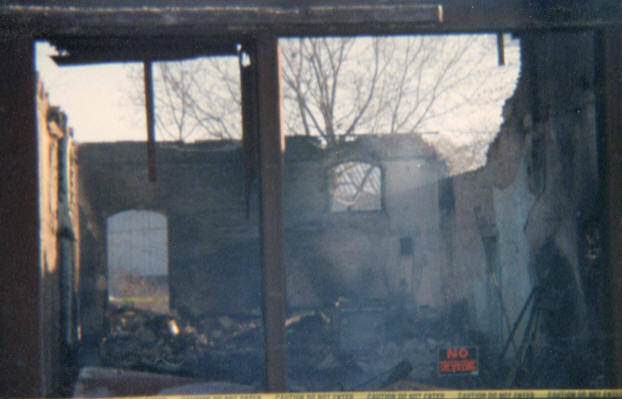
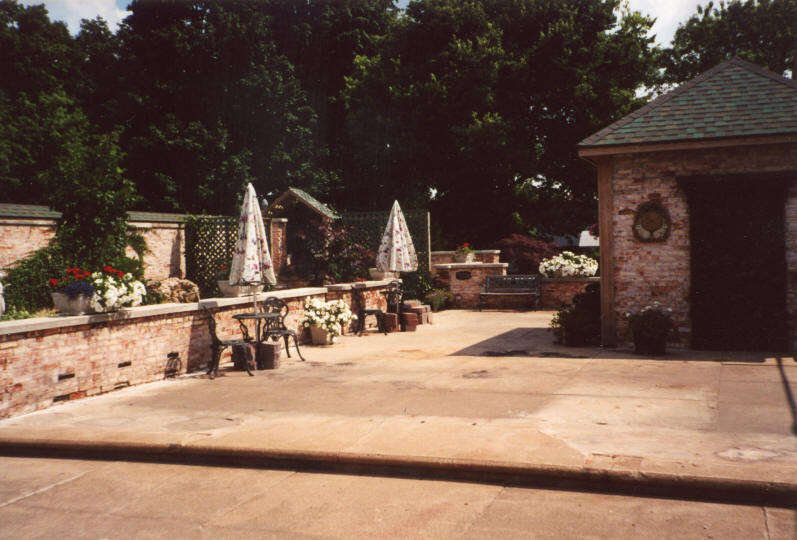
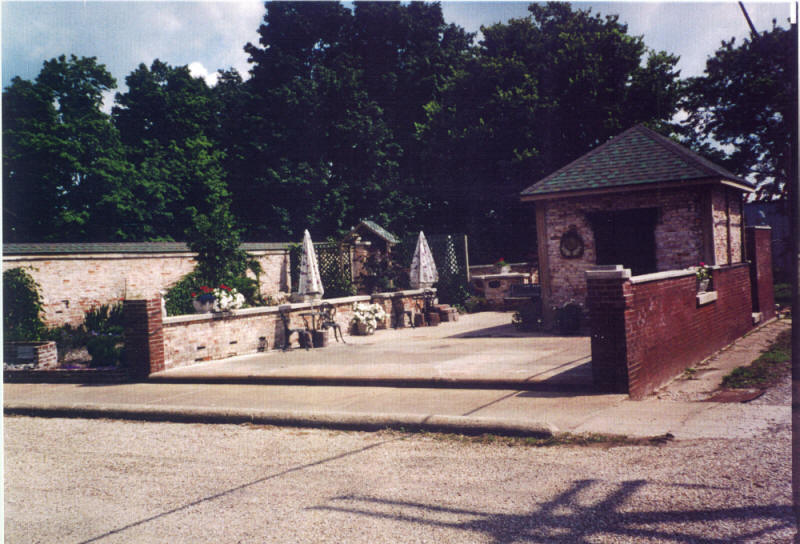
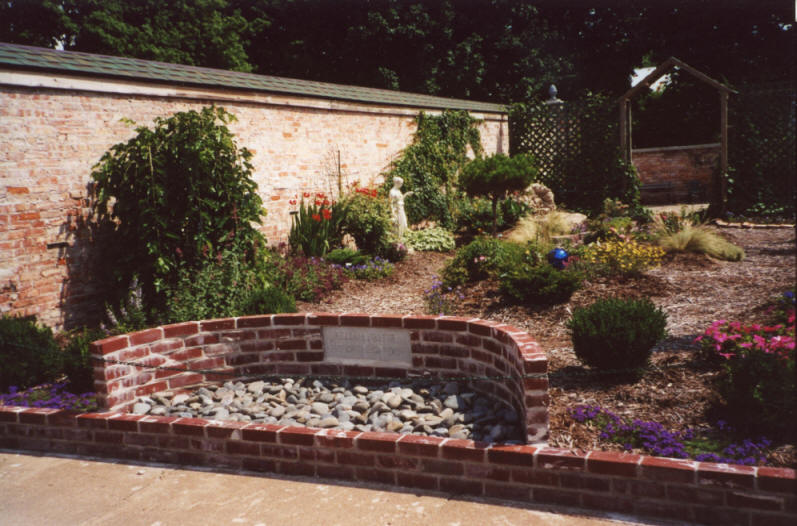
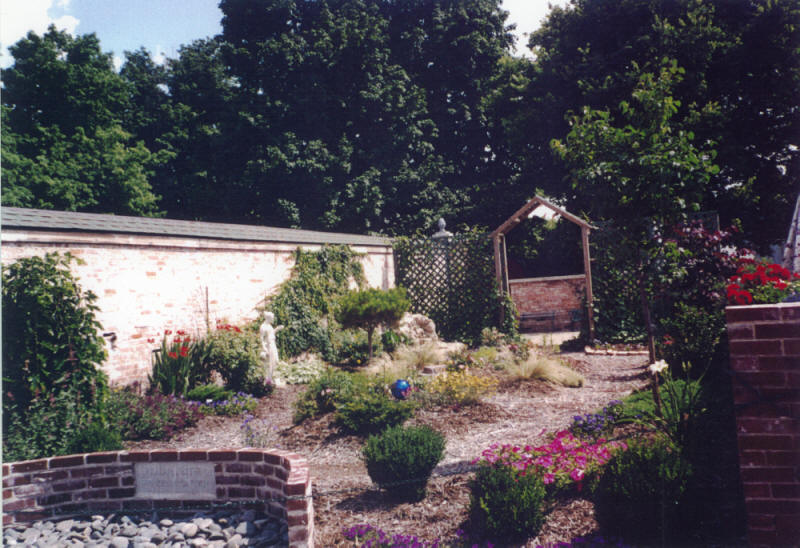
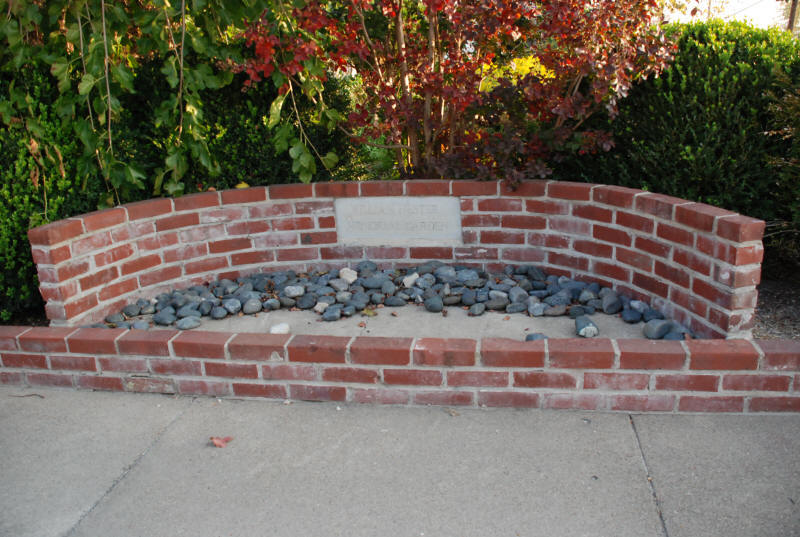
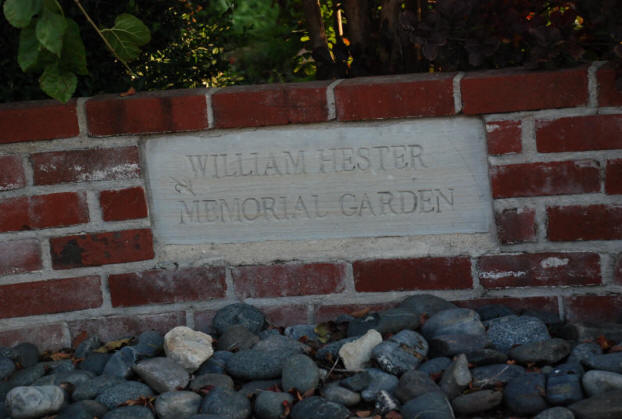
William Hester Memorial Garden - "Salem Times-Commoner" - Aug. 30, 2000
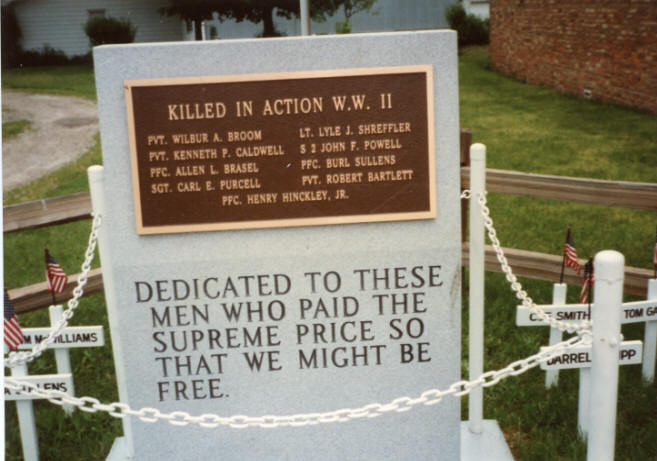
Alma Veterans Memorial of those who died in service, and the Alma School Bell
that stood on top of the old school
.jpg)
.jpg)
.jpg)
%20(155)-fix2.jpg)
.jpg)
.jpg)
.jpg)
%20Michael%20Fertilizer.jpg)
%20Southern%20IL%20Ag.jpg)
.jpg)
.jpg)
.jpg)
crop.jpg)
%20BA-54.JPG)
.jpg)
.jpg)
.jpg)
.jpg)
.jpg)
.jpg)
.jpg)
.jpg)
.jpg)
.jpg)
.jpg)


.jpg)
.jpg)
.jpg)
a.jpg)
.jpg)
.jpg)
.jpg)
.jpg)
.jpg)
.jpg)
.jpg)
.jpg)
.jpg)
.jpg)