
Historical Articles about Alma, Illinois
>>To search for a specific name, use your browser's find feature. (usually a Ctrl-F) <<
Return to

The following articles are typed below in their entirety:
Original copy of "The Plow and Hammer" - published by the Alma Industrial College Printing Co - May 20, 1898
"The Republican"; Salem, IL; July 9, 1908 - "Fire Loss at Alma; Immense Cannery Burned as Result of Fireworks Display"
"The Republican"; Salem, IL; Dec. 31, 1908 - "ALMA IS BURNED; Business Section of Village Swept Away; ONE STORE REMAINS - Loss Will Reach Several Thousand Dollars and is Severe One"
“Brinkerhoff’s History of Marion County, Illinois - 1909” - by Prof. J.H.G. Brinkerhoff - (pages 198-200) - "Alma Township and Village of Alma"
"The Centralia Sentinel"; Centralia, IL; Aug. 6, 1910 - "The Village of Alma"
"The Centralia Evening Sentinel"; Centralia, IL; March 3, 1913 - "Alma; The Lively Little Town in the North Part of the County Which is Growing and Thriving"
Original copy of "The Alma News" newspaper - July 11, 1918 (first edition)
“The Kinmundy Express” – March 11, 1920 - “Alma Growing”
"The Centralia Sentinel"; Jan. 4, 1934 - "Alma 'Hospitality Day' in Centralia, Sat., 6th - Alma, Flourishing Marion County City, Situated In Midst of Big Fruit Area"
Alma Public School Yearbook - "The Alma Mater" (1941-42) - "History of the Town of Alma"
Alma Public School Yearbook - "The Alma Mater" (1942-43) - "Alma History"
Alma Grade School Yearbook (1945-46) - "History of Alma School, and History and Accomplishments of Alma P.T.A."
Alma Grade School Yearbook (1946-47) - "Village of Alma"
Alma Grade School Yearbook (1948-49) - "Growth and Needs of our Educational System in the past eight years"
Alma Grade School Yearbook (1949-50) - "Histories of Alma Township and Town of Alma"
Alma Grade School Yearbook (1950-51) - "Flower Time"
Alma Grade School Yearbook (1952-53) - "Alma History" by Mrs. Lulu Owen
June 16, 1958, "The Kinmundy Express" - "F9F6 Navy Jet makes forced landing on Dace farm Monday"
“History of Salem, Illinois and Surrounding Territory” - "Alma"
by the Continental Historical Bureau of Mt. Vernon, Illinois (printed circa 1961)
Apr. 15, 1964 – "Centralia Sentinel" - Alma Easter flowers and schoolchildren
Circa 1965 - “Produce Inspector Recalls Days of Alma Melon Boom"
Aug. 16, 1966 – Salem Times-Commoner; "The Times-Commoner Reporter Visits ALMA"
Sept. 22, 1966 – Salem Times-Commoner; "The Times-Commoner Reporter Visits ALMA"
"Sesquicentennial of Marion County, IL (1823-1973)" - "Alma History"
"Salem Times-Commoner"; Salem, IL - "A Peek at Our Past" by Dr. George Ross - "Alma, the early years" - Part I & II"
"A Peek at Our Past" by Dr. George Ross; March 16, 1994 - "A Visit to the Alma Cannery"
Salem Times-Commoner; June 7, 1995 - "A Peek at Our Past" by Dr. George Ross; "Alma: Early 20th Century; Wagons lined up at Alma to unload "Alma Gems" melons prior to 1909"
"A Peek at Our Past" by Dr. George Ross - "Alma continued to thrive as the 1920s began"
"The Salem Times-Commoner"; June 21, 1995 - "A Peek At Our Past" by Dr. George Ross - "Alma: The Depression Years"
"Alma's early days remembered during Genealogical Society talk by Jim Hester"
"The Kinmundy Express" - June 26, 1975 - "Local Resident Survivor of Eastland Disaster on June 24, 1915, Tells of It"
Charles Tockstein recalls story about parents, Adolph Tockstein & Anna (Kolb) Tockstein
"The Kinmundy Express"; June 12, 1997 - "A Walk Around Alma" by Sue Hulsey
"The Kinmundy Express" - Sept. 7, 2000 - "History of Alma's Gregory Park"
"Salem Times-Commoner" - Aug. 17, 2001 - "Local farmer looks back on 50 years of change" (Bob Ford)
"The Centralia Sentinel"; April 23, 2006; "Famed for it's melons and daffodils, there is little left to remind one of Alma's golden age in horticulture" by Judith Joy - Features Editor
"The Illinois Steward - Discovering our Place in Nature"; A publication of the University of Illinois at Urbana-Champaign; Spring 2007 - Vol. 16; No. 1 - "Daffodils, Pears, Melons, and More" by Judith Joy
"Centralia Sentinel" - March 2006 - "Mazanek Plans to open winery in Alma"
"Salem Times-Commoner" - Aug. 29, 2006 - "Mazanek, Watson working to open Orchard View Winery in Alma area"
"Power Techniques installs, maintains conveyor systems for coal plants around country" - Cary Henken - April 28, 2010
"Dedicated group helping to revive activities on the streets of Alma" - "Salem Times-Commoner - Apr. 27, 2011
"The Sentinel" - Centralia, IL - Feb. 20, 2012 - Alma mayor discusses pride in community"
"Ronda (Swift) Yates completing 20 years of service as circuit clerk" - "The Sentinel" - Feb. 28, 2020
"Salem Times-Commoner" - July 29, 2020 - "Stan Jones looks back on early days of satellite television industry"
"The Sentinel" - Aug. 29, 2020 - "When not at home in Alma, Richard Day is in the Artic, watching polar bears"
"Salem Times-Commoner" - Dec. 4, 2020 - "Ronda (Swift) Yate
Original copy of "The Plow and Hammer" - published by the Alma Industrial College Printing Co - May 20, 1898
"The Republican"; Salem, IL; July 9, 1908
Fire Loss at Alma; Immense Cannery Burned as Result of Fireworks Display
The celebration of the Fourth of July at Alma was without doubt the most expensive thing of the kind ever before attempted in Southern Illinois. To be sure all of the fireworks that took place that evening were not on the bills or there would have been careful watching to see that it did not occur. Sometime after midnight of that day, the immense cannery belonging to Dr. W.S. Shrigley caught fire and burned to the ground. While it is not known positively, it is believed that the fire resulted from the display of fireworks given in the village that evening. It is presumed that the stick from a sky rocket carried sparks to the building where they smouldered for several hours before igniting and causing blaze sufficiently to be noticed.
About two o’clock, one of the nearby residents was awakened by the light from the burning building and even though the flames had gained such head-way that the total destruction of the building was foreseen, especially when then there were no facilities at hand with which to fight. The residents were absolutely helpless and they watched the destruction of their chief industry with saddened hearts.
This property passed to the control of Dr. W.S. Shrigley several years ago and he at once put it in condition for successful operation, and every season since that time it has increased in importance until it was reckoned as one the best enterprises of the kind in Illinois, and through it thousands of dollars found their way annually into the pockets of the producers and the workers of that vicinity. Dr. Shrigley carried insurance on the building and equipment to the extent of $10,000 and $250 on the stock on hand.
Hours before the fire had ceased burning the proprietor had decided on the immediate rebuilding and word to that effect had passed along the line. It is a remarkable spirit of thrift that is not daunted by such a disaster and Dr. Shrigley is insistent that the new plant will be completed in ample time to care for the present years crop. That is the spirit that will net down and Alma citizens are to be congratulated upon the possession of such a citizen.
"The Republican"; Salem, IL; Dec. 31, 1908
ALMA IS BURNED; Business Section of Village Swept Away; ONE STORE REMAINS
Loss Will Reach Several Thousand Dollars and is Severe One
The little Village of Alma, seven miles north of this city, was visited by a disastrous fire Monday afternoon and nearly the entire business section of the town was swept away by the flames. A total of fourteen business houses were destroyed including the Post Office building. The fire is believed to have originated in the hay barn of J.R. Clow which stood at the rear of his property on the street leading south along the Illinois Central Railroad. A large quantity of hay was stored in the barn and it is thought to have ignited by spontaneous combustion. The flames spread quickly to the large store building owned by Mr. Clow and then swept up the street running west from the Illinois Central depot. The large implement warehouse of B.G. Pullen, which stood south of the Clow hay barn, was also burned together with the contents. The losses as were given out Monday night are as follows:
B.G. Pullen, building and stock, $4500, insurance, $1100. I.O.O.F.P. Lodge, loss $600, insurance, $300; Citizens’ Bank building and Square, $1750, insurance, $400; J.R. Clow, large hay barn and contents, $3300, insurance and contents, $1600; J.R. Clow, store and buildings, $5500, insurance $2250; E.G. Ford, fifty tons hay, no insurance; Mrs. Jennie Dean, restaurant, loss $400, insurance, $400; J.W. Broom, merchandise, loss $7000, insurance $3000; Roy Gregory, restaurant, loss $400, insurance $250; C.M. See & Co., merchandise and building, loss $8500, insurance $2500; Berch & Fuller, Basket Company, loss $4000, no insurance; C.D. Tomlinson, barber shop, loss $500, insurance $300.
The post office building was entirely destroyed but Postmaster Winks succeeded in saving all the mail and equipment including stamps and money order forms.
After the fire had been under headway for some time, the Kinmundy fire department was appealed to for aid and they hastened to the scene of the disaster. The timely arrival doubtless saved the residence portion from destruction as the flying embers fired the roof of the Baptist church and other buildings were carefully watched until the flames burned out.
This is the second disastrous fire the little village has suffered within six months. On the night of July 4, the large cannery of W.S. Shrigley’s was burned to the ground. This was Alma’s chief industry and the loss was felt very heavily during the season. The fire Monday was even worse than the destruction of the cannery for the reason that very few of the owners of the establishments are prepared to stand such losses. Coming in midwinter as it did, the work of rebuilding is likely to be retarded owing to the probability of bad weather. Several of the persons were suffered in the recent fire have announced the determination to rebuild at the earliest possible day. They are an enterprising set of fellows in Alma and the little city will rise from it’s ashes, and will be the busy little mart that it was before.
“Brinkerhoff’s History of Marion County, Illinois - 1909”
by Prof. J.H.G. Brinkerhoff
(pages 198-200)
ALMA TOWNSHIP
Town 3 north, range 3 east of the third principal meridian, is Alma. Who suggested the name is not known, but whoever it was evidently had a sweetheart. Big creek and Dumb's Creek drain the township; the water from the first named flowing into the Kaskaskia, from the latter into the Wabash. Grand Prairie in the north, Summit Prairie in the center and a very small prairie in the southeast is called from a spring there, Red Lick. This township was originally mostly prairie and is now mostly cultivated, and like Stevenson, has fine farms and farm buildings and many orchards. The Illinois Central, Chicago branch, passes across the northwest corner of the township, while the Chicago & Eastern Illinois Railroad crosses it from north to south, leaving the township at the northwest corner of Stevenson township, first touching the southeast corner of Tonti. This railroad was originally the Chicago, Peoria & Memphis. It enters the township in section 3 and bends to the west and passes out as stated.
Marshall WANTLAND settled on section 35, and his brother, John, on section 36, in 1826. They were from Tennessee. It is told of John that he carried a spade and wandered over the country for a radius of thirteen miles, digging here and there and examining the soil, but concluded that section 36 was the best, so settled there. Both moved to Omega township and later Marshall went to Texas and John to Saline county. James BEARD, another Tennesseean, with his wife and two children, settled in section 23, but stayed only about ten years, when he moved to Missouri.
A Tennesseean by the name of James CHANCE, a blacksmith, settled in Salem in 1822. He had a large family. He was elected sheriff and served for eight years. He settled in section 11 at the expiration of his term of office and remained until 1835 when he moved to Tonti township, where he died in 1863.
Mrs. Letitia DUNCAN, the widow of a soldier under Jackson at New Orleans, who died in the hospital after the battle, brought her ten children, settled in Tennessee Prairie about 1818, but in 1833 she located in Alma, where she died in 1846. Mark TULLY's brother, William, came from Virginia about 1825, and after remaining in Salem about ten years settled on section 35. Afterward he went to Texas. Peter BRETZ and Robert PHILLIPS both came from Ohio about the same time. BRETZ had six children and PHILLIPS had nine, among whom were Israel and John, so long and well known in the east side of the county. J.P. FRENCH came from St. Clair county in 1838, and after living in Tonti township until 1855, moved into Alma. The township was first named Pleasant, but later changed to Alma.
The Baptists built the first church in the township in 1848. It stood on the line between sections 35 and 36. It was a small frame house. The first preacher of this church was N.R. ESKRIDGE. There are now three Methodist churches, one Baptist and one Christian church, besides regular union services are held in the town hall.
The first school was held in an old abandoned cabin and was taught by Isaac KAGY. The cabin stood on what is known as the WANTLAND (Marshall) place. It was a subscription school and the subscriptions were paid in produce, which in turn was bartered in RATE's store. In 1842 the first schoolhouse was built on the site of Pleasant Grove Methodist Episcopal Church. It was of the pioneer type, log cabin with clapboard roof, held on with roof poles. There are doubtless men and women now living in the township who remember the old schoolhouse of seventy years ago.
William TULLY built the first horse mill in 1836, and John BECK kept the first store. He failed and went out of business in a short time. He began his store-keeping in 1851, at the house of Squire SIPLE.
On section 35 the early settlers established a burying ground. It was used about fifteen years and then closed for burial purposes. It was called the Mound Graveyard.
This township was among the first to introduce imported stock and has ever since kept the best blood obtainable. Berkshire hogs were introduced in 1841; Durham cattle in 1840 by the HITE brothers; English draft horses by John CUNNINGHAM in 1852, and Southdown sheep by Thomas WHITE in 1856.
The first doctors were Thomas L. MIDDLETON, William HAYNIE, Doctor BAKER, T.B. LESTER and John DAVENPORT, and they traveled many miles in every direction. Their names will be found as the first physicians in several townships. The post office at Alma, established upon the completion of the Central Branch Railroad, was the first in the township.
In 1841 John HAMMERS opened a coal mine six feet underground by stripping, that is, by removing six feet of surface to a coal vein two feet thick, but when the railroad brought coal to Alma the mine was abandoned.
VILLAGE OF ALMA
The village of Alma is on the northwest corner of the township on the Chicago branch of the Illinois Central Railroad. It was first laid out by John S. MARTIN, in 1854, and the MARTIN, FRENCH, and TILDEN addition was platted about the same time. It was named Rantoul, after an officer of the railroad, but another town in the state had appropriated the same name, and it was changed to Grand Mound City, but in 1855 the named was changed to Alma.
Doctor HUTTON built the first store house in 1853, and was the first postmaster. SMITH and HAWKINS conducted the first blacksmith shop and John ROSS the first grist and sawmill. Jefferson HAWKINS was the first Methodist minister; John ROSS, the first Christian preacher, and was instrumental in building the first church in which he preached several years and from which he was buried, by the writer, about eighteen years ago. The Methodist Episcopal church was built in 1871. The first schoolhouse was burned and the second was built in 1866 and 1867. It was a two room building, but it is not now used. Some of the members of the Christian church conceived the thought of a Christian college at Alma. The ROSSes and others gave land and money and a good two-story schoolhouse, or college, was built and a college opened, but after a few years’ struggle the property was sold three years ago to the district for public school purposes.
Alma has grown from a hamlet to a village of two hundred or three hundred inhabitants and is incorporated as a village. It has many business houses and enjoys the trade of a large part of this, Tonti and Foster townships. On the 28th day of December, 1908, fire broke out in a large hay barn and destroyed the entire business part of Alma. Several stores, warehouses, shops and restaurants were burned and as all were of frame, the loss was total, but with true American grit, the ashes were hardly cold before the debris was being cleared away and preparation s for brick buildings were under way. In the spring of 1908 the large fruit cannery of Doctor SHRIGLEY
's was burned, also quite a serious loss to the business of the village. Alma is one of the chief fruit shipping points of the county. Thousands upon thousands of baskets of tomatoes, peaches and other fruits are annually shipped, while the Alma gem melon requires two or three cars per day during the season, and are the only rival of the Rocky Fords on the markets.
"The Centralia Sentinel"; Centralia, IL; Aug. 6, 1910
p. 122; The Village of Alma
The village of Alma was laid out and platted by John S. Martin in 1854. Additions have been made since by J.S. Martin, M. French, Samuel J. Tilden, S. McCullough, L.C. Pullen, N.D. Laughlin, L.C. Pullen, N.D. Laughlin, and J.W. Ross. The village is situated in sections 6 and 7, Alma township. The first stone house on the site of the original town was built by Dr. T.O. Hatton, father of Mrs. C.M. See. The town was first named Rantoul. As there was a town in the state by that name, the postoffice was named Grand Mound City in 1855. The town and postoffice were changed to Alma
Dr. T.O. Hatton was the first doctor, the first merchant, and the first postmaster. Other postmasters have been: J.S. Martin, R.C. O’Bryant, J.R. Sloane, H.L. Allmon, C.M. See, T.E. Mayes, N. Warner, MV. Helton, I.A. Sprouse, T.B. McCartan (incumbent), H.P. Winks.
The first teacher in Alma public schools was Hugh Moor. Alma has had as teachers, J.B. Abbott, J.E. Whitchurch, and J.S. Knisley - in all four men who were county superintendents of schools.
The first preacher in Alma was of the Methodist Episcopal denomination, by the name of Jefferson Hawkins. The first church was built by the Disciples, and was 40 X 30 in size in 1868. It coast $1,200. The Methodist Episcopal church was built in 1871 at a cost of $1,600, size, 36 X 46. The trustees were Josiah Gibson, Richard Wilson, J.W. White, J.B. Abbott, and John R. Sloane. Both the above buildings have since given way to modern structures. The Missionary Baptists also have a very comfortable house of worship.
Since Dr. Hatton, the following physicians have been resident practitioners here: J.B. Johnson, M.B. Losey, Dr. Boisdell, A.J. Hays, Dr. W. Noruski, Dr. Dean. S.L. Laswell is the present physician.
(A picture of Alma Main Street accompanied this article.)
J.W. Broom
General Merchandise
Motto - Quick Sales and Small Profits
This store is better known as the SQUARE DEAL. Starting in a small way, Mr. Broom has grown to be one of the leading, if not the leading store in Alma. While he has only been in the mercantile business four years, he had a varied experience of twelve years on the road and this fact coupled with his unusual foresight as a business man and trader has made his success very rapid. He was burned out December 28, 1908, during the big fire at Alma, and after that the I.O.O.F. put up a big brick building which is the pride of the town and is now occupied by Mr. Broom. His greatest asset in business is his daughter, Miss Carre, who is very frequently left in full charge of the business for many days at a time. Mr. Broom deserves your patronage.
(A dark picture accompanied this article.)
"Centralia Evening Sentinel"; Centralia, IL; March 3, 1913
Alma; The Lively Little Town in the North Part of the County Which is Growing and Thriving
The village of Alma is situated in the northern part of Marion county in sections 6 and 7 of Alma township. The history of the village dates back to 1854. It was laid out by John S. Martin, and later other additions were added by J.S. Martin, M. French, Samuel J. Tilden, S. McCullought, L.C. Pullen, N.D. Laughlin, and J.W. Ross. The first store house on the site of the original town was built by Dr. T.O. Hatton, father of Mrs. C.M. See. Dr. Hatton was the first postmaster, the first merchant. Among other postmasters were J.S. Martin, R.C. O’Bryant, J.R. Sloan, H.L. Almon, C.H. See, T.E. Mayes, N. Warner, M.V. Sefton, I.A. Sprouse, T.B. McCartan, T.P. Winks, Mrs. C.D. Pollock, the present incumbent.
The first teacher in the public schools was Hugh Moor. Alma has since had as teachers, J.B. Abbott, J.E. Knisely, all of whom have been county superintendent of schools.
The first preacher in Alma was of the M.E. Church by the name of Jefferson Hawkins. The first church was built by the Disciples in 1868, at a cost of $1,200. The Methodist was built in 1871 at a cost of $1,600. Both the buildings have since given way to modern structures. The Missionary Baptists also have a very comfortable house of worship.
While Alma has shown a marked progress during past years, the town has sustained the loss by death of several leading and respected citizens whose loss has been felt in business as well as social circles. Among the names are: Dr. W.S. Shrigley, who was wealthy and influential in the moral and business interests of the community. It was he who established a cannery some years ago, which was destroyed by fire.
W.S. Ross, who introduced the Alma Gen melon, which proved to be one of the most popular and profitable products in the community. He also encouraged fruit growing in many varieties.
Mrs. N.A. Winks, also Ed French, well known and respected, have recently passed away.
The public schools of Alma are excellent. The building used was formerly the Industrial College which was purchased by the school board.
F.B. McCartan is the principal, ably assisted by his daughter, Elizabeth.
The farming country around Alma is fertile and productive of small fruit and vegetables in abundance.
The fruit industry calls for baskets and packing cases, and these are manufactured right here by I.A. Sprouse. During the fruit season, Alma is one of the busiest little towns in the country. Shipping pears and apples are the principal products. Whole grain loads of fruit shipped from this point. In one season as many of 240 car loads of pears, 50 car loads of apples, tomatoes in large quantities, and good varieties are raised here.
Alma has a good banking institution which is doing a splendid business with a capital of $10,000. It’s officers are E.G. Ford, President; Joseph Mazanek, cashier, and C.M. See, Assistant Cashier.
Alma’s Business People
The business people of this thriving little village are prosperous, and their stores of well selected merchandise are kept in good condition.
There are four general stores, two hotels, a restaurant, lunch room, a lumber yard, livery stable, a basket factory, blacksmith shop and three churches. There are all the natural advantages here to be found in any town of its size and many small factory or other enterprise will receive encouragement.
J. Mazanek, General Merchandise
Among Alma’s mercantile establishments is Mr. Mazanek’s where is offered Dry Goods, Groceries, Hardware, and Specialities for Field or Garden.
Mr. Mazanek’s experience in the mercantile business gives him knowledge of buying that has saved his customers many a dollar.
While the prices at his store always reasonable, no article leaves his store unless it is in every way dependable and worth what is paid for it.
Mr. Mazanek is also interested in farming and stock raising in some degree.
The Square Deal
Mr. J.W. Broom, the proprietor has been a resident of Alma for about 13 years, starting in business here a little over 5 years ago. His business has grown to be one of the largest general merchandise stores in town. His years of experience as a traveling man coupled with his unusual foresight and business ability together with the able assistance of his daughter, Miss Carrie, has made his success rapid.
His motto is "The lowest price for good goods".
T.E. Maulding, General Merchandise
About one ago, Mr. Maulding purchased a stock of goods from C.M. See & Co., and continues the business at the same stand. He was reared in Alma but for ten years prior to purchasing this business, was located in East St. Louis, engaged in railroad work. Mr. Maulding now has a well stocked store, consisting of Dry Goods, Groceries, Clothing, Shoes and in fact everything usually found in any general store. In addition, he is handling flour in car lots, and has built up a splendid business.
R.E. Gregory, Gasoline Lighting Devices
The people of Alma need not go away from home for modern lighting devices, fixtures or accessories. Mr. Gregory will install the very latest in your home or store, furnish fuel or repairs at moderate prices. Mr. Gregory conducts a restaurant and confectionery where the public may be served with good things to eat.
J.M. Haslet, Livery
Mr. Haslet first came here from Beecher City about fourteen years ago after which he found a location. In Kinmundy in livery and boarding business, a few years, returning to Alma about a year ago and is doing well here. He is also interested in farming to some extent.
Alma Lumber Co.
The Alma Lumber Co. is one of Alma’s leading institutions, with Mr. R.E. Walters as manager. The members of the firm are R.W. Walters, C.W. Hall, Henry Bellamy, all of Sandoval and R.E. Walters of Alma.
The prosperity of the community has resulted in many improvements and the construction of new homes, and this company has supplied these improvements in an assortment of building materials, builders’ hardware.
They also handle grain, hay and coal. Mr. Walters is now prepared to do undertaking.
Alma People Who Have Gone to the Front
Young men from Alma who have made good in various vocations:
Among the most prominent in the ‘60s was Hon. Hale Johnson, son of Dr. J.B. Johnson of Alma, Ill. Hale Johnson was a candidate for vice president of U.S. on the prohibition ticket 12 years ago.
Some years before this, John Gibson, who afterward gained great wealth in a Philippine land syndicate and railroad; at present treasurer of the Coliseum of Chicago, Ill.
Later - George Shreffler, interested largely in Ohio oil fields; at present of a concrete factory at Freemont, Ohio.
Others of note are:
- Dr. S.C. Wilson - Located at Lincoln, Neb. for a number of years; later 10 years at Spokane, Wash. Present location in Vancouver, B.C.
- Dr. Samuel Wilson, dentist, Chicago, Ill. - For some years, state president Christian Endeavor Society; for the last ten years, Supt. Sunday School Woodlawn Park M.E. Church.
- Wm. F. Wilson - Lawyer, politician, and also teacher in public schools, Chicago, Ill., for past 15 years.
- Dr. J.D. Wilson, dentist - Located at Danville, Ill., for past eight years.
- Jesse Kline - State President, Y.M.C.A. work of Wisconsin for 18 years.
- J.H. Meneely, Supt. of Public Schools, Brooklyn, New York.
- Alonzo Abbott - Professor of Chemistry; address unknown.
- Dr. H.E. Wilson - Practicing physician, Centralia, Ill.
- Rev. Frank O. Wilson - Pastor M.E. church, Altamont, Ill.
- Zachariah Taylor - Postmaster, Colfax, Ill.
- Thomas Clow - inspector of Weights and Scales for the E.J. & E.R.R., Joliet, Ill.
- J.W. Ross - Florist, Centralia, Ill.
- Thomas McNeill - Train Dispatcher I.C.R.R., Champaign, Ill.
- Dr. Noah Deane - Practicing physician, Sumner, Ill.
- Dr. Clarence S. Lee - Located at Frederick, Okla., 1907; died 1908
- Edwin Wormley - Agent I.C.R.R., Kinmundy, Ill.
- George McNeill - Conductor I.C.R.R., Champaign, Ill.
- John R. McNeill - Building Contractor, Salem, Ill.
- Samuel McNeill - Building Contractor, Ormund, Fla.
- Mark Ross - Traveling wholesale salesman, Chicago, Ill.
- Walter N. Pullen - Furniture dealer and undertaker, Waynesville, Ill.
- Charles McCartan - Operator I.C.R.R., Odin, Ill.
- Charles Gammon - Agent I.C.R.R., Laclede, Ill.
- Rolla McCarty - Operator I.C.R.R., Farmer City, Ill.
- A.R. See - Agent I.C.R.R., Union Stock Yards, Chicago, Ill.
- Frank Coffin - Electrical Engineer, Chicago, Ill.
- Clifford Coffin - Supt. of Rates, Illinois Salt Works, Chicago, Ill.
- Ed Rainey - Editor "Marion County Democrat", Salem, Ill.
- Harry Coffin - Undertaker and embalmer, Centralia, Ill.
- Dorsey Sprouse - Fruit commission merchant, South Water Street, Chicago, Ill.
- Geo. W. Smith - Express messenger, American Express Co., Chicago, Ill.
- H.P. Smith - Illinois State Adjustor for The Home Insurance Co., Alma, Ill.
- T.E. Maulding - Transfer Supt., Southern R.R. East St. Louis, for a number of years. At present dealer in general merchandise.
- Roy Warner - Bank cashier, Vinita, Okla.
- Arthur Purcell - Chief of Police, Sapulpa, Okla.
- Morris Harvey - Clerk, I.C.R.R., Union Stock Yards, Chicago, Ill.
- Charles Claytor - Supt. Schools, Mason, Ill.
- Joseph Mazanek - Cashier, Citizen’s Bank, Alma, Ill.
- Rev. Clark Yost - Pastor M.E. church, Alton, Ill.
- Fred Clow - Purchasing agent for "Rothschild", Chicago, Ill.
Some young women worthy of mention are:
- Miss Bertha Purcell - Government nurse, New Mexico
- Miss Clara Hefton - Nurse, Henrietta Hospital, East St. Louis, Ill.
- Miss Rhea White - Nurse, Wesley Hospital, Chicago, Ill.
- Miss Anna Roberts - Deaconess Hospital, Great Falls, Washington
- Miss Ethel Hefton - Operator, I.C.R.R., Effingham, Ill.
- Miss May Schermerhorn - Purchasing agent, Seattle, Wash.
“The Kinmundy Express” – Oct. 19, 1916
“Alma's Thriving Enterprise”
“H.E. LAWRENCE, an enterprising citizen of Alma, is prepared to buy and make into cider all the apples that come to his mill, but not withstanding his 90 barrel capacity he has been running night and day. He is paid so much per gallon by Spillman Bros. & Co. of Chicago, and by pressure he forces the cider through pipes 1000 feet to tank cars on the canning factory switch. Last year it cost him $300 to have the cider hauled to the cars. For several years he has had much expense in removing the pumice, also had more or less trouble in securing a place to dump it. Happily that question has been solved by him. He has leased space and power to the Midwest Product Co. of Milwaukee, who have installed a pumice dryer that is capable of handling the product of 1250 bushels of apples every ten hours. Later on this Company will install plants in Olney, Newton, Flora, Dubais, Benton and Centralia. The pumice is sack shipped to Chicago and submitted to a process removing the saccharine, pectine and other ingredients and the balance is mixed with cotton seed to make stock food. Mr. LAWRENCE says the only thing lost is the rattle of the machinery which could be saved on the graphaphone record. He employs nine men and by next year he expects to double his capacity.”
Original copy of "The Alma News" newspaper - July 11, 1918 (first edition)
“The Kinmundy Express” – March 11, 1920
“Alma Growing”
“In the thriving little village of Alma in the northern part of the Marion co., there has quietly but surely grown an industry which has been more for reaching for general prosperity in this neighborhood than is generally known outside of this community, and indeed hardly appreciated by some of our citizens. This is the cider factory of the Midwest Products Co. with headquarters at Milwaukee, Wisconsin. The history of the development of this industry is quite interesting within itself.
In 1914, H.E. LAWRENCE installed a Cider Mill at Alma, it was considerably better equipped than the ordinary custom mill. It represented a capital of about $2000 and a capacity of 50 barrel per day with facilities for cooking apple butter by steam and employing from three to five men during the apple and pear season. It was situated several blocks from the loading switch necessitating heavy dragage bills and the pummies were not utilized at all. This being one of the largest pear and apple growing districts in the country, this mill was unable to handle near all the cider stock.
Mr. LAWRENCE at this time having become acquainted with some of the Midwest officers in a business way, he completed a deal with them whereby they acquired his mill and fixtures and retained him as superintendent. This was a rare combination for a successful business venture of this kind, the Midwest Products Co. with their unlimited capital and large business experience. Mr. LAWRENCE with his wide acquaintance among the fruit growers of this vicinity his practical experience as a cider maker and a thorough knowledge of the machinery connected therewith and above all a tireless and energetic worker for the best interests of the business.
The Midwest then bought ground on which a loading switch was already located and proceeded to erect a large two story up to date cider mill, fully equipped with all the latest and best machinery including their own electric light plant and special machinery for drying all the pummies and utilized them for commercial purposes. Also a number of large wooden vats holding thousands gallons of cider and bins providing for the storage of thousands of bushels of cider stock.
Every apple is thoroughly washed and cleaned by machinery before it goes to the crushers and then the juice is clearfied by the special process until the clear amber color of the finished product bears no more resemblance to the old fashioned mudcolored cider than the clear sparkling waters of the roadside ditch. All in all this cider factory represents an invested capital of $60,000 and this company paid out last year at this place $100,000 for fruit and labor.
They employ from twenty to thirty men all through the fruit season and four men the entire year and pay from forty to sixty cents per hour. They have a capacity of one hundred bushels per hour after that continuously day and night during the heat of season. One orchard in this community has averaged $4000 per year on their cider stock for the last two years.
Last year we had a severe wind storm early in the season and seventy-five percent of the fruit was blown off. The fall and winter varieties of apples and pears were not over_____ grown and of course were not suitable on the open market even as windfalls. But every bushel was marketed as the local cider mill at the regular price. When one stops to consider that cider stock is practically a waste product, you can very readily see what a local market at a fair price means to a large fruit growing center. Every practical fruit grower knows that in this time of close competition and high cost handling, it is folly to ship a poor grade of fruit in the open market. And even in the best cared for orchards there are quite a per cent of inferior fruit.
It is true that occasionally some “Wandering Jew” will drop into a neighborhood buy a few cars of cider stock and leave but that is only a “drop in the bucket” and not dependable. But if some party could be found who was financially able and mentally willing to buy every bushel of cider stock in the country.
It would be impossible to dispose of it without a local mill for the very good reason that owing to the large volume of business in other grades of fruit and other products of different kinds at that season of the year it would be impossible to obtain a sufficient number of cars to handle all ciderstock before it would perish.
Many towns have paid thousands of dollars in bonuses to acquire industries which have been of less benefit to the general public than the Midwest Products Co. have been to Alma by their honest dealing fair treatment and gentlemanly conduct this company has gained the goodwill and respect of this section of country to a very high degree. The fruit industry of this community is constantly growing and acres of new orchards coming into bearing every year.
And in order to keep pace with this growth the Midwest Co. is contemplating improvements in buildings and machinery for the coming season to the extent of $30,000 additional capital and more than doubling their capacity. But immediately following this announcement comes the report that the officers entrusted with the enforcement of the new prohibition laws are not uniform in their ruling. Some even going so far as to claim it prohibits the making of all fruit juices fermented or otherwise in any form. You can very readily see what that would do for the cider industry.
The great majority of people in this community are in full sympathy with prohibition laws and wish to see them enforced. But they do not want to see it handled in such a way that it will defeat the very purposes which it is intended to promote. The rulings in this matter should be uniform in all the states and should not interfere with legitimate industries that are not handling intoxicating goods nor of a higher percent of alcohol than the law provides.
The Midwest Co. at Alma do not handle intoxicating goods. Part of their cider is run direct from the press into the vinegar vats and left there undisturbed until it is loaded out direct to the vinegar factory. The remainder goes direct from the press to the cookers and is concentrated or treated so that it never ferments but remains perfectly sweet as the day it was made and is used as a soft drink and they do no custom work.
Fruit growers should wake up on this question and take steps to protect their interests. Not through any disposition to thwart the prohibition law but against the ignorant interpretation of it in some districts.
We trust the time will never come when some Ignoramus from the desert will drive us from the shade of the old apple tree or deny us the privilege of gathering its blossoms to strew the graves of our loved ones.”
"The Centralia Sentinel"; Jan. 4, 1934
Alma "Hospitality Day" in Centralia, Sat., 6th
Alma, Flourishing Marion County City, Situated In Midst of Big Fruit Area
Alma is a lively little town of 368 persons on State Highway No. 142 and the Illinois Central railroad that is located in the midst of a large acreage of peaches, pears and apples, which have become widely known. One of the largest and most modernly equipped fruit packing sheds in the state is located in Alma.
Besides the many persons who are employed in the cultivation, care, harvesting and marketing of Alma community’s fruit, the Gregory Orchard Supply Company, employing four men, is a well known industry of the city, while the A.M. Wilson poultry concern likewise employs four men.
Mr. Wilson is mayor of Alma, Alderman are E.L. Laswell, J.F. Neary, Leo Wikenhauser, William Gregory, John Mazanek, Jr., and H.E. Helm. Edward McWhirter is the police officer.
Alma’s high and grade schools are housed in one building under the superintendency of Earl Purdue. Members of the faculty in addition to Mr. Purdue are Miss Mary Pullen, Miss Anna Arnold, and Miss Lulu Foster.
Three churches serve the religious needs of the community. They are the M.E. Church with Rev. Dycus as pastor, the Christian Church with Rev. Marteny as pastor, and the Baptist Church with Rev. Wright as pastor B.G. Pullen.
Leading business firms include those of J. Bowen, C.E. Rainey, and B.G. Pullen.
Two parks, the school park and the Gregory Park, are available for recreational facilities.
The village is on the northwest corner of the township. It was first laid out by John S. Martin, in 1854, and the Martin, French, and Tilden addition was platted about the same time. It was named Rantoul, after an officer of the railroad, but another town in the state had appropriated that name, and it was changed to Grand Mound City, but in 1855 the name was changed to Alma.
Doctor Hutton built the first store house in 1853, and was the first postmaster. Smith and Hawkins conducted the first blacksmith shop and John Ross was the first Christian preacher. Rev. Ross was instrumental in building the first church in which he preached for several years. The Methodist Episcopal Church was built in 1871.
The first school house was burned and the second one was built in 1866 and 1867. It was a two-room building. Some of the members of the Christian Church conceived the thought of a Christian college at Alma. The Rosses and others gave land and money and a good two-story structure was built and a college opened. After a few years’ struggle, the property was sold to the district for public school purposes.
On December 28, 1908 fire broke out in a large hay barn and destroyed the entire business part of Alma. Several stores, warehouses, shops and the restaurants were burned and as all were of frame, the loss was total. Before the ashes were hardly cold, the debris was cleared away and preparations for substantial brick buildings were underway.
In the spring of 1908, the large fruit cannery of Doctor Shrigley was burned, being a serious loss to the village of Alma.
The Ross name has been associated with Alma history since shortly after the founding of the village. The family of William S. Ross, father of J.W. Ross of Centralia, came to Alma from the northern part of Illinois in 1866. In 1871, the Ross family moved westward, eventually settling in Texas where it remained until 1885 when it returned to Alma.
In 1881, the netted Gem melon, a small, oval, heavily netted, green fleshed fruit was first introduced to the public. This variety was destined to revolutionize the melon industry in America. It was tested for a few years and in 1885 was grown for market in a small way by William S. Ross, at Alma, and by J.W. Eastwood of Rocky Ford, Col. The melon seeds had been brought back by the Rosses from Texas.
Having more melons than his local market could consume, Ross shipped two barrels to Chicago in August, 1885. These were the first melons of this type ever seen on the Chicago market, and they were the occasion of considerable amusement on South Water street when the barrels were opened. The melons seemed ridiculously small as compared with the Hackensack and other melons then on the market. However, after the flavor had been tasted, the melons were readily sold, and an order received for all that could be furnished.
The next year Ross planted 20 acres and a few years later, 90 acres. Soon a number of his neighbors began planting and the industry grew at Alma until the shipments reached from 10 to 15 carloads a day. In 1900 from Alma alone, 253 carloads of "Alma Gems" were shipped. In the meantime, the industry had spread to other points in Illinois, including Anna and Balcom in the southern part of the state. Most of the Illinois melons were shipped in one-third bushel Climax baskets.
As the growing of Gem melons spread to other sections of the state and the markets became supplied with melons from those sections, the people of Alma and vicinity turned to growing other fruits, principally pears and apples, although there are a number of large peach orchards there. There are still some melons grown and shipped, but the industry today is only a shade of what it was formerly.
Alma Township
Alma township was originally mostly prairie, but nearly all of the land now is under cultivation. The Illinois Central railroad passes across the northwest corner of the township while the Chicago & Eastern Illinois Railroad crosses it from the north to the south.
Marshall Wantland settled on Section 25, and his brother, John, on section 36, in 1826. They were from Tennessee. James Beard, another Tennessean, settled on Section 23, but stayed only a few years. James Chance, a blacksmith from Tennessee, settled in Salem in 1822 and after serving as sheriff, moved to Section 11 in Alma township, where he lived for many years.
The township was first named Pleasant, but later changed to Alma.
The Baptists built the first church in the township in 1848. It was a small frame house. The first preacher was N.R. Eskridge.
The first school was held in an old abandoned cabin and was taught by Isaac Kagy. It was a subscription school and the subscriptions were paid in produce, which in turn was bartered in at a store.
In 1842, the first school house was built on the site of the Pleasant Grove Methodist Church. It was of the pioneer type, log cabin with clapboard roof, held on with roof poles.
On section 35 the early settlers established a burying ground. It was used about 15 years and then closed. The cemetery was known as the Mound graveyard.
This township was among the first to introduce imported stock.
The first doctors were Thomas L. Middleton, William Haynie, Doctor Baker, T.B. Lester and John Davenport.
The post office at Alma, established upon the completion of the Illinois Central Railroad through the town, was the first in the township.
In 1841, John Hammers opened a strip coal mine on a vein two feet thick, but when the railroads brought coal to Alma, the mine was abandoned.
(A picture of downtown Alma accompanied this article.)
History Read at Alma Homecoming
The following interesting history connected with the settlement of the territory in the vicinity of Alma was read at the annual Homecoming held at Jollywoods Park, near Alma, Sunday, August 12th by Miss Fleta SMITH, daughter of Mr. and Mrs. Harry SMITH.
At the beginning of the 18th century this land that is now known and designated as township three, range three, east of the third principal meridian, was practically uninhabited. No doubt a few pioneers had immigrated through and probably settled on this land, but no definite history has been obtained prior to 1826, when Marshall WANTLAND and his brother, John, settled on sections 35 and 36. It is told of John that he carried a spade, and wandered over the country for a radius of 13 miles examining the soil, and finally concluded that section 36 was the best and settled there.
Mrs. Letitra DUNCAN, a widow of the war of 1812, with her ten children, settled in Tennessee Prairie about 1818, but moved to Alma in 1833, where she died in 1846.
William TULLY came to Alma township about 1835 from Virginia and settled on section 35.
The township was first named Pleasant but was later changed to Alma.
The first church in the township was erected in 1848, and was of the Baptist denomination. This church was a small frame construction, and was built on the line between sections 35 and 36. The first minister of this church was N.R. ESKRIDGE.
The first school was held in an old vacant cabin on the Marshall WANTLAND place. This school was taught by Isaac KAGY. It was a subscription school, and the subscriptions were paid in produce which in turn was bartered at RATE's store.
In 1842, the first school house was built on the site of the Pleasant Grove Methodist Church. It was a true pioneer type, log cabin with clap-board roof, held on with roof poles. There are doubtless a few men and women now living in the township who remember that old schoolhouse.
William TULLY built the first horsemill in 1836, and John BECK kept the first store. He began his storekeeping in 1851, at the house of Squire SIPLE's.
This township was among the first in the county to introduce blooded stock. Berkshire hogs were first introduced in 1841, Durham cattle in 1840 by the HITE brothers, English draft horses by John CUNNINGHAM in 1852, and Southdown sheep by Thos. WHITE in 1856.
The early settlers established a burial ground on section 35. This cemetery was known as Mound Grave Yard, and was used about 15 years then closed for burial purposes.
The first doctors were Thomas MIDDLETON, William HAYNIE, Dr. BAKER, T.B. LESTER, and John DAVENPORT, and they traveled many miles in every direction.
In 1841 John HAMMERS opened a strip coal mine but when in 1855 the railroad began bringing coal to Alma, this mine was closed.
The village of alma was first laid out in 1854, and the Martin, French and Tilden additions were platted immediately. Alma was first named Rantoul after an officer of the Illinois Central Railroad, but another town in the state had appropriated that name, and it was changed to Grand Mound City. In 1855 the name was again changed to Alma.
Dr. HUTTON built the first storehouse in Alma in 1853. This building is still standing, and is familiarly known as the old catch-all. Dr. HUTTON was also Alma's first postmaster.
SMITH & HAWKINS conducted the first blacksmith shop and John ROSS the first grist and sawmill.
John ROSS was the first Christian preacher, and was instrumental in building the first Christian church in 1867. The M.E. CHURCH was built in 1871, Jefferson HAWKINS being the first minister.
The first schoolhouse burned and the second schoolhouse was built in 1866 and '67. This schoolhouse was a small two room building. In later years the location was changed from the B.G. PULLEN property to the present site.
In 1908 a fire broke out in a large hay barn and destroyed the entire business section of the town. But with true American grit, the ashes were scarcely cold before preparations were being made to replace the frame buildings with safe buildings of brick construction. The same year, the large fruit cannery of Dr. SHRIGLEY's burned, which was another serious loss to the town and community.
Fruit growing is the chief industry, as Alma is one of the most important shipping points in the country. Hundreds of cars of fruit are shipped from here each year. It is the second largest pear growing district in the United States, one district in Deleware being first.
Although Alma has never become a large city, it is a very prosperous and industrious small town with a population of some 300 or 400 inhabitants and enjoys the conveniences of electricity, automobiles and a hard road that puts it in connections with the larger cities.
Alma Public School Yearbook "The Alma Mater" (1941-42)
History of the Town of Alma
Alma is a lively little town of about ___ hundred person on state highway No. 142 and the Illinois Central Railroad that is located in the midst of a large acreage of peaches, pears, and apples, which have become widely known.
The village is in the northwest corner of the township. It was first laid out by John Martin, in 1854, and the Martin, French and Tilden addition was platted about the same time. It was named Rantoul after an officer in the railroad, but another town in the state had appropriated that name and it was changed to Grand Mound City, but in 1855 the name was changed to Alma.
Dr. Hutton built the first storehouse in 1853 and was the first postmaster. Smith and Hawkins conducted the first blacksmith shop, and John Ross the first grist and sawmill. Rev. Jefferson was the first M.E. preacher, and Rev. John Ross the first Christian preacher.
The first school house was burned and the second built in 1866 and 1876. It was a two room building. Some of the members of the Christian Church conceived the thought of a Christian College at Alma. After the college building burned the present school was built.
On December 28, 1908 fire broke out in a large hay barn and destroyed the entire business part of Alma. Before the ashes were hardly cold, the debris was cleared away and preparations for substantial brick buildings were underway.
In the spring of 1908, the large cannery of Dr. Shrigley was burned.
In 1881, the gem melons were planted and were tested for a few years before being offered to the public. In 1900, 253 cans of Gem melons were shipped from Alma. Very few melons are raised here now.
The principal crops raised for market now are peaches, pears and apples.
In 1941 and 1942 the basket factory was started in the building formerly used as a cider mill.
Alma Public School Yearbook "The Alma Mater" (1942-43)
The first Alma School was located where White School is now. It was taught by Uncle Billy Ross.
Then about 1898, the school house was moved where the Pullen house stands. It then had two rooms and a hall. It remained there until the old college didn’t prove to be a success.
When the college proved unsuccessful, it was given to the town for a grade school. The old school was torn down and the Pullen house built out of the lumber. The grade school remained in the old college building until it burned in the spring of 1912. This school being taught by Mr. and Mrs. T.B. McCartan.
The present school building was then built. It only had three rooms. The lower room covering the first floor. Teachers being Mr. T.B. McCartan and his daughter Pearl. The high school was established in 1919. They had a high school before, but it was not a credited one.
After the high school was taken away, the rooms were moved up one room, and a lunch room was added.
At present, those serving our school are Mrs. Grace Jackson, principal and teacher of grades seven and eight. Mrs. Ann Arnold teacher of grades four, five and six. Mrs. Lulu Owen, teacher of grades one, two and three. Mr. Ham Stipp, Janitor, and Mrs. Nina Middleton and Mrs. Blanch Austin, Cooks.
Alma Grade School Yearbook "The Alma Mater" (1945-46)
History of Alma School
The first Alma School was located where White School is now. It was taught by Uncle Billy Ross.
Then about 1898 the school house was moved where the Pullen house stands. It then had two rooms and a hall. It remained there until the old college didn’t prove to be a success.
When the college proved unsuccessful it was given to the town for a grade school. The old school was torn down and the Pullen house built out of the lumber. The grade school remained in the old college building until it burned in the spring of 1912. This school being taught by Mr. and Mrs. T.B. McCartan.
The present school building was then built. It only had three rooms. The lower room covering the first floor. Teachers being Mr. T.B. McCartan and his daughter, Pearl. The high school was established in 1919. They have had a high school before, but it was not a credited one.
They continued having high school until 1941, when it was taken into the Kinmundy Community High School District.
After the high school was taken away, the rooms were moved up one room and a lunch room was added.
At present, those serving our school are Mrs. Grace Jackson, principal and teacher of grades seven and eight. Mrs. Ann Arnold teacher of grades four and five and six. Mrs. Lulu Owen, teacher of grades one, two and three. Mr. Ham Stipp, Janitor and Mrs. Nina Middleton and Mrs. Blanch Austin, Cooks.
Written by Elnora Williams, Mary Bouseman.
History and Accomplishments of Alma P.T.A.
On Oct. 14, 1834, about 25 parents met at the Alma Church for the purpose of organizing a Parent Teachers Association. Mrs. G.R. Williams of Salem was present and explained the aims and ideals of the association and the necessary procedure of organizing and affiliation with the State Congress of Parents and Teachers.
The first regular meeting was held at the school building the next week with 25 charter members, and the following officers were elected for the first year: President, Mrs. Rhea Shreffler; Vice President, D.C. Day; Secretary, Kathryn Williams; Treasurer, Lulu Foster.
The school year of 1934-35 was the first year of our Alma Parent Teachers Association.
Our first undertaking was a penny supper which we held in the Mazanek building, and the proceeds were $34.06. $31.07 of this was used for electric light wire and fixtures, to wire the school building, the work being done and donated by the men of the town. This filled a long felt need, and has been much appreciated by the pupils and teachers, especially on dark winter days.
At the May meeting, it was voted to organize a band, using some of the instruments owned and donated by citizens of the town, but which would have to be reconditioned. This work was paid for by individual donations, and by the proceeds of a cafeteria supper, held May 9th, which netted $28.30. In June of that year we still had a balance of $22.31 in the treasury so a reconditioned piano was purchased for the school. This ended our first year of P.T.A. work.
Our Association began th eschool year of 1936-37 with D.C. Day as president, Jess Donoho vice president, Mary Winks secretary, Lulu Foster as treasurer, and a balance of $108.92 in the treasury. A sizable donation was added to this by the school district and play ground equipment, consisting of a slide and three swings was purchased and set up, also two new basketballs, sweat shirts and pants were purchased for the basketball squad - I might add that though pretty well worn, these suits are still in use by our present team.
The P.T.A. was influential that year in procuring the services of a doctor and nurse, who gave Smallpox vaccination, diphtheria and typhoid shots to all pupils desiring them. This ended our year’s work.
In 1937-38 our president was William E. Williams, vice president and secretary unknown, treasurer, D.C. Day and our enrollment was 31 members.
Two new basket balls were purchased for the team that year, also twenty-five Golden Song Books for the use of the school and Parent Teachers Association.
In the fall of 1937, several of our patrons attended a sectional P.T.A. meeting at Bridgeport and while there held the next district convention in Alma. This invitation was accepted and the convention was held here the following spring, with a large attendance.
Mr. Williams was reelected as our president for the year 1838-39. 37 members were enrolled.
At the beginning of the year 1939-1940, Mrs. J.C. Wilson was president of the P.T.A., but due to illness was forced to resign. She was replaced by Mrs. Merle Baker, with Mrs. Earl Jackson as Vice President, and Mrs. Jess Donoho treasurer, Sec. unknown.
A nice sum was made that year through the sale of magazine subscriptions. We had 31 members that year.
For the school year of 1940-1941, our P.T.A. officers were: President, Mrs. Warden Bishop; Vice President, Mrs. Ella Mae Hester; Secretary, Mrs. Opal Coyne; Treasurer, Mrs. Grace Jackson; We had an enrollment of 31 members and began the year with a total of $49.50 in the treasury.
That year we secured and paid the expenses of a speaker who helped us organize the Allied Youth Movement among our young people.
In April we purchased one dozen folding chairs and contributed $5.00 to the Child Welfare Fund. This ended our school year with $20.67 still in the treasury.
Mrs. Ella Mae Hester was our president for the year 1941-1942; unknown, Vice President; Grace Jackson, Secretary; and Kathryn Williams, treasurer. 41 members were enrolled.
A pie supper was held in October and the receipts were $23.27. A penny supper in November netted $25.17. It was in this month that a meeting of mothers was called to discuss a school lunch room. The idea was favorably received and it was voted to start the project with the P.T.A. as sponsor. With money in the treasury, and public and personal donations, the necessary dishes, pans, silverware, kerosene, and groceries were purchased. The school board purchased the stoves and lumber and other material needed to convert what was then the primary room, into our present day kitchen.
The work of building the tables, seats and storage space was done by Mr. Stipp.
The P.T.A. continued to sponsor the lunch room the first three years, while the school board has operated it the last two years with the P.T.A. helping in any way possible.
The association sponsored a paper drive in 1941-42 to help the war effort, and the school children collected and sold $20.10 worth which was placed in the treasury to help with the expenses of the kitchen.
Mrs. Hester was reelected as president for the year 1942-43. That year we paid $20 into the community school garden at Odin and received in return - cans of fruit and vegetables. 268 additional cans were purchased by donations and by dimes contributed by the school children.
In February of that year a Penny supper was held which added $31.68 to the treasury.
We boasted of 40 members in our organization that year.
Our first P.T.A. meeting for the school year of 1943-1944 was held in October at the school building with a potluck supper. Mrs. Gertrude Gammon was president that year, Mrs. Bert Humes, vice president, Mrs. Edith Williams secretary and Mrs. Grace Jackson, treasurer, and we had an enrollment of 44 members.
A $5.00 T.B. Health Bond was purchased and the P.T.A. sponsored a T.B. test and immunization program, the work being done by the county nurse and a doctor from Salem.
Our president, Mrs. Gammon attended the National Parent Teacher’s Convention in Chicago that year.
P.T.A. officers for the year 1944-1945 were Mrs. Genelle Aldrich, president; Mrs. Lola Williams, Vice President; Mrs. Ella Mae Hester, Treasurer, and Mrs. Melba Dietrich, secretary.
This was our highest year in membership, with an enrollment of 68.
Additional dishes for the kitchen were purchased also a $5.00 T.B. Health Bond.
Groups of the mothers met at the school kitchen in the summer and fall of 1944 and canned 136 quarts of tomatoes, and 140 cans of pears for a use of the lunch room. The fruit and glass cans were donated by the patrons.
The same officers were re-elected for 1945-46, the present school year. There are forty members.
This ends the review of the year by year accomplishments of the Alma Parent Teachers Association and now, in lighting these candles, one for each of the twelve years, it is with the hope that we shall continue to prosper and grow in the years to come, that we may always be able to serve and aid our school and our children.
A Review Written by Mrs. Lulu Owen
List of P.T.A. Presidents
1934-35 Rhea Shreffler
1935-36 Mrs. Jess Donoho
1936-37 D.C. Day
1937-38-39 William E. Williams
1939-40 Mrs. J.C. Wilson, Mrs. Baker, Mrs. Jackson
1940-41 Mrs. Warden Bishop
1941-42-43 Mrs. Ella Mae Hester
1943-44 Mrs. Gertrude Gammon
1944-45-46 Mrs. Genelle Aldrich
Alma Grade School Yearbook (1946-47) - "The Alma Mater"
Village of Alma
The village of Alma is on the northwest corner of the township on the Chicago branch of the Illinois Central Railroad. It was first laid out by John S. Martin 1854. It was named Rantoul, after an officer of the railroad, but another town had been given that name, and it was changed to Alma.
Doctor Hutton built the first store house in 1853, and was the first postmaster. Smith and Hawkins conducted the first blacksmith shop and John Ross the first grist and saw mill. Jefferson Hawkins was the first Methodist Preacher; John Ross, the first Christian preacher. The Methodist Church was built in 1871.
The first schoolhouse was burned and the second one was built in 1866 and 1867. It was a two room building, but is not now used. Some of the members of the Christian College at Alma. The Rosses and others gave land and money and a good two story schoolhouse, or college, was built and a college opened, but after a few years struggle the property was sold to the district for public school purposes.
Mr. Abbott was one of the first school teachers and was an outstanding educator and leader of the community of that time.
Alma has grown from a hamlet to a village, and was incorporated in 1896. It has many business houses and has the trade of this, and Tonti and Foster township. On the 28th of December, 1908 a fire broke out in a large barn and destroyed the entire business part of Alma. Several stores, warehouses, shops, and restaurants were burned and as all were of frame, the loss was total, but with true American grit, the ashes were hardly cold before the debris was being cleared away and preparation for brick buildings were under way. In July of 1908 the large fruit cannery was burned.
One of the first pioneers of the community, Wm. Ross, introduced the netted Gem melon, a small, oval, heavily netted, green fleshed fruit; Mr. Ross brought the melon seeds back from Texas in 1855. The melons were grown commercially for several years by local farmers and shipped to the Chicago market in barrels. At one time the shipments reached 10 to 15 carloads a day.
In the same year that Mr. Ross introduced the melon he also started the kiefer pear tree which he imported from Texas. Other trees were grafted from the original tree; the beginning of many large pear orchards in the surrounding community. The original tree in still standing.
Alma has become one of the chief fruit shipping points of the county.
The first section house in Alma was located near the Mike See place and J.T. Claytors father was the first section foreman, and they lived in the section house. The tool shed being located across the railroad.
Mike See was one of the first station agents; the family lived above the station until their house was completed.
The first bank was located in Mr. Mallot’s store, located where Roy Gregory now has his filling station.
"Alma, Missed by Oil, Still Fruit Capital of Marion County"
"Alma, once the melon center of southern Illinois and still the heart of one of the state's largest fruit centers, is unperturbed by oil developments which have boomed Salem, Centralia, Tonti, and Patoka, neighboring Marion county cities.
The shady little village, today is surrounded by dry holes where attempts have been made to draw up black gold. But there has been no luck so far. Someday oil may be found within the township, but so long as peaches, apples and pears grow in abundance, and so long as normal farm crops hold up, Alma will be satisfied with its unhurried pleasant spot in life.
Oil has had some influence upon the village, though, for there has been considerable building of new homes. Many persons who could not find adequate living quarters in Salem or who could not afford the higher cost of building, found Alma's shady residential district a cheerful place to make their homes. Only seven miles north of Salem, the distance was no object.
About a dozen business establishments make up the shopping district, county service stations. One of the stations, Phillips 66, is owned by the mayor, Charles BEE.
NAMED ALMA IN 1855
Probably no village in Marion county has a more interesting historical background, and if luck had allowed, the name would now be either Rantoul or Mound City. When another city assumed the name of Rantoul, now the center of a mighty army air field, the citizens chose Mound City or the name, then later settled on Alma. That was in 1855. The town first was laid out by John S. MARTIN in 1854.
As far back as the oldtimers can remember, Alma has been the chief fruit shipping point in Marion county, and to the east of the village is the largest fruit farm in the state - that of John BROOM, who raises mostly peaches on his 300 acre spread. His brother, Stanford BROOM, also is a prominent fruit grower.
Alma was one of the first townships to introduce livestock, once had a strip coal mine, a fruit cannery, was an important strawberry shipping center - and at one time shipped as many as 16 carloads of melons per day.
BUSINESS DISTRICT BURNED.
Like Chicago, the entire business district was burned to the ground after a fire started in a barn. That was in 1908, and immediately the town sprang up once again, with brick construction replacing the ruined frame places. The fire occurred on Dec. 28, 1908, with the flames destroying among other dwellings and business places, the SHRIGLEY fruit cannery.
There are many persons in Alma who know the story of the village from the beginning up, including A.M. WILSON, hardware merchant, J.T. CLAYTOR, Mrs. Mollie DUGAN, the Rev. W.E. WRIGHT, Jabe JOHNSON, Mrs. Rosa WINKS, whose son Andrew is now township supervisor, Mrs. Sadie PURCELL and quite a few others.
Eventually the soil refused to produce melons as it used to, and strawberries hardly became a profitable business, the coal mine opened in 1841, closed when the railroad brought in coal – which left things pretty much up to the peaches, apples, pears and general farming.
EXTENSIVE FLOWER FARM
One of the beauty spots of the township, however features flowers – and is primarily a flower farm with as many as 40 acres in Easter Lillies alone. This is the Andrew ROSS place, a mile west of the village and the old homestead where William ROSS planted the first melon seeds of the area which he bought in Texas.
M. SHREFFLER, although not growing flowers as extensively as ROSS, has a nursery at his farm west of the village, in addition to growing fruit. Alma residents have a fondness for flowers and attractive shrubbery, as a glance about the village indicates.
The HESTER brothers, Jim and Bill are the biggest pear growers in the area. Their farm west of the village running right into the city limits itself. John MAZANEK, south of town, Ira HUMES, also south are large fruit growers, and as a matter of fact, there are probably a hundred growers of fruit with smaller acreages of 40 acres more or less scattered throughout the township. Supervisor WINKS has about 40 acres of trees.
Probably the biggest big-business man with a fruit-growing interest in Alma is Bert EISNER, who lives in Champaign, and owns about 125 Piggy-Wiggly stores.
The Illinois Fruit Exchange at Carbondale is a major fruit buyer at Alma, represented there by A.T. EGELSTON, and many small buyers are attracted to the village during the fruit season.
JOLLYWOOD PARK POPULAR
When the citizens feel in need of relaxation and the pleasure of picnics or a lazy afternoon in the shade, they go to Jollywood Park which is owned by R.E. GREGORY. Near a small lake and an ideal park spot, Jollywood Park at one time a few years back was the scene of a community fair, horse racing and trimmings.
Like most villages, local politics is more or less a necessary evil, although at times there is considerable fun in campaigning for various candidates. During the last election when Charles BEE was elected mayor, Paul WATSON became town clerk; J.W. GAMMON, justice of the peace; W.E. WILLIAMS, magistrate; E.J. JACKSON, constable and Garrison WILLIAM, Virgil SPITLER and Bill GREGORY town board members. Carl HINES is the postmaster.
The business district consists of the following establishments: DIETRICH’s Grocery owned by Ted DIETRICH; RAINEY’s Store, general merchandise, C.E. RAINEY; Edna’s Beauty Shop, Miss Edna MORTON; WILLIAMS’ Café, Mrs. Lottie WILLIAMS; WILLIAMS’ St. Clair Station, Loren WILLIAMS; A.M. WILSON hardware; GREGORY’s Restaurant, R.E. GREGORY; GREGORY’s Orchard Supply; BARBEE Feed Store, Byron BARBEE; Standard Service Station, Noah GRAVES; GRIFFIN’s Garage, Marion GRIFFIN; and C.A. GLORE Lumber Company, E.J. JACKSON, Manager.
FIRST SETTLERS
To make the story of Alma at least partially complete, the first settler in the present township was Marshall WANTLAND, 1826, settling on section 35, and his brother, John on section 36, coming from Tennessee. James BEARD an early settler, was also from Tennessee. Mrs. Letitia DUNCAN, widow of a soldier under Jackson at New Orleans, settled at Alma in 1833. Mark TULLY’s brother, William came from Virginia and settled in section 35 in 1835. Peter BRETZ, Robert PHILLIPS, and J.P. FRENCH, hailing from Ohio, settled in Alma in 1855.
The first store built in Alma in 1855 by Dr. HUTTON, who was also the first postmaster. Jefferson HAWKINS was the first Methodist preacher and John ROSS the first Christian preacher. The first Methodist Church was built in 1871. A Christian College was started, but failed.
The township, which originally was mostly prairie, is served by the Illinois Central Railroad and C.M. SEE who retired as I.C. agent after 49 years of service, can spin many tales about early railroad methods as compared with the modern systems.
The Baptists built their first church in 1848, with N.R. ESKRIDGE serving as the first preacher. The first school was conducted in an old abandoned cabin at the WANTLAND place, taught by Isaac KAGY. The subscription paid in produce. The first schoolhouse was built in 1842.
An old settler’s burial ground was established in section 35 but was closed after 15 years.
Imported livestock was introduced first in 1840 with Durham cattle, then in 1841 Berkshire hogs, 1852 with English Draft horses and 1856 with Southdown sheep.
At the present time there are three churches in Alma, the Primitive Baptist, Methodist and Christian. Pastors are the Rev. W.E. WRIGHT, Rev. W.G. WIGHAM, and Rev. WILSON respectively.
Alma township communities are Oak Grove, Glenridge, Pleasant Hill, Brubaker, Cubbage Chapel, and Zion.”
Alma Grade School Yearbook (1948-49) - "The Alma Mater"
Growth and Needs of our Educational System in the past eight years
On March 8, 1941, the High School District of Alma was consolidated into a community High School with Kinmundy as its center. When high school was out in the spring, the Alma High School was no more.
In the fall of 1941, the grade school convened with Mrs. Grace Jackson as principal, Mrs. Kathryn Williams, and Mrs. Lulu Owens as teachers. This same year a lunch room was put into our school. The P.T.A. sponsored and outfitted the room. Help was given by the national program of P.W.A. and many surplus products were used. It was a success and the next year found the lunch room again in action.
Today we have several new pieces of equipment that have been added. A general Electric refrigerator, pressure cooker, new cooking utensils, dishes, glasses, and some new silverware.
In 1942 the ceilings of the school were covered with insulation board and the walls were painted, which greatly added to the attractiveness of the rooms. Several new pieces of playground equipment were also added.
The year 1942-43 and 1943-44 we were fortunate to have a music teacher, Mrs. L.E. Hard. In the spring of 1944, an operetta, “Liberty Lane”, was given in the gymnasium in Kinmundy.
In 1947 shrubbery was set out around the schoolhouse by the P.T.A. and was dedicated to the boys from our town who paid the supreme sacrifice in World War II.
The basement was excavated and finished in the summer of 1947. This added a lot of space for a play room and a storage room. The furnace and coal rooms are also housed in the basement.
In 1947 indoor toilets were put in.
A duplicator was purchased by the P.T.A. The three rooms donated the money they received as prizes from the Marion County Fair to help buy it.
A Bell-Howell projector for visual-education was purchased by the P.T.A. during the winter of 1947-48.
Reading circle books have been purchased each year for each grade.
Some of the needs of our educational system are: a new stove for the kitchen, basketball goals, new basketballs, new textbooks, a gymnasium equipped with a stage, movable unit seats, a nine months school term, and a higher educational tax levy.
From the 1948-1949 yearbook
- 2 men from Alma paid the supreme sacrifice in World War I.
- 40 men from Alma were in the service of their country in World War I.
- 7 men from Alma paid the supreme sacrifice in World War II.
- 69 men from Alma were in service of their country in World War II.
- 2 women from Alma served in World War II.
- John Broom, Jr. became a Lieutenant-Colonel in World War II.
Alma Grade School Yearbook (1949-50) - "The Alma Mater"
Alma Township
Town 3, north, range 3 east of the third principal meridian in Alma. Big Creek and Dumbs Creek drain the township. Big Creek drains to the Kaskaskia and Dumb’s Creek to the Wabash River. Grand Prairie in the north, Summit Prairie in the center and a very small prairie in the southeast called from a spring there, Red Lick. This township was originally mostly prairie and is now mostly cultivated.
The Illinois Central, Chicago branch, passes across the northwest corner of the township, while the Chicago and Eastern Illinois Railroad, crosses it from north to south.
The two earliest settlers in Alma township were Marshall and John Wantland, who came from Tennessee.
This township was first named Pleasant but later changed to Alma.
The Baptists built the first church in 1848.
The first school was held in an abandoned cabin and was taught by Isaac Kagy. It was a subscription school. In 1842 the first schoolhouse was built. It stood where the Pleasant Grove church now stands.
William Tully built the first horse mill in 1836. John Beck kept the first store.
The first burying ground was called Mound graveyard.
Alma township was the first to introduce imported livestock.
In 1841, John Hammers opened a coal mine six feet under ground by stripping, that is removing six feet of surface to a vein of coal two feet thick, but when the railroad brought coal to Alma, the mine was abandoned.
Village of Alma
The village of Alma is on the northwest corner of the township on the Chicago branch of the Illinois Central Railroad. It was first laid out by John S. Martin in 1854.
It was named Rantoul, after an officer of the railroad, but another town had been given that name and it was changed to Grand Mound City, but in 1855 was changed to Alma.
Doctor Hutton built the first storehouse in 1853, and was the first postmaster. Smith and Hawkins conducted the first blacksmith shop and John Ross the first grist mill. Jefferson Hawkins was the first Methodist preacher; John Ross, the first Christian preacher. The Methodist church was built in 1871.
The first schoolhouse was burned and the second one was built in 1866 and 1867. It was a two room building but it is not now used. Some of the members of the Christian Church conceived the idea of a Christian College at Alma. The Rosses and others gave land and money and a good two story schoolhouse, or college, was built and a college opened, but after a few years struggle the property was sold to the district for public school purposes.
Alma has grown from a hamlet to a village and was incorporated in 1896. It has many business houses and has the trade of this, Tonti, and Foster townships. On the twenty-eighth of December, 1908, a fire broke out in a large barn and destroyed the entire business part of Alma. Several stores, warehouses, shops and restaurants were burned and as all were of frame construction, the loss was total, but with true American grit, the ashes were hardly cold before the debris was being cleared away and preparations for brick buildings were under way. In the spring of 1908, the large fruit cannery was burned. Alma is one of the chief fruit shipping points of the county.
The first section house in Alma was located near the cemetery. The first express agent was Gex Pullen’s grandfather. He had peaches to ship and he was made an agent so that he could ship his own peaches.
The first bank was located in Mr. Mallot’s store, located where Leslie McWhirter now has his filling station.
The musk melon business was probably Alma’s greatest industry. Many days ten to fifteen cars were shipped out daily.
Alma Grade School Yearbook (1950-51) - "The Alma Mater" - "Flower Time"
Written by Lulu F. Owen
In 1886, William Ross, his wife, and seven children, Whittie, Hattie, Edith, Emma, Rosa, Andrew, and Lizzie moved back to Alma, their former home, after ten years of living in Texas.
Mr. Ross, a versatile, alert young man, had practiced dentistry, photography, ran a nursery, and been a sewing machine salesman in Chicago before the great fire of 1871. This was in the days of the midget Tom Thumb, who he knew personally. He now began to seek ways and means of earning a livelihood and of helping the people of the community and little town of 200 population.
Their new home, purchased from Mrs. Appleman, the present home of the H.L. Downey family, was surrounded by many clumps of flowers, the Pheasant Eye, Poet Narcissus, and the Alba Plana, or the white Mother’s Day flower, which had been set by Mrs. Appleman, grandmother of the Rhodes family.
A neighbor, Nathan Winks, who lived just up the street, the present home of Mrs. Belle Broom, also had clumps of these same flowers.
Mr. Ross, always a flower lover, decided to try to find a market for these lovely spring flowers. He packed them in market baskets, sewing cloth over the tops, and shipped them to Chicago, where he had shipped strawberries and cucumbers, back in 1864, before going to Texas. The flowers quickly sold and more were requested.
Having found a market, Mr. Ross divided his present flower clumps to make more plants, and two years later he purchased the present Ross farm and moved his bulbs and family to it. There he began sending many wild flowers, red bud, crab apple, violets, etc., to the Chicago market but the daffodils and narcissus proved the most profitable, so Mr. Ross ordered $1000 worth of bulbs from Holland.
Year after year he ordered more bulbs, always seeing new varieties which would thrive in this soil and climate and prove profitable, but never among those received could he find the little Pheasant Eye Poet. At least fifty times he ordered varieties which he thought might be it but without success, so he carefully cared for his own stock of bulbs, giving his friends a few from time to time, until everyone in and around Alma had a clump or two of the “poets” in their yard. Thus his little Pheasant Eye, the grandparent of the present ones in the community, became well distributed.
People far and near heard of this new business and wrote or came for information and bulbs, until down through the years this one man’s idea has resulted in the spread of the growing daffodils and narcissus from the Gulf of Mexico, through the southern state, Indiana, Michigan, the state of Washington, and even to a little island off the coast of British Columbia, Canada.
The flowers are sent by truck, train, and in the present day many go to the market by airplane. Some go to the eastern markets, but the Chicago market is still the larges flower market in the U.S.
At present an estimated 2000 boxes, holding from one hundred to one hundred fifty dozen, flowers are raised in Alma. The Ross farm, managed by Andrew Ross, produces the largest crop, having forty acres in flowers.
Two grandsons of “Uncle Billy”, Eugene and Andrew Winks, continue to send abroad for new varieties, having received a $500 order of bulbs last year from Ireland, including pink and all white daffodils.
Mr. Ross not only instigated the raising of flowers but developed the Alma Gem melon from the seed of a melon which he found beside a road in Texas. He encouraged the growing or orchards, lima beans, and strawberries in this locality.
Mr. Ross died in 1923, but the fruit of his ideas lives on in the lovely orchards and the fields of white and golden flowers of our community.
Alma Grade School Yearbook (1952-53) - "The Alma Mater"
1952-1953 History of Alma School – (from the 1953 Alma School Yearbook)
In 1854, one year after the main line of the Illinois Central Railroad was laid, the town of Rantoul, later named Grand Mound City, and finally called Alma, six blocks in size, was laid out by John Martin. Children from this settlement attended the one room school located east of town in the Pleasant Hill neighborhood. One of its outstanding teachers was a John Abbott whose family lived at what is now the John Broom home. In 1869-70, Uncle Billy Ross taught the school.
In 1898 the school was moved to the location of the “Pullen home”. It later burned and was replaced by a two room building. The lumber of this one was used by John McNeal when the Pullen house was built.
The two room school was taught by various teachers, including two, J.E. Whitechurch and Scott Knieseley, who later became County Supt. of Schools in Marion county. When the Christian sponsored College, which was built in 1897, a few rods north of the present building, was discontinued, for lack of funds and low enrollment, the building was turned over to Alma to be used as a grade school.
The “Checkerboard” so called from the design of the shingles, across from the college, was the home of the college president, Henry Boles. The Rosa Winks home, then the home of Whitty Ross, who had both houses built, housed out of town college students.
The college building, a large square, dormer windowed building of four rooms below, class rooms, and a Chapel above, burned in March 1912. The school term was finished in the Baptist church, Mazanek Hall, and “The Checkerboard”.
School began the following October in the new building, the one now in use.
It had two rooms upstairs, as now, but only one large room down stairs, the partition being put in later. One room was then used as a playroom until December 8, 1919 when a credited two year high school was established with T.B. McCartan as teacher. He was replaced in the grades for the balance of the term by Gordon Winks, Miss Pearl McCartan was lower grade teacher.
In 1941 the High School was taken into the Kinmundy Community High School District, as voted on March 8, 1941. The following fall the three grade rooms were moved up one room and a lunch room was added and sponsored by the schools very active and helpful P.T.A., which had organized October 15, 1934. In 1945 the other half of the basement was completed, and a water system and indoor toilets were added. In September 1952 the kitchen was moved to this basement room, another teacher was added, making four teachers, with two grades to each room.
On May 9, 1953 a vote was taken to form a Unit District including all or part, of the townships of Alma, Kinmundy, Omega, Meacham, Tonti and Foster and passed, and so passes District 74, into a new era and a new District, #301.
Information from Mrs. Rosa Winks, Elizabeth Rainey and others.
“History of Salem, Illinois and Surrounding Territory” - Alma
by the Continental Historical Bureau of Mt. Vernon, Illinois (printed circa 1961)
Alma is a lively little town located on State Highway 37 and the Illinois Central Railroad. The village is on the northwest corner of the township.
The village was first laid out by John S. MARTIN in 1854, and the MARTIN, FRENCH, and TILDEN additions were platted about the same time. It was first named Rantoul, after an officer of the railroad, but another town in the state had appropriated that name and it was changed to Grand Mound City; in 1855 the name was changed to Alma.
Doctor HUTTON built the first stone house in 1853, and was the first postmaster of the village. SMITH and HAWKINS conducted the first blacksmith shop, and John ROSS had the first grist and saw mill. Rev. JEFFERSON was the first Christian preacher. Rev. ROSS was instrumental in building the first church, in which he preached for several years. The Methodist Episcopal Church was built in 1871.
The first school house was burned and the second one was built in 1866 and 1867. It was a two-room building. Some of the members of the Christian Church conceived the thought of a Christian College at Alma. The ROSSes and others gave land and money, and a good two-story structure was built and a college opened. After a few years the property was sold to the district for public school purposes.
On Dec. 28, 1908, fire broke out in a hay barn and destroyed the entire business part of Alma. Several stores, warehouses, shops and restaurants were burned, and as all were of frame construction, the loss was total. Before the ashes were really cold, the debris was cleared away and preparations for substantial brick buildings were under way.
The ROSS name has been associated with Alma history since shortly after the founding of the village. The family of W.S. ROSS, father of J.W. ROSS, came to Alma from the northern part of Illinois in 1866. In 1871 the ROSS family moved westward, eventually settling in Texas where they remained until 1885 when they returned to Alma.
In 1881 the netted Gem Melon was first introduced to the public. This variety was destined to revolutionize the melon industry of America. It was tested for a few years, and in 1885 was grown for market in a small way by W.S. ROSS at Alma and by J.W. EASTWOOD of Rocky Ford, California.
Having more melons than his local market could consume, Mr. ROSS shipped two barrels of them to Chicago in August, 1885. These were the first melons of this type ever seen on the Chicago market and they were the occasion of considerable amusement on South Water Street when the barrels were opened. The melons seemed ridiculously small as compared with the Hackensack and other melons then on the market. However, after the flavor had been tasted, the melons were readily sold and an order for all that could be furnished for the next year was speeded to Mr. ROSS.
The next year, Mr. ROSS planted twenty acres and a few years later ninety acres of these melons. Soon a number of his neighbors been planting them, and the industry grew at Alma until the shipments reached from ten to fifteen carloads a day. In 1900, 253 carloads of “Alma Gems” were shipped. In the meantime the industry had spread to other points in Illinois, including Anna and Balcom in the southern part of the state.
As the growing of Gem Melons spread to other sections of the state and the markets became supplied with melons from those sections, the people of Alma and vicinity turned to growing other fruits, principally pears, apples and peaches.
The Alma area also raises the jonquil. These flowers are shipped to a Chicago market. About a hundred acres is in jonquils, and the acreage was increasing until a few years ago.
Many of the peach and pear trees have been pulled and today Alma is a grain and cattle raising area.
The school of Alma is in a unit system and is consolidated with Kinmundy as the Kinmundy-Alma Unit. The attendance center of Alma includes six grades. Junior High and High School are located at Kinmundy.
--- Mrs. Earl Jackson (Grace Ross Jackson)
June 16, 1958 - "The Kinmundy Express" - "F9F6 Navy Jet makes forced landing on Dace farm Monday"
%20(295)b.jpg)
%20(295).jpg)
Apr. 15, 1964 – "Centralia Sentinel" - Alma Easter flowers and schoolchildren
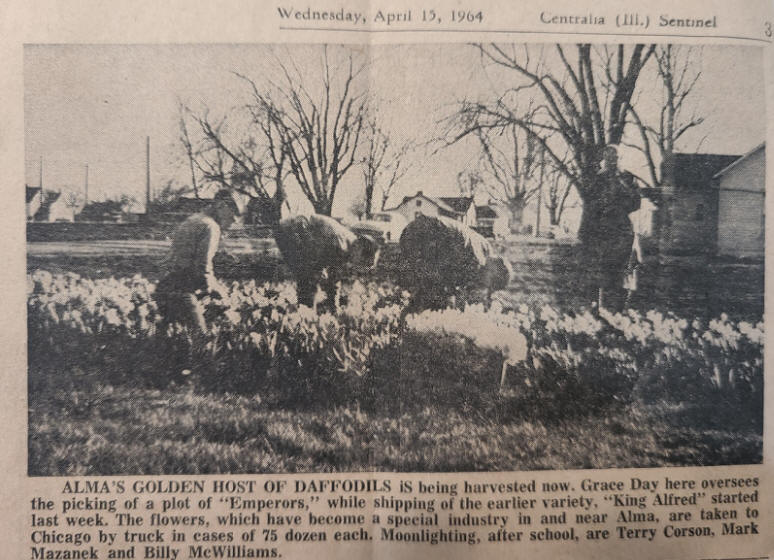
(From the Jim Hester Archives: “In a newspaper article sent to Nellie Jo MAZANEK by her father, Joe MAZANEK, about 1965, the following information was detailed.”
“PRODUCE INSPECTOR RECALLS DAYS OF ALMA MELON BOOM” (ca 1965)
“SAYS FARMERS COULD GROW MELONS AGAIN.”
“The time is ripe for farmers to try growing cantaloupes again” according to Andrew ROSS of Alma, the son of the man who introduced the famed Alma Gem melon to the area 75 years ago.
Ross, 82, is a federal produce inspector who is currently inspecting strawberries shipped from the C.S. WOOTERS commission house here. He was raised in the fruit business. His father and brother both had nurseries and orchards, and they raised cut flowers. ROSS himself owned a pear orchard at Alma until about 1901.
SEEDS FROM TEXAS
His father, William S. (Uncle Billy) ROSS brought the melon seeds from Texas in 1885. His success in growing the small, green, netted skin melons prompted hundreds of other farmers in the Alma area to start growing melons. The crop flourished more than ___ years until a rust disease wiped it out. It developed because farmers failed to rotate their melon crops.
Normally, the melon harvest season extended from late July until frost. When the rust came in the early 1900’s, farmers were lucky if they could get one or two pickings before the rust killed their vines. Often the vines died before a crop could be produced, Ross recalled.
RUST KILLED INDUSTRY
He theorized that when population of anything, animals, birds or plants such as melons becomes too heavy in an area, a disease develops to thin them out. “The melon growers should have practiced crop rotation to keep the soil cleaned out.” he said.
A neighbor of the ROSS family in Texas introduced the melon variety which later became known as the Alma Gem, ROSS recalled. This farmer crossed a Hackensack musk melon with a pomegranate and a cucumber. All of these plants are from the same family, he explained.
Breeding was accomplished by cross-pollenization - - that is, pollen from one plant bloom was sprinkled on the bloom of another. The Hackensack melon, a cantaloupe the size of a small water melon, was chosen for its netted surface. The pomegranate was chosen for its size, flavor and smell. The result was a small, webbed-surface melon about the size of a softball. It had the pleasing smell of a pomegranate and a sweeter flavor than the Hackensack melon.
ROSS’s brother, J.W., sold melons his family raised in the nearby town of Gainesville, Texas. When the family moved to Alma, they planted a half-acre of melons. They shipped two barrels of them to Joe Spies, a Chicago produce broker.
SOLD TO THE PALMER HOUSE
At first, SPIES’s customers were reluctant to buy them, for these were the first melons shipped to Chicago. SPIES send a telegram to W.S. ROSS asking him what to do with the shipment. Before he could receive a reply, a buyer from the Palmer House hotel restaurant tasted one of them and bought a barrel for $5.50. The restaurant man later requested all the crop he could get.
The Alma melon business was on its way. Neighboring farmers bought seed and planted their own crops. In 1886, ROSS had 20 acres of melons, and his acreage was destined to reach 80 acres, his son recalled.
Around 1895, the Alma Shippers Association was formed. It provided an inspection service for farmers at Alma and at the Chicago terminal market. It also secured lower freight rates. It copyrighted the name Alma Gem.
2,000 ACRES OF MELONS
By 1904, the Association had 2,000 acres of melons under its control. ROSS recalls that 38 carloads daily were shipped to Chicago during the harvest season. The cars left about 1 p.m. and arrived in Chicago 6½ hours later. The melon industry contributed $70,000 annually to Alma’s economy.
Melons were a high value cash crop. Sixty years ago, the cash return per acre was $100 to $200. ROSS recalled farmers got 60 to 65 cents per basket for melons in normal years. Each basket held about eight average sized melons.
SUGGEST CROP NOW
“Almost any soil around here would be good for growing melons,” ROSS said. “Farmers need to fertilize each hill. The best fertilizer we had was rotten horse manure. It has a high ammonia content. But since it is no longer plentiful, a farmer’s best bet today would be to use commercial fertilizer.
ROSS left Alma in 1898 and joined the Army during the Spanish-American War. He then attended osteopathic college and practiced his profession for two years. The wanderlust bug bit him and he went prospecting in Arizona and New Mexico.
About 18 years ago, he began working as a produce inspector for the Federal Government. Inspecting strawberries, peaches and apples grown in Southern Illinois keeps him busy during spring, summer and autumn months.
“Most of the fruit growers are reasonable and try to sell only good quality fruit,” he observed. “Most mistakes made in packing result in ignorance of grades rather than intent.” Strawberries, he said, are difficult to grade. This crop is highly perishable and color is not definite. Berries getting a good grade at the shipping point can lose quality fast during a 200 miles haul if a hot spell comes.
Ross lives in Alma with his stepson, D.B. GAMMON.”
Aug. 16, 1966 – Salem Times-Commoner; The Times-Commoner Reporter Visits ALMA
"D. Purcell is Expert on Alma Lore"
"Dwight Purcell is believed by his neighbors to know all the folk tales that ever grew up around Alma, even if they occurred before his time, which dates back 75 years. Purcell, who said he was related to all the Purcells in the countryside, has spent his life in the Alma area and says that while some of these tales are true, some are, of course, fiction. Haunted houses and even haunted bushes he’d heard about in the area but he’d never paid any attention to such foolishness. Some of the country boys used to be afraid to come into town to pass those haunted bushes, and told some wild stories about happenings to innocent passers-by, but he’d never believed them and so never had any trouble. But the “Hungry Nine” were real. Today they would be called hoodlums. They were nine tough young fellows who wouldn’t let any country boys come to town. They threatened the country boys with everything they could think of, but one day, one sneaked by. They beat him up so badly that he spent a month in bed. This frightened them, Purcell said, so they gave up. But that was long ago, and Purcell assured us that no such element lives in or around Alma now – nor has for quite a while. He also hear about the “Silly Six” which were he says, just what they sound like, six silly women.
A vigorous man, whose great-grandfather Purcell fought the railroad, Purcell lives in an attractive little home with his charming wife in town, having moved in, as many retired folks do, from the farm. What great-grandfather Purcell objected to, was that the railroad, which came through in ?1850, cut crossways through his property, which was one of the biggest cattle ranches in the area. It extended from the present Alma down to Brubaker road and east, and goodness where else. But after the railroad cut up his ranch, he sold his cattle and never did another thing for the rest of his life, according to his great-grandson. Alma has had three names, says Purcell, but he can’t recall what the first one was. The second was Rantoul. It was once suggested that the town be named after one of the local landowners, but he refused. Alma is the third name, but Purcell doesn’t know how it got that one.
Although he used to go to all their family reunions down in Salem at the park, he doesn’t anymore, since his eyesight is impaired. Some years ago, another Purcell told him he ought to go down just to see one of the more prolific branches of the family. He did, and still shakes his head over it. How many do they have now?, he asked. We had to admit that we had lost track.
Purcell is an interesting, humorous, and informative man to talk to. He has a storehouse of memories about the history of Alma and it’s families. Even the elderly women who have spent their lives in and around Alma also will immediately refer anyone to Dwight Purcell as the man who probably knows, if anyone does, about something out of the historic part of Alma."
24 Members Working in Lions Club
Although a newly organized club, the Alma Lions, chartered in February, have gone a long way toward fulfilling the goal of community services that characterizes the Lions. Sponsoring Santa Claus at Christmas time, an Easter egg hunt, and a new Boy Scout troop are among their major accomplishments. When the group was formed last fall, their first public effort was a ham and bean supper to raise funds for undertaking their various projects. As a result of this successful endeavor, they acquired some working capital for the community projects to come. For the first time, the Lions brought to Alma it’s own Santa Claus, who came riding into town on a sleigh known in other seasons as a fire truck of the Kinmundy-Alma Fire Protection district. Santa strolled throughout the business district, spreading Christmas cheer among the children during the yuletide season. When Easter came, a traditional Easter egg hunt was arranged by the Lions and about 150 youngsters scrambled for eggs and prizes.
Although there has been a Cub Scout pack going in Alma, it has been awhile since there has been an active Boy cout troop for the Cubs to move up to. So the Lions are now sponsoring a Boy Scout troop, which meets at the community center. Their next job is to retile the floor of the city hall, or new community center, and they need to raise more funds for that, as they do not have enough left from last fall’s supper proceeds. The Lions, in seeking ways to raise money, must look for some way that won’t conflict with what some other group is doing, for otherwise they would not doing a community service.
The Lions have 24 members right now from among the men of the community. Bill Hester is president, and has three vice-presidents, Gerald Mulvaney, first; Robert Ford, second; and Howard Downey, third. Other officers are Ernest Broom, secretary; Lester McWhirter, treasurer; Bill Beard, tall twister, and Robert Williams, lion tamer. President Bill Hester, who has lived in Alma all his life, occupies with his wife the house where he and his brothers grew up and “batched” with his dad, his mother having died when he was small. Among his early recollections of Alma include when there was a grading down at the railroad track which slowed down the trains when they tried to puff uphill, especially when they had a load. When this occurred, a load of hobos would roll off the train and come over to town looking for a free meal. His dad, says Bill, never turned a man away hungry. He fed everyone who came, because, he said, although may be only one out of ten might deserve it, he had to feed the other nine to find the one. Bill’s office, where he handles his real estate and insurance business, is in a little house out back where he has the congenial company of two gentle dogs, a tan cocker and a yellow and white hound. When we visited, he had an addition to the ménage – his grandson, Kelly, an energetic little fellow with bright brown eyes.
Bill can see ways in which the new Highway 57 north can hurt Alma. One way is by taking traffic off Highway 37. Alma gets a lot of business from 37, Bill says, and much will be diverted to the other highway. Also, many arterial roads will be cut off out in the county and Alma will lose from that. If Alma loses business, the Lions feel it is up to them to help the community find other ways to promote business and interest in the town. These ways are often discussed at meetings, and as time goes on and the club progresses, no doubt they will succeed. For Alma, the Lions serve a similar purpose to what a Chamber of Commerce does, in some ways, because in seeking community betterment, they are, also looking to improve business for the town in general.
Alma Senior Citizens contd from page 1
….Christian. Then they combined, formed the present organization and elected officers. The original two groups first met two years ago. An average of 25 members attend meetings, though they have at 10 to 12 more who come occasionally. Most of the members are women, but there are around 10 men. Officers are Mrs. Beryl Smith, president; Mrs. Ruth Wilson, Vice President; and Mrs. Mary Hines, secretary-treasurer. The center as such is already in use by the Senior Citizens, the 4-H Club, the Boy Scouts, and other civic groups are expected to meet there. In the fall, the Lions Club is anticipating finishing the floor with new tile. Meanwhile, the Lions are studying various means of raising the money for the undertaking. A big picnic cookout was enjoyed last month by the Senior Citizens at Forbes State Park. Nineteen attended and hamburgers and wieners were barbecued for the occasion. The next big Alma event planned by the group is a picnic supper on Friday night, Aug. 26, served out in the street in front of the city hall. The street will be roped off and tables and chairs set up in that area. The main dishes to be served that evening are chicken and noodles and meat loaf. Serving will start at 5 p.m. and continue until the food runs out, which is usually around 7 p.m. Price is $1.25 for adults and 50 cents for children under 12.
Alma Methodist Church Ladies (Picture included)
Seated, from left, Stella Laswell, Sadie Foster, Hazel Maxey, Jessie Cole. Standing: Emma Rainey, Ina Middleton, Linnie Polanka, Lulu Owen, Mary Hines, Grace Bailey, Agnes Bee.
Prepare for Annual Bazaar: The big event of the year given by the Ladies of the Alma Methodist church is the annual bazaar and dinner. This year it will be on the second Saturday in November, and it is for this that the women have been quilting all year, besides making quilts for other people. In addition to the quilts and quilt tops, they will offer dresses, aprons, pillow slips, yard goods and food choppers for sale. The bazaar will be at the town hall all day with doors opening at 9 a.m. Lunch will be served starting at 11:30 a.m., consisting of soup sandwiches, coffee and pie. Sandwiches and coffee will also be served later in the afternoon. Proceeds from the bazaar always go to getting something for the church. Recently, the group has bought new stained glass windows.
Alma Christian Church Gleaners Class (Picture included)
Standing: from left: Ima Jean Feather, Ruth Wilson, Flossie Altom, Lottie Getts, Ann Arnold, Edith Johnson of Peoria (not a member, but visiting daughter of member Mrs. Mazanek.) Back row: from left, Hattie Green, Essie Mazanek, Allie Eagan, Emma Wiley.
Lower row: from left, Elsie Smith, Grace Day, Beryl Smith, Lelia Schoonover.
Although the quilters at the Christian Church in Alma are often referred to as the Ladies Aid, they are actually the women of the Gleaners Class. The Ladies Aid, as such, disbanded about 4 years ago, and the Gleaners took over the quilting and other money raising projects. Whatever the name, the purpose is the same, to help the church, and so there is continuity to the work started 66 years ago in 1900 when the group was first formed. Next year marks the 100th anniversary of the Christian Church in Alma, the oldest church in town, and there is already talk of a celebration. Besides quilting, the women hold a bazaar and dinner annually, the first Saturday in December. Handmade rugs are also sold. Proceeds go to obtain needed items for the church. A new piano and carpeting are two outstanding contributions the women’s group has made through their efforts. The Gleaners Class, which meets on Sunday, is composed of men also, and their teacher is Marvin Bassett. An average of about 14 women usually turn out for the weekly quilting on Wednesday afternoons, and some come as far away as eight miles to be with them. Mrs. Lottie Getts, president of the quilting circle, has a picture of the original Ladies Aid taken in 1900. It is of great interest to all because some of the women show are mothers or grandmothers of some of those in today’s group, and the rest, except one, are known to them. Officers of the circle are Mrs. Getts, president, Mrs. Flossie Altom, vice president; Mrs. Ann Arnold, secretary; and Mrs. Eleanor Whitson, treasurer.
Sept. 22, 1966 – Salem Times-Commoner; The Times-Commoner Reporter Visits ALMA
Alma Grade School Has Up-To-Date Facilities
A visit to the Alma School is wonderfully pleasant, and it must be a combination of factors that make it so. Situated in a lovely location out on the edge of town, overlooking green fields on one side with horse grazing across the road, and shaded by fine old trees on the other side, the Alma School is bright and cheerful, with it’s well-equipped playground carpeted throughout with good grass.
Well-mannered children patter down the corridors so quietly that their movements are almost imperceptible. Table manners in the lunch room are excellent, and classroom deportment seems remarkably good. Although there are 104 children in the Alma School, with two more coming in this week, they are certainly quiet and respectful in school during the times they are expected to be. They know the rules and abide by them. As small a school as is the Alma unit, it has a wealth of good basic educational materials, such as one expects to find only in larger schools. It’s filmstrip library is quite up-to-date, with strips on a wide variety of subjects – jet planes, spacecraft, foreign lands, art, mathematics, language, and everything relating to materials studies in the classroom plus some additional “enrichment” materials. A good movie projector, film strip projector, an opaque projector, a tape recorder and record players are available to the teachers to enhance their classroom work. Several microscopes are there for science in the sixth grade. Many audio-visual aids have been donated by their very active P.T.A. A new school library is a welcome addition to the Alma School. It was started last summer and is still in the process of being installed by the principal, Mrs. Nellie Williams, assisted by two of her teachers, Mrs. McClelland and Mrs. Ross. Attractive, colorful and appealing books for all grade levels and all reading levels, relating to all subjects taught in the school, are now on the shelves and more are being added all the time. Since there is no public library in Alma where the children can obtain books, and no library closer than Salem, this new library will be a great help to Alma’s children.
Mrs. Williams has been at the Alma School 15 years, and the past three of those as it’s principal. She also teachers fifth and sixth grades. This past summer a new remedial program was brought to Alma School children, reading, math and speech. These were taught by Mrs. McClelland and Mrs. Ross, with Mrs. Williams as director. Alma School has four teachers – Mrs. Williams, Mrs. McClelland, Mrs. Ross, and Jim Woods. Woods is the brother of Raymond Woods, the new superintendent of Odin School district. In two rooms, two grades are taught, but in the two others, one grade in each. This arrangement changes from year to year, depending on the number in each grade. At present, first grade is taught alone and so is fourth. Under this system, there is no overcrowding in the classroom – the larger grades are alone.
The Alma unit, as a part of the Kinmundy-Alma school system, is able to share in many benefits. Among these are the music teachers, Mrs. Leach and Mr. Murphy, who come over to Alma for music classes. Band students are transported to Kinmundy by bus for band practice, but individual instrumental instruction is given at Alma by Murphy and Mrs. Leach has her music classes at Alma too. Mrs. Leach’s classes are varied – the children have music appreciation as well as singing. When we visited, they were listening to a record by Hizzel and were asked to tell what it sounded like to them. They listened intently and then offered their interpretations. Mrs. Leach said the interpretations vary greatly from grade to grade, with the littlest ones hearing fairies and elves dancing, while the oldest students will instead hear large animals or other large objects. Apparently the small ones think small and the larger ones think big. Alma’s music room is well-located up on the top level of the building so that sound does not carry easily downstairs to disturb the classes.
The Alma building is an interesting combination of the old and new. The new addition was built in 1955 and is the part of the building which gives the overall impression of the school. It is of course modern, designed with plenty of light and air, conveniently arranged, and completed with a sparkling stainless steel kitchen. The gym serves as both cafeteria and auditorium, and a nice stage is provided for performances. Hot lunch is served to the children in two staggered lunch periods. The younger ones eat first and then go out to play. After a short cleanup period, the older ones come in. Each lunch period has three 6th grade helpers, who assist the children in various ways, and then clean up afterwards. They seem most efficient, and take their responsibilities seriously. This privilege of being a server changes periodically so that everyone may have the opportunity to serve. The kitchen lunchroom are preceded over by Mrs. Phillips, a pleasant woman who takes a real personal interest in the children. The older building, which has been blended onto the new, can be seen when one mounts the stairs to the music room. Two other classrooms are in this part, second and third grade, and fourth. This older building was once a college, we are told, many years ago, and later a two-year high school. It is in good-repair, however, and serviceable. (DFM note: The college was down the street in a different building which burned years prior.)
Mrs. Williams has not always taught at Alma. Her first teaching assignments were in country schools, and she has taught near Salem at a country school east of town. At one time she lived in Salem at the county jail when her husband was deputy sheriff. However, she and her family seem to consider Alma their home. The Williamses have four grown children, three daughters and one son. Two daughters live in Alma, and three granddaughters are attending Alma school. The son lives in Pana, and the other daughter in Neenah, Wisc. A Williams grandson will graduate from high school there next year. Mrs. Williams’ preparation for teaching was obtained at McKendree College where she received her B.A. degree. Ever since then, she has been busy, she says. The daily time we could see Mrs. Williams was during her “free” period which occurs Tuesdays and Thursdays, half-hour at a time, when her class goes to music. But Mrs. Williams is a person of quiet charm who takes time to be patient and considerate. In her classroom, the children seem eager and interested, and certainly respectful. Some of their science drawings were displayed on the board, illustrating different types of cells found in animals. They have not yet seen these cells under their microscopes but the soon will, Mrs. Williams said. They enjoy their microscope work, using mostly prepared slides. But sometimes they bring in some pond water and have live – and lively – specimens to look at. The pleasant atmosphere at Alma School is surely felt by any visitor. The children must be happy there, while studious and orderly, because they are relaxed as well as attentive. Mrs. Williams attributes their good conduct to the Alma community pointing out that the attitude of the people helps set the tone of the school. We think that the teachers must have a great deal to do with it, too, as well as the administration, but perhaps these factors work together, as the whole is equal to the sum of its parts.
The school board of the Kinmundy-Alma district consists of Floyd Jones, president; John Shaffer, secretary; and Ivan DeVore, Dale Hulsey, Edward Jezek, Eugene Mulvany, and Andrew Winks. Jezek and Winks are from Alma.
(A photo was included “Alma School Principal Nellie Williams.)
Alma School Scenes:
1st photo: Alma Grade School students in music class.
2nd photo: Energetic youngsters enjoy recess.
3rd photo: The school day includes a ball game too.
4th photo: The kids show a hearty appetite in the cafeteria.
Alma Has Active Scout Troop
Eight energetic Boy Scouts have been busy making money for their troop these past few weeks, and now Alma’s Boy Scout Troop 272 is $32.75 richer than it was. To raise funds to carry on an active Scout program this coming year, these eager boys undertook, as their first money-making project, to sell subscriptions to the Times-Commoner and brought in 13 near yearly subscribers and seven renewals. Roger Purcell won the $2 prize offered by Scoutmaster Jerold Mulvaney for bringing in the most. At their last Scout meeting Wednesday night, Roger was pronounced winner for having gotten seven subscriptions. Sponsored by the Alma Lions Club, the Boy Scout troop is going into it’s second successful year and is expecting some new members soon who will be moving up from Cubs. These Lions are the troop leaders, although the original intention of the Lions Club was only to sponsor the troop, not to provide the leaders also. However, since other leaders could not be found, so it was up to the Lions. So Lions Mulvaney, Ernest Broom, and John W. Ford have taken over the leadership. Broom and Ford are assistants to Mulvaney.
The Scouts’ next fundraising efforts will be a bake sale next Saturday, Sept. 24, at the town hall starting about 9 a.m. and continuing until sold out. We suspect, however, that the mothers will do the baking, although we hear that on their camping trips to the lake this summer, the boys did their own cooking. Another money-making project in the offing soon, Scoutmaster Mulvaney said. The boys are going to pick corn and sell it to a nearby elevator. About 500 acres will be made available to them by two of their leaders, Broom and Ford, who are farmers. The corn will be what is left after the mechanical corn pickers have gone through the fields. Apparently considerable corn is missed by the pickers and the boys are invited to take the rest and sell it for what they can get. Tractors and wagons will be donated for the collecting and hauling so the boys will have clear profit. Meanwhile, between all these business endeavors, the boys are going on a five-mile hike and will be camping out again on the island at Forbes State Park. They have already spent some time this past summer on the island, clearing it for a campsite, and they expect to raise a flagpole there in the near future.
As winter approaches and outdoor activities are not so feasible, the boys want to start on some handicraft, perhaps with leather and wood. As supplies and tools for these undertakings cost money, this is where some of the money will go that the boys have been working for this fall. The troop meets on Wednesday nights at 7 o’clock at the town hall, and though it was raining when we were there last week, all were present but one. Any boys in the Alma area who are interested in Scouting are welcome to join Troop 272, even if they have not previously been Cubs.
(A photo was included: “Alma Boy Scouts: Last row, from left, Ernest Broom, John W. Ford, and Jerold Mulvaney, leaders. Second row – from left, David Higginson, Larry Hall, Mike Pannell, David Purcell. Front row – from left, James Broom, Virgil Higginson, Roger Purcell.)
May 23, 1967 – Salem Times-Commoner; The Times-Commoner Reporter Visits ALMA
"Earl Allmon - Old Timer Recalls Alma Highlights" by Diana Smith
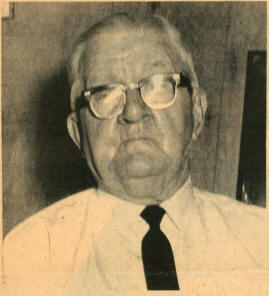
"In 76 years, a fellow sees a lot of things happen, but certain ones stands out more than others in his mind.
That’s been the experience of Earl Allmon, Alma’s busy barber, who has lived in and around Alma for more than three quarters of a century.
One vivid picture that has stayed with Allmon all these years was in 1898, when he was a boy, during the Spanish-American War. About 15 or 20 volunteers from Alma were standing on the railroad platform, waiting to leave, and the Alma band played a stirring farewell tribute which was apparently very moving to all. He still remembers the tears in the eyes of those boys as they listened to the band play, right before they left.
His happy school days at Happy Hollow over on Brubaker Road, when they moved outside of town, also left an impression on Allmon. His teacher was Harry Rainey, a farmer in the Brubaker community. There were about 60 students enrolled in the eight grades at the time, the biggest enrollment the school ever had, he believes.
The big fire in 1908 which destroyed Alma’s business district is another sight he hasn’t forgotten. He can still recall the piles of merchandise and canned goods in the streets where they had been moved hurriedly out of the stores. As all business buildings on both sides of the streets were wooden structures, they all went up in flames and every business was burned out. It was never rebuilt quite the same.
Acres and acres of pears, muskmelons, peaches, apples, tomatoes, and flowers are a sight still fresh in Allmon’s memory, when Alma was a fruit and flower center. Long lines of wagons winding down the street and around the corner, waiting to get to the depot, are something he well remembers.
"Our muskmelons were sweet and nice, with a small center," he reminisces. "I’d like to have one now. They were called ‘Alma Gem’"
There was even a canning factory in Alma then, but it burnt down one fourth of July when some fireworks set it off. There was also a basket factory and a pickle factory.
Alma had three different names - Mound City, Rantoul, and then Alma. It was finally named "Alma" because of the Battle of Alma in the Crimean War, says Barney Craig.
We couldn’t figure out how the Crimean War got over here, but Craig believes the name was bestowed by one of the early settlers, Uncle Billy Ross, a preacher in the Christian Church. Uncle Billy was of British background, probably Scotch, judging by the name. He also helped establish the fruit and flower industry here because he brought the original seeds and bulbs for the pears and Easter flowers.
Uncle Billy brought the Christian Church here too, and no doubt was influential in establishing the Christian Church College in 1896 for training preachers. Part of the old cottage building is still in use where Alma Grade School now is.
Uncle Billy brought the Christian Church here too, and no doubt was influential in establishing the Christian Church College in 1896 for training preachers. Part of the old college building is still in use where Alma Grade School is now. (DFM note: The Alma Industrial College wasn’t a college for training preachers, although it was started by the Alma Christian Church and supporters such as Billy Ross. Also, the old college building burned down in the spring of 1912. It was used for about 11 years as the Alma Public School, but a new building was built after the fire on the Alma property.)
Allmon has been active in town affairs over the years in various ways, and was town clerk for 12 years. He is now a member of the Senior Citizens, one of the most energetic groups in town, and has missed only five Sundays from church in the past 15 years. He has been a devoted gardener, but is giving up gardening now. He still has beautiful flowers in his barber shop from his garden, however.
Although Allmon and his wife had no children of their own, they adopted a little girl. Later, after she grew up and married, they adopted her son and raised him. The son died just a few years ago. Allmon is now a widower and lives along.
“I don’t get mad at anybody,” is Allmon’s philosophy, and he must have a lot of friends as a result. He can’t see why people should fight and argue. They can discuss and even disagree, in a friendly way, but there’s no need to get mad, he says.
Allmon is a great town booster. “We’re proud of our streets here,” he points out. “All hard surface.” And he quickly enumerates many of the other advantages Alma has, the stores, the restaurant, the new post office.
Probably Alma’s greatest asset, though, is its good people.”
"Sesquicentennial of Marion County, IL (1823-1973)"
Alma History
Alma is located on State Highway 37 and the Illinois Central, in the midst of what used to be a big fruit-raising area, known far and wide for its peaches, pears, and apples. One of the largest and most modernly equipped packing sheds in the state was located in Alma in the 1930's.
The village was laid out in 1854 by John S. Martin. Originally named Rantoul, it was discovered another town in the state had appropriated that name, so it was changed to Grand Mound City, but in 1855, the name was once again changed - this time to Alma.
The first storehouse was built in 1853. Smith and Hawkins conducted the first Blacksmith shop, and John Ross operated the first grist mill. Rev. Jefferson was the first Methodist preacher and Rev. John Ross was the first Christian minister.
On December 28, 1908, fire broke out in a large hay barn and destroyed the entire business part of Alma. Several stores, warehouses, shops, and restaurants were burned. Before the ashes had hardly cooled, preparations had been made to reconstruct the buildings with brick.
In the spring of 1908 the large fruit cannery of Doctor Shrigley was burned and was a serious loss to the community.
The Ross name has been associated with Alma history since shortly after the founding of the village. The family of Wm. S. Ross, father of J.W. Ross of Centralia, came to Alma from the northern part of Illinois in 1866. In 1871, the Ross family moved westward, eventually settling in Texas where it remained until 1885 when the family returned to Alma.
In 1881, the netted German melon, a small, oval, heavily netted, green-fleshed fruit, was first introduced to the public. This variety was destined to revolutionize the melon industry of America. It was tested for a few years and in 1885 was grown for market in a small way by Wm. Ross at Alma and J.W. Eastwood of Rocky Ford, Colorado. The melon seeds had been brought back by the Rosses from Texas.
Having more melons than the local market could consume, he shipped two barrels to Chicago in August, 1885. These were the first melons of this type ever seen in the Chicago market and they were the occasion of considerable amusement on South Water street where the barrels were opened. The melons seemed ridiculously small as compared with the Hackensack and other melons then on the market. However, after the flavor had won the approval of customers, the melons were readily sold.
The next year Ross planted 20 acres and a few years, later 90 acres. Soon a number of his neighbors began planting and the industry grew at Alma until the shipments reached from 10 to 15 carloads per day.
As other parts of the state began growing the melons, the people of Alma began raising fruits, principally pears and apples.
Alma Township was originally prairie, but nearly all of the land is now under cultivation. The Illinois Central passes the northwest corner of the township while the Chicago and Eastern Illinois Railroad crosses it from the north to the south.
The Baptist built the first church in the township in 1848. It was a small frame house. Rev. N.R. Eskrid was the minister.
The first school was held in an abandoned cabin and was taught by Isaac Kagy. The first school was built in 1842 on the site of the Pleasant Grove Methodist Church.
In 1841 John Hammers opened a strip coal mine on a vein two feet thick but when the railroad brought coal to Alma, the mine was abandoned.
In 1938, Alma had three general stores, each employing three persons, two restaurants, four filling stations, a lumber yard and several other establishments. In addition to its fame as a fruit growing center, Alma was also known for the flowers raised in the area.
.jpg)
.jpg)
.jpg)
"Salem Times-Commoner"; Salem, IL
"A Peek at Our Past" by Dr. George Ross
Alma, the early years
Of the many communities in Marion County, it appears that Alma has maintained a continuous unique character throughout the years - its citizens have been a thrifty, independent, hard-working people whose love and respect for the land when coupled with muscle and sweat have brought forth the best of that which Mother Earth had to offer. So it was from the beginning; the Wantland brothers - Marshall and John - the first settlers in the township, carried with them a spade, turning over the earth as they traveled from Tennessee in 1826, and stopping in Alma where they said they found soil which had no equal. Other early township settlers included James Beard (1830), James Chance (about 1832), Letitia Duncan (1833), William Tully (1835), Thomas Berthert (1836), Peter Bretz (1838), Solomon Smith (1836), Wiley Garner (1836), Jeremiah Allmon (1836), John Lynch (1837), John P. Wilson (1837), Robert Phillips (1839), Tunis A. Spitler (1840), J.W. White (1841), Samuel Wilson (1842), and John P. French (1855). The standard histories indicate that Rutherford, Gillam and James Duncan, sons of Letitia, widow of a veteran of the War of 1812, improved the first farms in Alma Township. Dr. Isaac Kagy taught the first school in 1840 in a deserted log cabin on the Marshall Wantland farm. It was a subscription school and the teacher was usually paid in either local products or services. Bishop Roberts preached the first sermon in the township in 1841 at the Pleasant Grove schoolhouse. The Old School Baptists built the first church in 1848 with Nathaniel Eskridge as pastor. William Tully built the first mill (operated by horse power) in 1836. John Beck kept the first store in the township beginning in 1851 at the home of Squire Siple. E. Heaton operated the first dairy, winning the blue ribbon for his cheese at the State Fair in Central City in 1858. According to Brink-McDonough, "John Cunningham introduced the first blooded horses, English Draft, ‘Falcon’, about the year 1852. Durham cattle were introduced by John and Andrew Hite in 1840. Hogs of the Berkshire breed were first brought here in 1841. In 1856, Thomas White introduced the first graded sheep of the Southdown breed." Early justices of the peace included Solomon Siple, Tunis Spitler and John B. Abbott. Josiah Hull built the first carpenter shop about 1850, and the first blacksmith shop was erected by Jacob L. Smith in 1841. John Hammers uncovered a two foot vein of coal, six feet below the earth, in Section 10. It was worked from 1841 until coal was brought in by the Illinois Central Railroad in the late 1850's. When townships were formed, this was known as "Pleasant Township", but was soon changed to Alma.
Surnames of families living in the Alma area in 1860 besides those previously listed include Ange, McCullough, Micheal, Mitchell, Galman, Beaver, Berry, Furry, Foster, Finley, Hoss, Huster, Warner, Powell, Allen, Hults, Sheifer, Griffin, Rose, Hartley, Alexander, Winks, Hudson, Cope, Harlin, Oyler, Sabin, Davis, Mast, Simmons, Houton, Newson, Wilhoy, Literal (Luttrell), Harris, Howard, McCarty, Haden, Cummings, Daniel, Patterson, Burrows, Wilky, Beats, Elder, Crane, Brown, Miller, Marcus, Stokely, Heaton, Bodine, Larydale, Purcell, Craig, Branson, Merrith, Clow, Senprenand, Beaudin, Slane, Tilden, Winings, Shepherd, Spencer, Adams, Bass, Martin, McConnel, Cowden, Taylor, Malone, Graves, Rush, Hainy, Bond, Hughes, McGuire, Arnold, Lovell, Cantine, Simonson, Davis and Baker.
"The Village of Alma is in the northwest part of the township on sections six and seven, and was laid out and platted in 1854 by John S. Martin, with additions by J.S. Martin, M. French, and Samuel J. Tilden. It was at first named ‘Rantoul’, in respect to a railroad official, but as there was a town in the state by that name, the post office was called ‘Grand Mound City.’ In 1855, the name of Alma was given to both town and post office," according to Brink-McDonough. It is believed that it was named for a battle fought in the Crimean War. Dr. T.O. Hatton, who was the first physician and postmaster, built the first store house in 1853. The April 19, 1855, Salem Advocate contains an advertisement announcing the opening of John S. Martin’s new store in Alma. Mr. Martin was the father of four Civil War veterans - Gen. James S., Capt. Robert, and Pvts. Thompson G. and Benjamin - all who later lived in Salem.
Later additions to the original village were laid out by S. McCullough, L.C. Pullen, N.D. Laughlin and J.W. Ross. Later physicians living in Alma were Drs. J.B. Johnson, M.B. Lacey, Boisdell, A.J. Hays, Fred Wnorowski, Dean, and S.L. Laswell. The first post office was established in 1854 and in addition to Dr. Hatton, John S. Martin, R.C. O’Bryant, J.R. Slane, H.L. Allmon, C.M. See, T.E. Mapes, N. Warner, M.V. Hefton, Isaac A. Sprouse. H.F. Winks and T.B. McCartan were early postmasters.
The village took much pride in its school - four of Alma’s schoolmasters became county superintendents of school; Hugh Moore (the first teacher), J.B. Abbott, J.E. Whitchurch, and J.S. Knisely. A Miss Cooper was the schoolmarm in 1865 and Miss Hannah Dean taught in 1866. The first schoolhouse burned so another was erected in 1867. The first school directors were F. McConnell, J.W. White and T.W. Purcell.
The first church was built in the village by the Christian denomination in 1868 with Elder John Ross as its first pastor. The Methodist Church was built in 1871 under the supervision of the following trustees: Josiah Gibson, Richard Wilson, J.W. White, J.B. Abbott, and John R. Slane. The first minister in the village was Jefferson Hawkins, a Methodist. John Leeper followed.
In 1855, the first blacksmith and wagon shop was erected by Smith and Hawkins. John Ross built the first mill in the village in 1870 and it was both a grist and saw mill. The April 22, 1877, issue of the Salem Advocate tells that A.D. Tomlinson was operating the Tomilson House - the Alma hotel.
The Brink-McDonough history written in 1881 tells of Alma at that time, "The surrounding country is known to be an excellent fruit region. As many as two thousand boxes of peaches and three hundred barrels of apples have been shipped by here in one day. The population of the town is one hundred and fifty. The surrounding country is known to be an excellent fruit region. As many as two thousand boxes of peaches and three hundred barrels of apples have been shopped from here in one day. The population of the town is one hundred and fifty. The following shows the business of this enterprising place: General Merchandise - H.L. Allman; Millers - L.B. White and W. Perrin; Blacksmith - Granville Gammon; Painter - E.D. Johnson; Physicians - J.B. Johnson and M.B. Lacey; Grain Buyers - H.L. Allman and S.M. McCullough; Hotel - A. Tomlinson; Station and Express Agent - C.M. See; Shoemaker - A.F. Kline." J.R. Dunlap served as the township’s first supervisor in 1874, followed by J.H. Kagy, J.W. White and Tunis A. Spitler. The same publication lists, as prominent township farmers and stockgrowers, the following: J.W. Brown, W.L.S. French, Richard J. Holstlaw, S.M. Marshall, J.P. Shriver, G.W. Shriver, Andes Tulley, William D. Wilson, J.W. White, and Samuel E. White.
Activity and prosperity continued to increase in Alma and this will be covered in next week’s column, "Alma: The Middle Years."
Sources: (1) Brink-McDonough, "Combined Histories of Marion and Clinton Counties, 1881"; (2) Salem Advocate, April 19, 1855 and April 22, 1877; (3) Centralia Sentinel, August 6, 1910.
"Alma: The Middle Years"
"Salem Times-Commoner"; Salem, IL
"A Peek from our Past" by Dr. George Ross
For the first few decades, Alma remained a rather sleepy little hamlet with less than 100 inhabitants. It was probably W.H. "Uncle Billy" Ross who contributed most to bringing new life to the village. Ross came with his family to Alma from northern Illinois by way of Texas where he learned a great deal about horticulture. The June 3, 1887 issue of the Salem Herald-Advocate records that W.H. Ross and son have put in 90 acres of watermelons. Shortly after they produced a succulent cantaloupe, unique in both size and flavor which was dubbed the Alma Gem. The melons caught on in Chicago, resulting in a ready market. In 1890 the editor of the Salem Republican reported after visiting Alma, "At one time Monday, 125 teams were at the trains to unload melons. Tomlinson and McNeely shipped 105 baskets one morning and 65 the next out of the same patch of ground. In addition to melons, other fruits and vegetables were grown and shipped from Alma. The Centralia Sentinel of May 1, 1911, reports that "Alma is said to have 600 acres in apples, 400 in pears and 175 in peaches." The same article reports on the harvest of daffodils and the growing of tomatoes.
"Uncle Billy Ross was the man who started the flower industry in the Alma area. He made his first planting with Emperor daffodils, imported from Holland in the 1890's. For years he and his son, Andrew, had a forty acre field southwest of Alma," said the Centralia Sentinel on April 15, 1961. Peak acreage of the daffodils, which were shipped to Chicago, was about 75 acres. Charles and John Mazanek, Eugene and Andrew Winks, H.D. Krutsinger and D.E. Gammon were among those who grew these symbols of spring.
As Alma grew to become a harvesting and shipping center, other economic institutions developed. By 1889, R. Wilson was operating a molasses mill and in 1892, Isaac Maulding was operating a butcher shop and Warner and Mazanek had a grain purchasing and storing operation. By 1898 Alma had three factories which manufactured baskets for the picking and shipping of fruit run by J.R. Clow, L.C. Pullen and H.P. Winks. In the March 29, 1899 issue of the Centralia Sentinel we read that "Clow and Telford are erecting a cannery (which was in operation by August) which will employ 150 and produce 25,000 cans per day. W.S. Ross and R.G. Pullen have an evaporator which employs 30 hands. The Village Council has just put down sidewalks." On June 12, 1903, the Sentinel reports that Alma has a new Building and Loan Association with L.C. Pullen as president. During 1906 there was a flurry of speculation about oil in the Alma area. During that same year the bank opened at Alma with R.F. Mallott as president and Jesse Evans as cashier. In July of 1908, disaster struck when the cannery now owned by Dr. W. Shrigley burned to the ground with a total loss of over $25,000. The fire was caused by negligence in igniting a fireworks display. It was quickly announced that the cannery would be rebuilt but plans changed and Salem was chosen as the new location. By 1911, Alma had a grist mill, and in 1917 it boasted a pickle factory.
In 1896 it was determined that there would be advantages to the incorporation of Alma which was granted on December 10, 1897, according to the Marion County Democrat. The results of the first election, as reported in the January 13, 1898, Salem Republican, gave victory to M.O. Allmon (president), John Mazanek, H.P. Winks, J.R. French, G. Gammon and R. Edwards, plus a tie between John R. Ross and William Harvey as trustees. In 1902 Alma voted to continue as a "dry" town and elected J.R. Clow (president), J.T. Claytor (clerk), M.V. Hefton, N. Henthorn and John R. Ross (trustees). By the time of the 1910 census, the population of Alma had grown to 380.
In 1896, the erection of the Alma Township House was completed at Brubaker. Several farmers in the vicinity of Alma experimented with methods of maintaining good roads when automobiles became a reality. A "dragging" operation on these thoroughfares was conducted by George B. Wakefield, George Headley, Fillmore Nichols and Robert Lambert plus their faithful "teams".
Educational, cultural, and entertainment activities were not neglected during those years. In 1894, a minstrel show by a traveling troupe was performed at Pullen Hall. In September of 1896, the Marion County Soldiers and Sailors held its annual reunion and encampment at Alma. From 1896 to 1900 the Southern Illinois Christian College operated in the village, bringing with it a myriad of educational and cultural activities. Clark Braden, president of the college and a renowned debater, engaged I.N. White, one of the 12 apostles of the Mormons, in a verbal conflict in 1899. The Plow and the Hammer, a newspaper espousing the cause of the Farm-Labor Party, was published at Alma during the late ‘90's. In 1915 a new 17-piece brass band was organized by Walter McLeod and concerts galore were given for the pleasure of local citizens and those of surrounding towns. In 1916, Alma hosted its first agricultural fair which operated for several years as the county fair. Exhibited were farm animals, crops, products and ladies’ fancy goods. Thousands of county residents made their way to these pleasant gatherings. An Odd Fellows Lodge was instituted in Alma in 1897 and for many years was a social force in the community.
In 1900, a new Methodist Church was dedicated and in 1907 the Baptist Church was erected. The January 31, 1901, Salem Republican reports that "Religion sweeps Alma ... 66 have joined the Methodist Church and 31, the Christian." Revivals or protracted meetings were customary with the churches at this time.
Notice was given during the years to the disappearance of Alma landmarks. The March 9, 1914 Sentinel reports that "Alma’s oldest house - built in 1850 by Marshall French - is being torn down." The November 11, 1915 issue of the same newspaper tells that "Gammon is tearing down his old blacksmith shop at Alma which as built in 1864 by N.A. Winks as a residence for John Robb."
Alma’s greatest setback occurred on December 28, 1908, when the business district was swept by fire. According to the Sentinel, "The fire originated in the hay barn of J.R. Clow and was soon too hot to combat and the adjoining buildings were also soon in flames. There being no provision for fighting fires other than buckets and common pumps, the fire met little opposition in spreading. Alma, like most towns along the Illinois Central, is situated on both sides of the railroad right of way and the business houses were strung along facing the railroad ... The falling embers and intense heat soon had the buildings on both sides in flames." Losses were sustained by B.C. Pullen, Odd Fellows Lodge, Citizens Bank, J.R. Clow store and barn, E.G. Ford (hay), Mrs. Jennie Dean’s Restaurant, J.W. Broom’s store, Roy Gregory’s Restaurant, C.M. See’s store, Berch and Fuller’s Basket Factory, Charles D. Tomlinson’s Barber Shop and the post office. The Sentinel of March 26, 1910 records that "Eight new buildings are going up in Alma."
An article in the March 1, 1913 issue of the Sentinel described Alma of that date. F.B. McCartan was in charge of the school, assisted by his daughter, Elizabeth. The Alma Bank was operating with E.G. Ford as president, Joseph Mazanek, cashier, and C.M. See, assistant cashier. The town had four general stores, 2 hotels, 2 restaurants, 1 lumber yard, 1 livery stable, 1 basket factory, and 1 blacksmith shop. Three churches - the Methodist, Christian and Baptist were active. Owned largely by Sandoval citizens, the lumberyard was managed by R.E. Walters, J.M. Haslett ran the livery stable, J.W. Broom had named his general store the "Square Deal".
The same paper carried an account under the caption "Alma People Who Have Gone to the Front", and listed the following: Hale Johnson (Prohibitionist candidate for vice president in 1900), John Gibson, (amassed great wealth in land and railroads in the Philippines), George Shreffler, Drs. S.C., Samuel, J.D. and H.E. Wilson, Atty. W.F. Wilson, Jesse Kline (head of Y.M.C.A. in Wisconsin), J.H. Meneely (superintendent of schools, Brooklyn, NY), Alonzo Abbot (chemistry professor), Dr. Noah Dean, Dr. Clarence Lee, Zachariah Taylor, Thomas Clow, J.W. Ross, Thomas McNeill, Edwin Wormley, George McNeill, John R. McNeill, Samuel McNeill, Mark Ross, Walter N. Pullen, Charles McCartan, Charles Gammon, Rolla McCarty, A.R. See, Frank Coffin, Dorsey Sprouse, George W. Smith, H.P. Smith, T.E. Maulding, Roy Warner, Arthur Purcell, Charles Claytor, Joseph Mazanek, Rev. Clark Yost, Fred Clow, Bertha Purcell, Clara Hefton, Rhea White, Anna Roberts, Ethel Hefton and May Schermerhorn."
(Footprints in Marion County - Summer 1985; Vol X; No. 1)
"A Peek at Our Past" by Dr. George Ross; March 16, 1994
A Visit to the Alma Cannery
Early in the history of Marion county, its settlers began producing fruits and vegetables in abundant quantities. With the development of necessary equipment, canneries were introduced here. One of the first was introduced in Alma. This operation was described in the Salem Republican of October 5, 1905.
Alma citizens are justly proud of the Shrigley canning factory which as been in full operation there during the season just closing. This enterprise means much to the citizens of that village and the surrounding community. The vast sums of money that has been put into the channels of trade through the operation of this concern cannot be fully estimated until the season’s work in finished and there is a general summing up of details, which is no easy matter in a plant of such vast proportions.
"Imagine if you can, a string of wagons extending five or six blocks on a street in this city; not only that but they are standing two or three abreast, and off on a nearby vacant lot there is a jam of loaded wagons. The bringing of tomatoes to the cannery is likened unto a circus parade for there is a crush and jam and hurry that always accompanies such. Do you wonder that Alma prospering when such scenes have been the daily occurrence for months. The tomato growers are jubilant; the thrifty housewife is content for there is ample funds for the children’s schooling. This has been a wonderful season for Alma and the citizens round about have recovered from the effects of last year’s failure."
Dr. W.S. Shrigley, the proprietor and general manager of the cannery, is responsible in great measure for the abundantly prosperous times at Alma. He has provided a market for the products of the farm and given labor a chance to earn a weekly stipend. Everyone desiring work was given a chance, the amount of their earnings depending entirely upon their own efforts."
"A trip through a plant of this kind is worth going miles to see and it scarcely can be pictured. The first scene which greets a visitor is the weighing in and unloading of the tomatoes. The vegetable is contracted for by the bushel and 20 cents is the contract price. The grower who neglected to contract is not so fortunate as he receives only 18 cents per bushel. From the store room, the tomatoes are put through the scalding process and then carried to the peelers. For peeling, the price is 3 cents per bucket, and many of the ladies who do this work earn $1.50 per day. The fruit is then taken to the filler and then the remaining part of the work is done by the perfected machinery. The can is filled with the proper amount and then it is passed on to the capping and soldering process after which the can passes through a vat of hot water to ascertain if there be any leaks. If one is discovered, the can is taken out, resoddered and again tested. It is next placed in the processing tubs where the vegetable is subjected to cooking for thirty minutes, then removed to the warehouse, and ricked for ten days before labeling and shipping."
"The great ware room is already filled to overflowing but a few more ricks of shining cans are put in and this continues until a car is loaded for shipment. The immense amount of work, the untiring energy necessary to the successful operation of such an extensive concern cannot be appreciated. During the present run, 120 persons were employed daily and each one had a place to fill to make complete the full operation of the plant."
"The cannery has a capacity of 15,000 cans daily and nearly every day for three weeks from 1,000 to 1,500 bushels were consumed. Ten cars, with a capacity of 24,000 cans to each car, have already been shipped to market and yet the amount of stock on hand seems scarcely touched. The season has been an exceptionally good one and the plant will certainly be made to realize handsomely for the proprietor."
"The great burden of the work in this plant necessarily must fall on the superintendent and Dr. Shrigley is fortunate in securing the services of Freeman Eagan for the place. He understands the management of affairs quite thoroughly and he has been tireless in his efforts to keep the machinery moving so there would be no waste of time or material. The cannery is certainly a boon to Alma, and citizens of other places have cause to look on it with envious eyes."
In the spring of 1908, the larger cannery belonging to Dr. Shrigley burned to the ground - a serious loss to the village - a center of fruit and vegetable production.
(A picture of "Alma before the fire of 1909" accompanied this article.)
Salem Times-Commoner; Salem, Illinois; June 7, 1995
"A Peek at Our Past" by Dr. George Ross
Alma: Early 20th Century; Wagons lined up at Alma to unload "Alma Gems" melons prior to 1909
The village of Alma was laid out in 1854 by John S. Martin simultaneously with the laying of the rails of the Illinois Central’s Branch Line to Chicago. The settlement was located at the northwest corner of the township at a point said to be one of the highest in the area. This spot located on a ridge or divide gave excellent drainage of water to both the Ohio and Mississippi rivers. The population largely supported by the farming, fruit, and flower industries declined slightly in the village going 380 in 1910 to 366 in 1920 and then to 334 in 1930.
Alma, throughout it’s history, has been considered a patriotic village and township. It’s citizens have been quick to answer our nation’s call in times of war. In the four cemeteries located in Alma township - Alma Village, Mounds, Wilson, and Yost - and in Martin, which though lying in Foster township is the resting place of many Alma citizens, lie the remains of many who have fought and some who have died for their country. These include: an unknown soldier of the War of 1812; MEXICAN WAR - Alan Jones; CIVIL WAR - S.E. Shipley, C.L. Loyd, James A. Wilson, John McNeill, C.M. See, Early Marshall, Robert Sprouse, John Wilson, James Boyd, Dr. J.B. Johnson, James H. Shreffler, Joseph Shaffer, Louis Bender, Samuel C. Claytor, A.D. Tomilson, I.A. Sprouse, Nathan Winks, Isaac Maulding, John Wesley Spain, N.T. Stoner, Henry Sanders, Joseph Brown, Eli Headley, Thomas J. Boring, Vernal Prewitt, John Sprouse, George Mundwiler, W. Harrington, James Wright, George High, John Boring, Robert D. Easley, John A. McCarthy, J.M. Campbell, Francis Day, Obediah Thornton; Spanish-American War - Kirk A. Williams, John A. McCarty, and Arthur Shreffler; WORLD WAR I - Lester Dorr, Willie Reynolds, Andrew I. Ross, George McWilliams, Gordon A. Shreffler, James Arnold, Edwin B. Cheatum, John S. Ford, Walter Voyles, Otis G. Hines, William E. Williams, Sherman J. Lewis, Ernest Harris, Francis Ross Day, Oscar N. DeFord, John H. McIntosh, Benjamin Jenkins, George L. Clark, Edwin Boring Hopper, Archie C. Arnold, Charles Bee, Ralph E. Davis, Henry L. Powell, Frank M. Rainey, Joseph G. Bilek, James E. Campbell, John Doudera, Will Eagan, Frank Roller, Wm. L. Ruddell, and John Sanders; WORLD WAR II - Allen L. Brasel, W.A. Broom, Henry Hinkley Jr., Carl E. Purcell, Noah C. Williams, Wm. J. McWilliams, Loyd Hines, Calvin Coe Smith, Marshall A. Tolliver, Ralph E. Davis, Aaron A. Shreffler, Henry H. Hayden, Fred J. Moody, Bruce F. DeWeese, James H. Sanders, Lyle Shreffler, Bryant McIntosh, Harold J. Morris, Doyle Berry, George Black Jr., Samuel Casner, Merle Headley, Russell Howard, George McClurg, John Parker, L.T. Richardson, George Schuler, and Walter Slater; Korea - George Black Jr., Dwayne E. Butts, Charles L. Williams, and Doyle Berry; and VIETNAM - Douglas M. Shoreck.
Shortly after the Southern Illinois Christian College failed in 1900, the major building was sold to the Alma schools and was used until it burned in March of 1913. The Salem Republican of June 21, 1913, recorded that "Alma was building a new brick building school consisting of three rooms in two stories and costing $4,000. It is located on a five acre plot and will be ready for use in the fall."
"Alma Township", according to the Salem Times-Commoner in 1973, "consisted of two communities, Alma and Brubaker, and nine neighborhoods, generally surrounding schools. They were Shriner (northeast), Wilson (north central), Pleasant Hill (northwest), Happy Hollow (west central), Allen (east central), Elder (extreme east), Redlick (south east), Kagy (south central), and Union (south west).
The Alma Citizens State Bank which began operations in 1906 was held up in March of 1914, but the attempt was foiled. A second robbery on July 10, 1919, however was successful as was a third one in 1925 when $2,000 was stolen. The bank was forced to close in 1931 at the onset of the Great Depression.
In 1913 the old wooden sidewalks were replaced with new ones made of concrete and in 1915 the village installed 13 new gasoline lamps. The agricultural fairs first held in Alma in 1916 were moved to Matt Allmon’s grove in 1919.
Lilacs and Christmas trees were added to the list of Alma exports during the teens. W.S. Ross who was shipping the holiday trees gave one to every family in Alma in 1919.
C.A. Glore bought out the Henry Hall lumber yard in 1918, and it operated many years in Alma.
Much game hunting was pursued around Alma. In 1913 Mayor Carter Harrison of Chicago and the top officials of the I.C. sidetracked their private railroad cars while they hunted on the Joseph Telford farm west of Alma.
(A picture of the wagons lined up unloading melons was included with this article.)
"A Peek at Our Past" by Dr. George Ross
Alma continued to thrive as the 1920s began
Nestling among the fruit orchards of Marion County, Alma entered the ‘20s, the decade known for normalcy, with little fanfare. Although there was little indication of growth, the little village continued to thrive.
Local politics held a fascination for many Alma residents, and from time to time village elections became spirited contests. The local officials elected in 1923 included W.E. Donoho, president, and J.H. Yost, Nabe DeFord, W.E. Wright and Frank Day, trustees. Elected in 1925 were Jason Owens, president; L.G. Downing, treasurer; Q.E. Huchison, clerk; and Ira Jackson, Harry McCarty and Doc Slagley, trustees.
Both the grade school and high school in Alma were sources of pride for the community. Teachers included T.B. McCartan, Pearl McCartan, Elizabeth Claytor, and Anna Mazanek, 1920; Earl Jackson, Rita Ross, Kathryn Laswell, and Lulu Foster, 1924; Delsie Malone, 1927, and W.G. Featherly and Anna Arnold, 1928. B.F. Farthing served as custodian much of this time.
The Christian and Methodist churches ministered to the spiritual needs of the community in many ways. Much of the social life of the town was centered in the churches, and the Christian churches became known for their annual homecomings, which drew folks from far and near. Some of the pastors assigned to the Methodist Episcopal Church during the ‘20s included J.P. Watson, C.C. Yeck, J.T. Clower, C.C. Mays, A.A. Farrell, and C.R. Wise.
Alma’s industries included Winks Basket Factory; the pickle factory, operated by M.J. Laux, the "Pickle King of Alma", who shipped many railroad cars each year; and the factory operated by R.F. Gregory, which manufactured spray for fruit trees. A number of local citizens were employed at the Sexton Clothing Factory and the Brown Shoe Factory in Salem.
Business events in the community were sometimes recorded in the Salem and Centralia newspapers during this decade. C.L. McMackin and Son opened a branch of their Salem furniture store in Alma in 1926. Mrs. K.A. Williams bought the Walter Schoonover store in 1927, and J.C. and A.M. Wilson opened a feed store in 1929. N.J. Rhoads was operating a hotel here.
Mrs. Delsie Malone succeeded O.N. DeFord as Alma postmaster in 1929 and served until 1924, when Mrs. Roy Telford replaced her.
For a small town, Alma seemed to have numerous social and recreational opportunities. Lodges of Odd Fellows and Modern Woodmen offered fraternal and insurance possibilities. Beginning in 1921, the County Fair was held in Allmon’s Grove and drew many visitors. Among its many attractions were horse races and a baby show. A lyceum offering cultural opportunities was first offered in 1922. Alma was proud of its baseball team, the Jollywoods Stars, which had an outstanding season in 1925. Leon "Pete" Rhodes graduated to baseball’s minor leagues and signed with the Cleveland Indians in 1931 for a short time. The LaMont Circus, headquartered in Salem, frequently gave performances at Alma.
The October 25, 1928, issue of the Salem Republican announced that the contract for paving the road north from Salem to Alma had been negotiated. Work began in March of 1929 using 40 mules and was completed on Aug. 29, 1929. The overhead at Allmon’s Crossing on this road was opened on Nov. 27, 1930. The dirt road from Alma to Kinmundy was oiled in 1929, and the pavement was completed on Oct. 30, 1930. This stretch of road was a part of Route 142 until 1935 when it became U.S. Route 37.
The remains of Willie Reynolds, an Alma soldier killed in World War I, were returned for burial. Notable deaths of this decade included W.S. Ross, fruit grower and nurseryman, known for developing the Alma Gem muskmelon, who came to Alma in 1866, but spent 1876 to 1885 in Texas, and died in 1923; John E. McNeill, and N.T. Stoner, Civil War veterans, who died in 1924; the Rev. K.A. Williams, crusader against bootleggers, who died under mysterious circumstances; and Charles M. See, a Civil War veteran and Alma’s representative on the Executive Committee for County Reunion, who died in 1925; and John Wesley Spain, a Civil War veteran, who died in 1929.
The ever faithful Dr. S.L. Laswell continued to care for the health of Alma residents. He died in 1937.
Alma fruit growers in 1923 included Dr. Laswell, Smith, Brooms, William Hester, Prof. Brock, D.D. Purcell, Shrefflers, Telfords, W.S. Ross and J.G. Day. The Alma Gem was no longer grown in such quantities as it was at the turn of the century when it was consumed by the guests at the Waldorf-Astoria and the Palmer House. Reasons given for its gradual demise here were that rotation had not been practiced; the appearance of rust; they were shipped too green; and it was necessary to work on Sunday. The Keifer pear also experienced a decline. J.A. Broom, C.M. See, Archie Kyle, Mel Shreffler, and William Hester had been early growers. When spraying became necessary in 1918, they dropped most of the pears and turned to apples and peaches.
(The third and final installment about Alma will be published in the Feb. 4 Morning Sentinel.)
"The Salem Times-Commoner"; June 21, 1995
"A Peek At Our Past" by Dr. George Ross
Alma: The Depression Years
Alma, according to the Sentinel at Centralia on Jan. 4, 1934, "is a lively little town of 368 persons on State Highway No. 142 and the Illinois Central Railroad that is located in the midst of a large acreage of peaches, pears, and apples which have become widely known", according to the Centralia Sentinel of Jan. 4, 1934.
"One of the largest and most modernly equipped fruit packing sheds in the state is located in Alma. Besides the many persons who are employed in the cultivation, care, harvesting, and marketing of Alma’s community fruit, the Gregory Orchard Supply Company, employing four men, is a well known industry of the city, while the A.M. Wilson poultry concern likewise employs four men." Cider and vinegar were also Alma products.
"The leading business firms include those of J. Bowen, C.E. Rainey, and B.G. Pullen." It should be noted that the Keifer pear made a come back and by 1934, Alma became known as the "Keifer Pear Capital of the World" having shipped 350 railroad cars.
The "hard road" brought some new businesses to Alma. By 1930, M.E. Griffin operated a garage and Texaco gas station while Roy Holt, opened a Sinclair station on the corner west of the depot. Pete Rhoads operated the Standard Station which he later relinquished to Loren Williams. In 1930, Mrs. Alice Boyce opened a restaurant in the B.G. Pullen building.
Earl Jackson, former school principal, operated the C.A. Glore Lumber Yard during these years handling building materials, hardware, paints, and roofing materials. He was the victim of a hold-up in 1932.
An account in the July 12, 1930 Sentinel tells of G.B. Welch, a 90 year-old Alma resident. "He is very fortunate in having his daughter, Mrs. Mary Dugan to minister to him in his old age. His daughter is the proprietor of quite a nice little store next to their home and this makes it very convenient for her to wait on the customers and also take care of her father’s wants."
Vernon and Fletcher Gragg opened a grocery store in the location which formerly housed S.G. William’s barber shop. Vernon Gragg also operated a feed store in Salem.
Electricity came to Alma in 1930 delivered by Central Illinois Public Service. R.E. Davis and served as agent for the I.C. Railroad.
The Alma Citizen’s State Bank opened in 1906 and in 1930 it’s officers included George E. Crist (President), A.E. Hutchinson (Vice President), and L.C. Downey (Cashier). The bank closed in 1931.
Village officials in 1930 included R.E. Davis (President), R.F. Gregory, J. Donoho, J. Mazanek, William Featherly, W.E. Sullens, and Ham Stipp (trustees). 1934 officers were A.M. Wilson (President), S.L. Laswell, J.F. Neary, Leo Wikenhauser, William Gregory, John Mazanek, Jr., and H.E. Helm (trustees), and Edward McWhirter (Police officers).
Alma’s high and grade schools were housed in one building built of brick. The teachers of 1930 were William Featherly, Anna Arnold, Grace Jackson, and Lulu Foster. Teachers from Alma attending institute in 1931 were Edith Hines, Ava Mathews, Lulu Foster, Bessie Hiestand, Anna Arnold, J. Scott Knisely, Rada Garrett, Edna Williams, Ethel Fyke Knisely, and Grace Jackson. Earl Purdue became principal in 1932 with Mary Winks, Imogene Foster, and Lulu Foster as teachers. The rural teachers of Alma township in 1934 were Lester Howell (Shriver), Mrs. Ethel Knisely (Wilson), Grace Jackson (Pleasant Hill), Dorothy Stratton (Happy Hollow), Mrs. Bessie Hiestand (Allen), Helen Wantland See (Elder), Lana Baker (Red Lick), Ruth Conley (Kagy), and Merle Baker (Zion).
Despite "hard times", Alma residents found ways to enjoy life and entertain themselves. Picnics and dances were frequent occurrences at Jollywood Park. The annual community homecomings were replete with speeches, music, baseball games, and mounds of food. The days of the Great Depression gave rise to the popular 4-H Club movement for young people in rural areas. Boys were concerned with farming, while girls focused on cooking and sewing. There were two Alma sewing clubs in 1930 - the Busy Bees sponsored by Mrs. Guy Featherly and the Alma Junior Club sponsored by Mrs. Mary Hines.
An interesting sidenote to this period was the witnessing by Hilary Smith of Alma, of the assassination of Mayor Cermak of Chicago and the attempted assassination of President Franklin D. Roosevelt in 1933. Smith had been vacationing in Miami, Fla.
(A picture accompanied this article of
the "Methodist Church and parsonage at an earlier time".)
"The Kinmundy Express"; June 12, 1997
"A Walk Around Alma" by Sue Hulsey
Shall we continue our walk in memory around our little Alma town? There are no signs, we never needed them. We could find our way blindfolded through the streets and alleys. This one is High Street, according to the old Martin, Tilden and French plat. The sidewalk is in pretty fair shape. Aunt Myrt Day has finished her morning’s work and is relaxing in her porch swing before dinner. Frank will be home soon from his carpenter’s job with Jim Kennedy. Dinner is a twelve, supper at six and lunch is carried in a pail to work or in a basket to a picnic.
Here comes Mrs. Winks from the Christian Church with her white pocket book and matching shoes. She’s been up to something constructive.
Raymond and Allie Eagan are in their garden. Peas are already climbing and look at that lettuce, calling for green onions, hot vinegar and bacon drippings. Their only son, Russell, was lost to polio. Perhaps there will be a cure for that awful disease before long.
Other back yard gardens are in various stages. Jim Johnston has made his annual trip to town and his wonderful team of horses and newly sharpened plow, making quick work of each plot. Some of us consult the Farmer’s Almanac or discuss the correct signs for planting with knowledgeable neighbors before dropping a seed. Family youngsters, pressed into the duty of planting cabbages or seed potatoes are always more interested in the fishin’ worms turned up by the plow. The promise of a trip to Hester’s pond or Bilek’s "Crick" when the job is finished serves as an incentive. Supper this evening might very well be bluegill dredged in cornmeal and fried potatoes.
Some families have a chicken yard, or at least an old "settin hen" with her brood of pom-poms on little stick legs. The Sunday dinner of choice around here is chicken. Before being plattered and presented in all its crispy goodness, a fowl must have it’s neck wrung, be scalded, have it’s feathers and innards removed, be cut into pieces, flour-seasoned and fried in a dutch oven - all by the lady of the house.
Emma Rainey is doing her spring cleaning, and so are her neighbors - mattresses are dragged out of the back door - (not an easy task) - setup on saw horses in the sun, turned to air out all sides - curtains are laundered and put on stretchers to dry, and carpets are flung over clothes lines and hit mercilessly with a wire carpet beater, sending clouds of dust into the air. Windows made smokey by winter wood and coal stoves are cleaned and polished to a diamond shine with a cake of bonami and an old cotton Rockford sock.
Well, those washday beans probably need tending and there’s the cornbread to bake, so let’s head back home. Got a penny? Let’s get a stick of gum from Tubby’s machine outside the restaurant‘s front door. There’s Leone peering through the windows. Dan Rainey and Shine Wilson are standing outside their grocery and hardware across the street. Customers have gone home or to Jessie Slagley’s for dinner. There’s Beth Rainey planting bluebells beneath her red-bud tree - and Miss Ann Arnold in her sun bonnet leaving the post office.
All this walking has made me hungry. Great aromas waft from the kitchens along the street. The Wrights must be having liver and onions, Nina Middleton has baked bread today without doubt. Kids on bicycles hastily pedal home in time for dinner as instructed, calling each yapping dog by name as they pass it’s house; "Go home Popeye, go home Puddles - "Get!" Smokey. The canines dutifully obeyed. Old Champ, Judy’s dog who enjoys a midday nap in the middle of the street, is avoided with reverence by bikes and cars alike.
It must be quilting day at the Methodist Church. Lelia Ford’s wonderful laugh can be heard from the open window.
Here comes Harry Smith across the tracks, carrying his push lawn mower over his shoulder, as if it were weightless.
As you read the names of these dear old ones whose voices have been long stilled, I hope their faces become clear, however briefly, as they did to me, and as we turn each corner, others come to mind with their influences, just by living as our neighbors, on our young lives. One of the very best, who just left us, is to be remembered with much respect and gratitude, "Miss Kathryn" Williams. We have recently lost another childhood friend, Bob Middleton, "Pud" as we knew him.
Gone for several years now, but never to be forgotten for the wonderful father that he was, by Becky, Sue and Jim, I selfishly mention Bill Hester.
So - dear friends, if you remember collecting a set of dishes from Duz detergent, chalking the corner, privies along the alleys, party lines, playing "Andy Over", the school fire escape, or as Sylvia mentioned, the sound of those safety pins that held the sheet stage curtains for Mrs. Jackson’s plays being scraped across that wire - can we talk?
"Alma's early days remembered during Genealogical Society talk by Jim Hester"
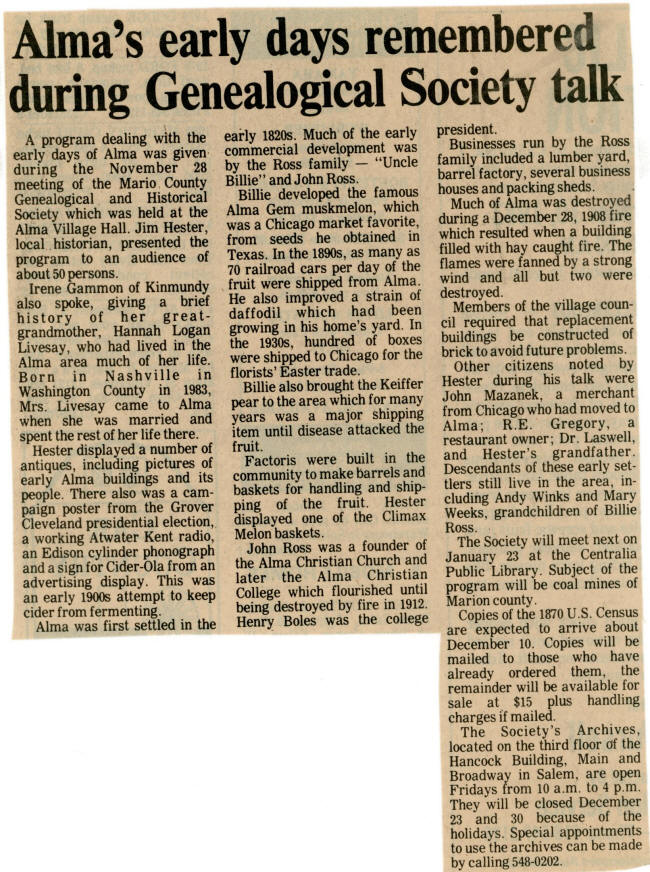
"The Kinmundy Express" - June 26, 1975
"Local Resident Survivor of Eastland Disaster on June 24, 1915, Tells of It"
Charles Tockstein recalls story about parents, Adolph Tockstein & Anna (Kolb) Tockstein
%20Tockstein%20and%20sinking%20of%20Eastland%20ship-%20Kinmundy%20Express%20-%20June%2026,%201975.jpg)
(From the James D. Hester archives:) To the Alma Village Board -
The current membership of the Alma Village Board may not be familiar with the history of the land currently known as Gregory Park as none of the current members were present at the time the land was acquired.
To help to eliminate some of this lack of understanding we present the following: In 1931 the land (currently called Gregory Park) came up for sale by the then current owner. Mr. GREGORY had heard that the land was available and told his wife that he would buy the land but he just didn’t have the money. His wife, Leona, the woman who kept their restaurant running, learned that the owner was arriving on the train and was planning to meet with the prospective buyer at the Rhodes hotel on a certain date. On that date, without telling her husband of her plans, Leona met the owner at the train before he got to the Rhodes Hotel and persuaded him to sell the land to her.
She didn’t tell her husband what she had done until the date of his birthdate at which time she presented him with the deed to the land. They planted the original trees that were on the land during the drought of 1931-36, watering them by hand to keep them alive. Later, Roy built the service station at the corner of 7th and Railroad Street. They kept all of the land except the parking lot area that was turned into the Alma Post Office and later the Alma Village Hall.
After Roy died, Leona was approached by a string of interested parties to purchase the land. She refused to sell to anyone for years. Then, as time as beginning to catch up with her, she was approached by a buyer who offered her a good price and she considered what she should do. She didn’t really want the land to be turned into commercial property but she felt that she was in a position where she was compelled to make a decision as to its disposition. Her solution was to summon a member of the Village Board to come and talk with her. The board member accepted her invitation and learned in their conversation that she had received a very good offer for the land, but, she would make the land available to the Village for the purchase for a period of one week (and one week only) at a price below what she was being offered. But, the offer contained some stipulations.
The offer was returned to the Board for consideration. After some very conservative and often lengthy discussion, the decision was made to purchase the land with the acceptance of the conditions stipulated by the owner. These stipulations were that the land should be named Gregory Park, that a sign designating the land as that park should be erected, and that the land was not to be sold or used for commercial, but only village purchase.
The Board agreed to the seller’s terms and purchased the land. Subsequent to that purchase, under the supervision of, and with the labor of, the Alma Lions Club the building that now serves multiple functions as Village Hall, Meeting Place for Senior Citizens, Church Bazaars, family reunions, Alma School Reunions, Alma township Meetings, Boy Scout Meetings and other functions, was built all with the aid of volunteer labor.
"The Kinmundy Express" - Sept. 7, 2000 - "History of Alma's Gregory Park"
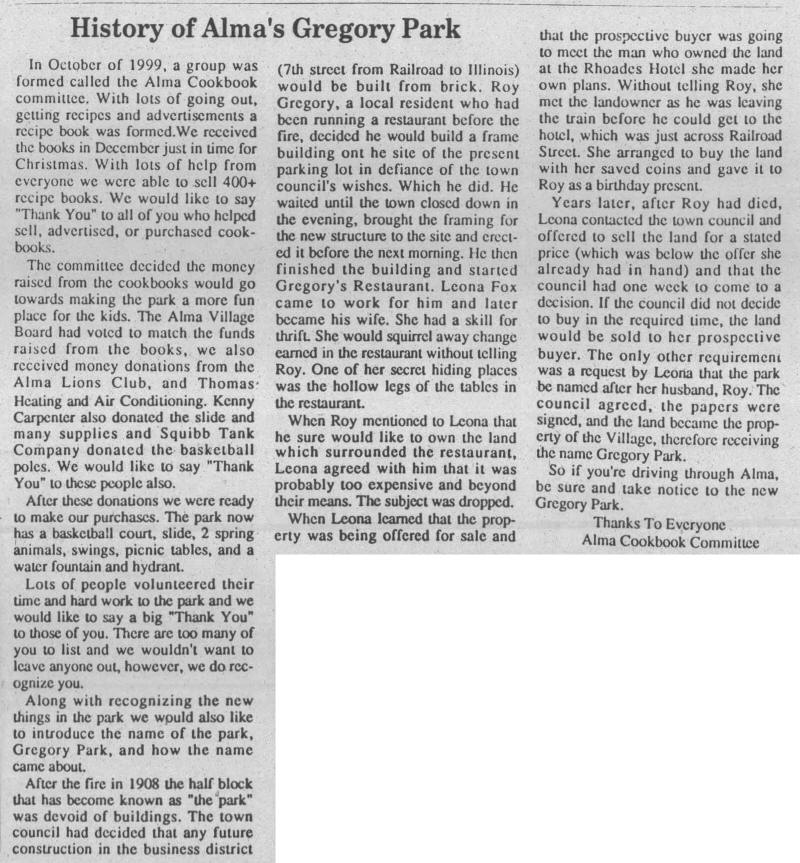
"Family remembers father with garden retreat" - Williams Hester family - Sept. 13, 2000
.jpg.jpg)
%20combined.jpg)
b.jpg)
Spencer Hulsey, Carson Hulsey, Carter Hulsey, and Morgan Hulsey with Sue Hulsey, Becky Jones, Jim Hester
"Salem Times-Commoner" - Aug. 17, 2001 - "Local farmer looks back on 50 years of change" (Bob Ford)
%20final.jpg)
"The Centralia Sentinel"
April 23, 2006
"Famed for it's melons and daffodils, there is little left to remind one of Alma's golden age in horticulture"
by Judith Joy - Features Editor
Alma - Back in 1979, I wrote a feature about Alma's daffodil farms and interviewed Mary Winks Weeks, the granddaughter of "Uncle Billy" Ross, the founder of Alma's daffodil industry. Earlier this spring, I returned to Alma only to find that the daffodils are gone, but Mary Weeks, now 97, still remembers the old days when the fields around Alma were covered with golden daffodils.
.jpg)
.jpg)
At age 97, Mrs. Weeks still lives alone, drives her own car around town and can remember the frosty mornings when Alma's children took to the fields before school began and picked bunches of daffodils, which were shipped to Chicago on the Illinois Central. "We were divided by size," Mrs. Weeks recalls, Aand I was small for my age, so I got put in the nickel bunch." When I asked her if she got a nickel for each bunch of flowers, she said, Ano, the nickel was for the morning's work." After the flowers were picked, the children hurried off to school, which was delayed until the daffodils were harvested. Meanwhile, the women in the packing shed sorted the flowers and packed them - a baker's dozen to a bunch - in cardboard cartons for shipment to the Water Street Market in Chicago. The season extended a considerable time and began with the variety King Alfred and continued on to the Narcissus type. AThe last to bloom were called Mother's Day flowers, while the earlier ones we called Easter Flowers," explained Mrs. Weeks.
.jpg)
.jpg)
Mrs. Weeks' mother, Rosa Ross Winks, was a daughter of William Slutz Ross, better known to everyone as "Uncle Billy" Ross. Mrs. Weeks credits her grandfather with Alma's success of the fruit business. "He was full of ideas of all sorts. First, he started a nursery and the fruit-growing business. He was constantly thinking up new things." Probably Uncle Billy's greatest success was the Alma Gem, the small, heavily netted melon that he had imported from Texas. AThat was a tremendous business for a few years," said Mrs. Weeks. AThey served Alma Gems as far away as New York City. Everyone was planting them and wanting to get into the business." The Ross family moved from Chilicothe, Ohio, to Bureau County, Ill., in 1843, and to Alma in 1866. From Alma, they moved back to Bureau County in 1869, and in 1875, Uncle Billy, his wife and children took off for Texas. Among Uncle Billy's children was Joseph Whitaker Ross, who later started Ross Flower Shop in Centralia. In a Sentinel article printed July 7, 1948, Ross said that in 1881, his father noticed a new melon, then being grown in Texas, and planted a few acres of them himself. J.W. Ross, who was then a young man, peddled them on the streets of Gainesville, Texas, for his dad. When the Ross family moved back to Alma in 1885, the seeds came with them, and Uncle Billy planted half an acre to see if they would do well in Illinois. According to J.W.'s recollection, they shipped some melons to Chicago in two sugar barrels covered with burlap sacks. One restaurateur sliced a melon open and liked it so much, he bought the cultivation of the renowned melon, the Alma Gem.
The following year, Uncle Billy planted 20 acres, and the year after that, 990 acres. The neighbors, too, eager to jump on the bandwagon also set out rows of melons, which, according to the story, added $70,000 a year to Alma's economy. During the melon season, all five roads leading to Alma would be lined with wagons bringing melons to be loaded on the Illinois Central 1 o'clock train to Chicago. On a normal day, said local historian Jim Hester, three or four railroad cars of melons would be shipped out of Alma on the IC, but at the peak of production - on just one day - 25 carloads of Alma Gems were shipped by rail. The melons were so famous, they were served at the Waldorf in New York and the local baseball team took the name of the Alma Gems.
In September 1904, the St. Louis Globe Democrat sent a reporter to Alma to describe the Alma Gem phenomenon. His description is still worth quoting: "Men who were once so poor that they had no windows in their houses, no linen on their tables, no tables or beds, are now prosperous. The whole plane of living has been raised. Land worth $10 per acre can be bought for $100. In some instances, an acre of land yields $350. From $100 to $200 an acre in return is not uncommon. Through the whole month of August and into the first or second week of September the industry continues. "Each morning there is a jam of wagons in the little town. The good wives come with their husbands and with the assurance of a neat check of their wagon loads, the wives shop industriously. The little restaurant close to the railroad is thronged with farmers by noon. The railroad agent has a busy time of it. And why not? With a few acres in melons - seldom more than 12 and often no more than four - the children's winter schooling is assured. Their books and clothing come easy. One merchant cashes an average $1,000 worth of checks each day for the farmers. Several others do almost as much. The market is thought to be unlimited. "At this time 2,000 acres are under cultivation and control of the Alma Shippers Association. The first car shipped to Chicago cost the shipper $100. After the organization of the Association the cost was cut to about $20. The Illinois Central railroad has made special provisions and each day a train of all refrigerator cars leaves Alma at 1 p.m. and has the melons on the market in six and a half hours. >Alma Gems' have found their way to the Waldorf Astoria in New York and other points in the East." In another part of the story the writer painted the following word picture of Alma just after the turn of the century: AAs far as the eye can reach in every quarter of the compass - north, east, south, and west, you behold long trains of wagons wending their way to town. The dust which they raise can be seen for miles. In this multitudinous procession are vehicles of every description - staunch farm wagons, oxcarts and phaetons; anything that has wheels, and in the beds and boxes of these vehicles are bushels upon bushels of Alma melons, one of the most luscious fruits ever evolved by the ingenuity and pains of a man. By noon, from 700 to 1,000 wagons have assembled in the little town where as fast as possible their loads are transferred to waiting fruit cars on the Illinois Central tracks."
.jpg)
There are several versions of the cause of the Alma Gem's demise. Mrs. Weeks said that the farmers themselves ruined the market by shipping the melons when they were too green, just so they could get the high prices the early melons commanded. Hester says a rust problem contributed to the eventual abandonment of Alma's leading crop. W.L. Green of Kinmundy recalled that in 1948, farmers from 12 to 16 miles away would load their wagons with melons packed in baskets holding a third of a bushel. The melons were packed in two layers, with the smaller ones naturally being placed on the bottom layer. As time went by, said Green, farmers began to put in melons that should have been culled. Farmers not only packed the culls on the bottom, where they couldn't be seen, but towards the close of the season they also shipped everything left on the vine. This is the reason, said Green, that the price of melons declined. It may well have been a combination of circumstances that caused the melon's fall from grace. On Aug. 28, 1948, the Sentinel ran an article in which Roy Green of Alma was quoted as saying the "growers shipped the melons too green, and the had no flavor." In a later article, (6/4/60) Andrew Ross, another son of Uncle Billy, explained that the failure of the farmers to rotate their melons led to the development of a rust problem. By the early 1900s, Ross said, the rust problem was so bad that farmers were lucky to get one or two pickings before the disease killed the vines. With the failure of the melons, Uncle Billy Ross and the other area farmers turned to planting Kieffer pears. The pear is named for its originator, Peter Kieffer of Roxborough, Pa., who produced the new variety from the seed of a sand pear c. 1863. The Kieffer had fewer grit cells than the original sand pear and also showed resistance to fire blight, which killed most European pear varieties. Another advantage of the Kieffer was that the harvest could be spread over a six-week period, and the trees produced a prolific crop of 8 to 14 bushels a tree. J.A. Broom, a station agent for the IC in Alma, recalled in another Sentinel article (9/11/48) that between 200 and 300 cars of pears moved out of Alma in 1908. The pear orchard business looked so promising, in fact, that Broom planted a pear orchard himself and eventually quit his railroad job to become a fruit grower.
Jim Hester, whose father, Willim Phipps Hester, was a fruit grower in Alma, said some of the Kieffer pears his dad planted are still bearing fruit after 100 years. Jim's grandfather, William Hester, came from Brown Co., Ind., and planted an orchard of over 14,000 pear trees, both Kieffer and the variety Garber, which was needed for cross-pollination. At one time, said Hester, there were five fruit-packing sheds in Alma, and workers came from as far as Ohio for the fruit harvest. Mary Weeks says that her dad grew pears and shipped them all the way to Nebraska, where her brother, Vern Winks, was supposed to market them. "My father, Howard Winks, was very entrepreneurial," said Mrs. Weeks, "but unfortunately, he died young." Left a widow, Rosa Ross Winks, who was known to all as Aunt Rosie, raised six children on her own and was such a vigorous woman that she was still spading her garden at age 89. "She died of cancer in 1964," said Mrs. Weeks, "but she still spaded up her garden that spring - she had a world of energy." The pears, which had been introduced to Alma by Uncle Billy Ross, did well until about the time of World War I, when they, too, began to have problems with pests and diseases. Spraying helped control the pests but also added to the costs of production. But this time, Alma's farmers had not put all their eggs in one basket. They were also growing large quantities of apples and peaches, as well as daffodils. Again, the remarkable Uncle Billy Ross was responsible for the first plantings. Eugene "Red" Winks, a grandson of Uncle Billy and a daffodil grower himself, recalled in a Sentinel article (4/15/61) that Uncle Billy had made his first plantings of Emperor daffodils, which he imported from Holland, in the 1890s.
.jpg)
.jpg)
For years, Uncle Billy and his son, Andrew, had a 40-acre field of daffodils southwest town. At one time, there were 65 to 75 acres of daffodils in Alma, and during the picking season, the local payroll was between $1,500 and $2,000. In addition to the 40 to 50 children who picked the flowers, 100 women sorted and packed them in boxes, each containing dozens of daffodils. In addition to Eugene Winks, the Mazanek brothers shipped 40 to 50 boxes of daffodils each day during the season. John Mazanek came to America from Bohemia, now the Czech Republic, in 1861, and the family eventually moved to Chicago. Around 1885, while visiting his brother Ed in Alma, John Mazanek met his future wife, Anna Doudera, and then purchased 160 acres in Alma. Like many of the early farmers, the Mazaneks helped augment their income by cutting railroad ties and mine props in the winter. So many ties were cut, said historian Jim Hester, that they'd be piled up along the tracks for a quarter of a mile, waiting for the railroad to pick them up.
.jpg)
John and Anna Mazanek began their married life in a log cabin in the country but eventually moved to town, where, in 1900, they built a fine brick house. In addition to farming and fruit growing, Mazanek owned a store and was also involved in life insurance and several other enterprises, including a basket factory that burned.
.jpg)
.jpg)
.jpg)
At the turn of the century, Alma was a prosperous town with four general stores, two barber shops, three churches, a basket factory, a cannery and other businesses. Trouble started in July 1908, when the Shrigley Cannery burned down. Then, in December of the same year, a heater in a livery stable sparked and set the hay afire. The resulting conflagration burned the entire business district, leaving only Dr. S.E. Laswell's office and the home of Tunis Maulding (he was the father of the late Paul Maulding of Centralia) to survive the blaze. Undaunted, the citizens of Alma rebuilt their business district the following year, this time specifying that the buildings be of brick, not wood. Mrs. Weeks can remember another fire, which occurred when she was just 4 years old. "I can remember standing by the window and watching the Christian College burn," Mrs. Weeks recalled. The college was also the brainchild of Uncle Billy Ross and the pastor of Alma's Christian Church. The school, which was a two-story, eight-room frame building, opened in Sept. 1896. Boys were supposed to work part-time on the farm and girls in the printing office. In addition to this labor, each pupil was supposed to pay a tuition of $110 per year for tuition, room and lodging. "Uncle Billy thought that other churches would help support the college, but they didn't," said Mrs. Weeks. Appeals to surrounding communities yielded little support, and in 1900, the school was discontinued, but the property was sold for public use.
.jpg)
.jpg)
When Mary Winks Weeks was growing up in Alma, the high school only had two years of instruction, and those who wanted to continue their education had to go to Kinmundy. During good weather, Mary and her brothers drove to Kinmundy, but when the roads were too muddy or snowy, they took the train. The Illinois Central train went north at 9:30 a.m. and left Kinmundy at 4:30 p.m. A weekly pass cost $1.80, and the Kinmundy high school arranged its schedule so that the Alma students didn't miss any classes. I asked Mrs. Weeks if she ever recalled the train being late, and she shook her head. "No", she said. "It was always on time".
Although the era of the Alma Gem had passed, Alma still had a huge acreage in horticultural crops. In 1911, for example, there were 600 acres in apples, 400 in pears, 175 in peaches, plus additional acres in daffodils and tomatoes. During the Prohibition era, a man by the name of Laux came from St. Louis and purchased the cider mill. "They were going to make something called ciderola," said Mrs. Weeks, "which was a concentrated type of cider. It was not fermented when they sold it, but it could be - so the government closed them down because it could be made into hard cider." Charles and John Mazanek were among Alma's daffodil growers, as were Eugene and Andrew Winks, H.D. Krutsinger, and D.E. Gammon. Today, the Mazaneks are the only family still in the fruit business. Back in 1979, when I asked Eugene Winks why the daffodil business was nearly extinct, he listed three reasons: First, he said, "the high school kids today are too lazy to pick." Secondly, the Railway Express Co. was out of business and growers no longer had enough flowers for a complete truck load. The third reason, said Winks, is that there were "no more street peddlers - they're all on relief."
In the days when Alma farmers were producing melons, flowers, pears and other fruit, the little town was a busy place. Hester, who is 67, can remember the "Toby and Suzy" tent shows that came to Alma in peach season following a circuit from town to town. The name, Toby and Suzy, he explained, was a generic term for the four-character comedies that were put on by these troupes of itinerant thespians. There is little in Alma to remind one of its glory days in the fruit and flower business - an old pear tree, a few clumps of daffodils in someone's yard - that's about all that's left. And what became of the Alma Gem? That question is often asked.
A Sentinel article (9/19/48) shows a photo of Homer Adams of Centralia, who claimed to grow melons that were the direct descendants of the Alma Gem. However, Adams' melons had yellow flesh because he had crossed them with Hearts of Gold cantaloupes. Another Sentinel story from the same year says that a Chicago fruit broker, H. Woods & Co., who handled Rocky Ford melons, wanted to have a melon that ripened at a different time. He obtained seeds of the Alma Gem and gave them to the Burpee See Co., hoping to breed a new variety. Roy Gregory of Alma was quoted as saying that the variety Burpee Gem might be a continuation of the Alma Gem. Jim Hester said the story he heard was that Burpee bought out the rights to the Alma Gem and then retired it immediately so it wouldn't compete with Burpee's own varieties. Sue Hulsey, Hester's sister, who lives in Kinmundy, called the Burpee Seed Co. several years ago and asked if they had any information about the Alma Gem and was told there was no record of such a melon. Hulsey then planted some melon seed she thought might be similar, but the growing season was too long and they didn't ripen in her garden. This spring, she ordered seeds of the Emerald Gem, described as green-fleshed with a heavily netted exterior. The J.L. Hudson Seedsmen in La Honda, Calif., from which she ordered the seeds, has been in business since 1911. It's a long shot to be sure, but it's possible that the Emerald Gem may be a long-lost descendant of the fabled Alma Gem. At this writing, Sue Hulsey plans to start the seeds indoors to give the melons plenty of time to ripen. Stay tuned, and maybe the Alma Gem will be born again in Kinmundy.
Editor's note: The author would like to thank Mary Weeks, Jim Hester, Charlotte Mazanek, and Sue Hulsey for their help with this story.
.jpg)
.jpg)
"Centralia Sentinel" - March 2006 - "Mazanek Plans to open winery in Alma"
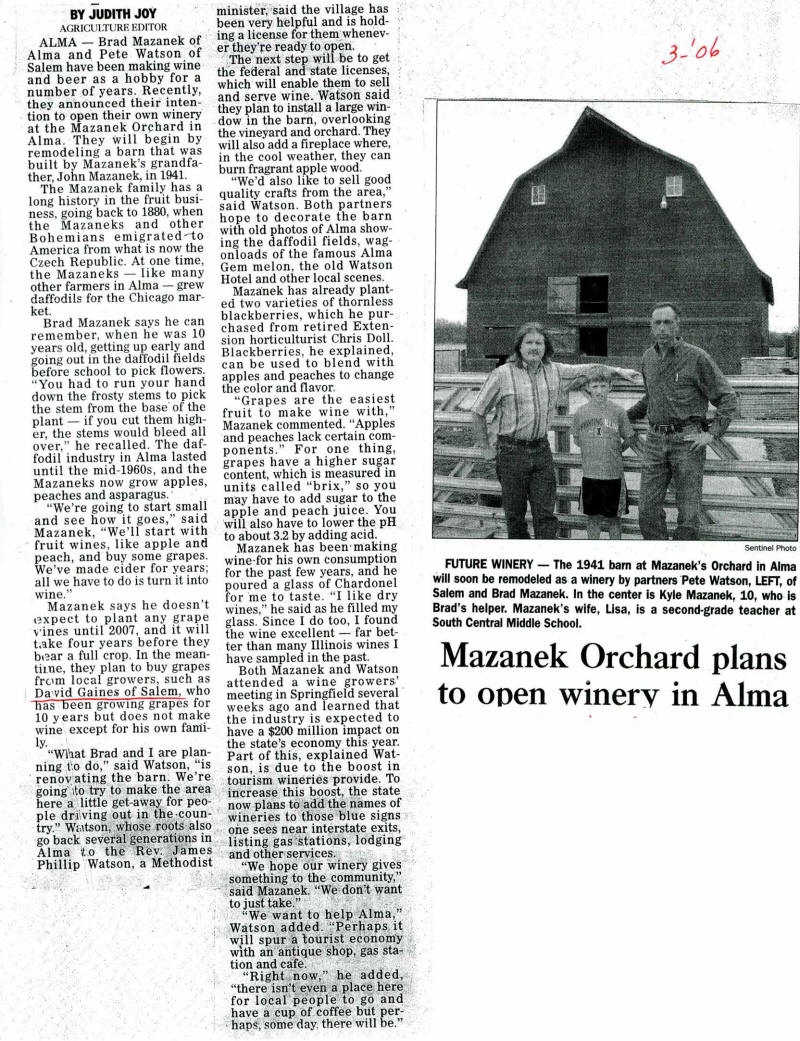
"Salem Times-Commoner" - Aug. 29, 2006 - "Mazanek, Watson working to open Orchard View Winery in Alma area"
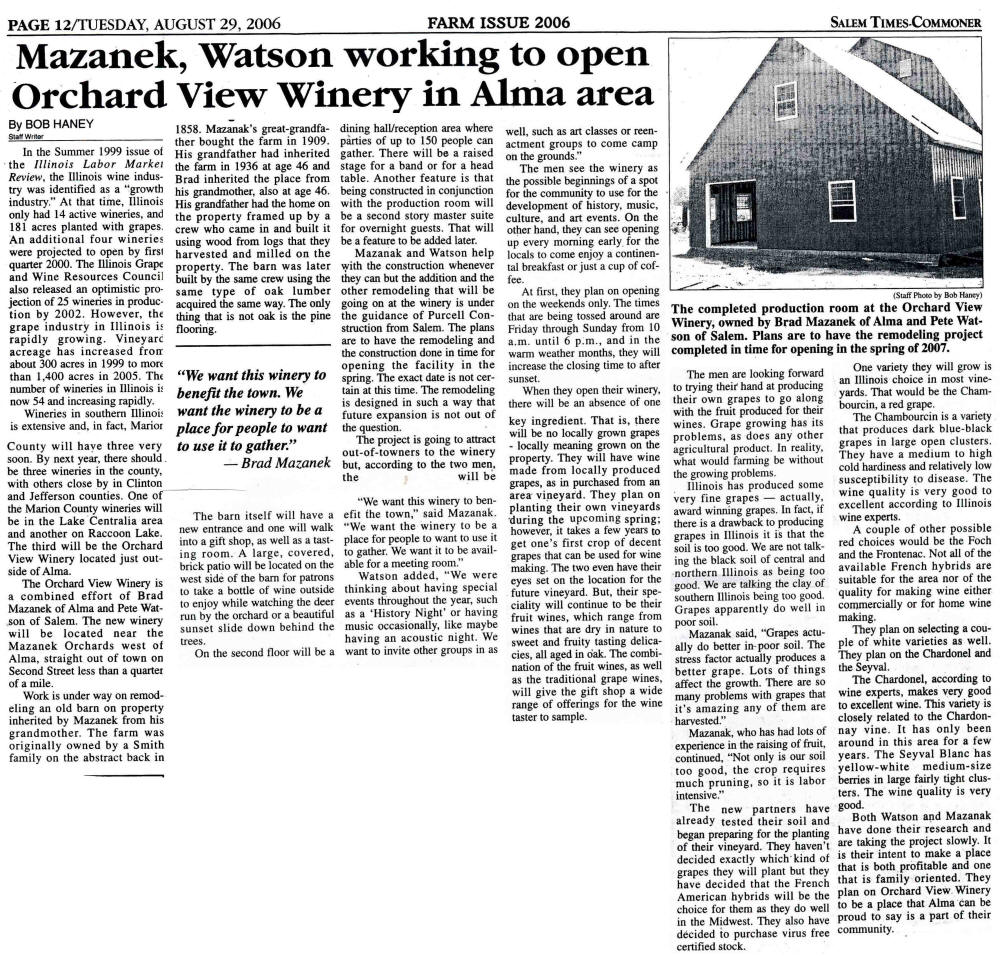
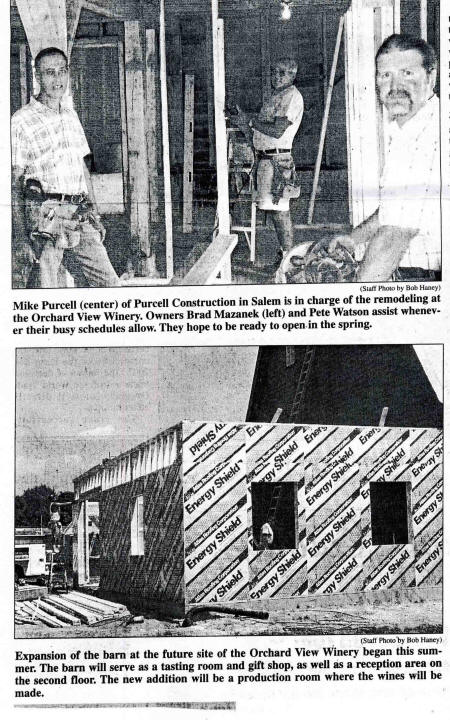
"Daffodils, Pears, Melons, and More" by Judith Joy
Published in "The Illinois Steward - Discovering our Place in Nature"; A publication of the University of Illinois at Urbana-Champaign
Spring 2007 - Vol. 16; No. 1
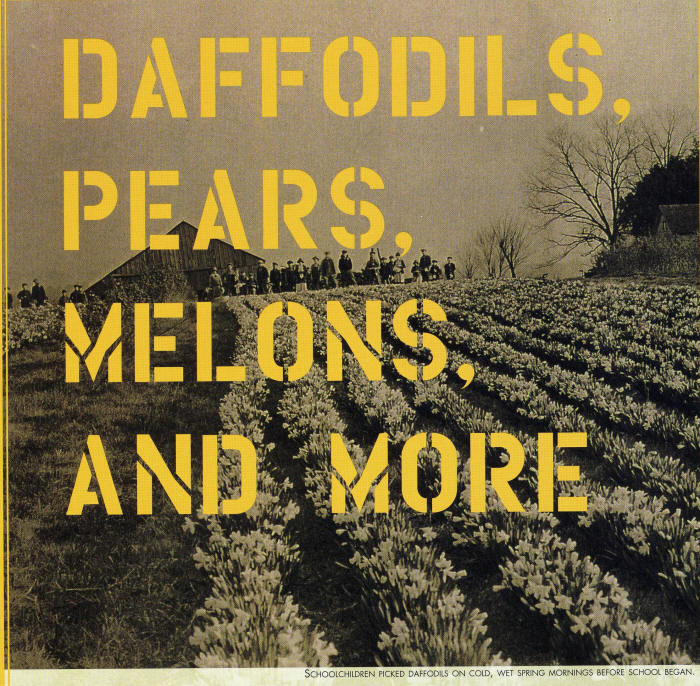
If a horticultural history of Illinois were ever written, the Village of Alma in Marion County would deserve more than a passing mention. Today, only a few patches of daffodils and neglected pear trees remind older residents of Alma's flourishing fruit and daffodil farms; and gone forever is the Alma Gem, the melon that brought the town its greatest period of prosperity.
Fields of Gold
Mary Winks Weeks, who is now 98 years old, still remembers the old days when the fields around Alma were covered with golden daffodils. When the flowers were in bloom, school was delayed so that the children could harvest the daffodils at the peak of freshness. The children were paid according to their size. "I was small for my age, so I got put in the nickel bunch," Mrs. Weeks recalled. Asked if she got a nickel for each bunch of flowers, she answered that the nickel as for the morning's work.
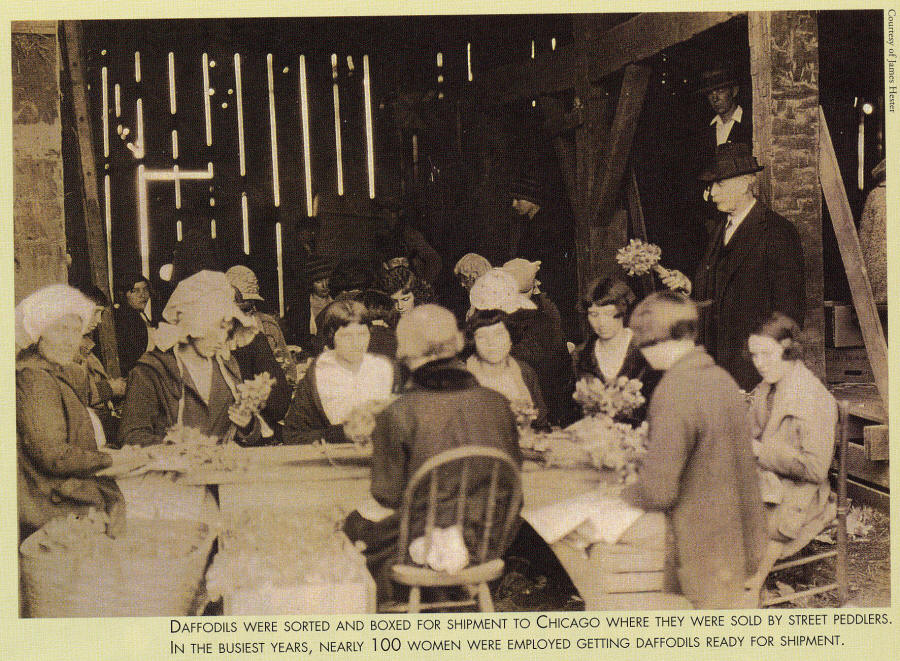
After the children went off to school, the women in the packing shed sorted the daffodils and packed them - 13 to a bunch - in cardboard cartons for shipment to the Water Street Market in Chicago. By planting a number of different varieties, growers extended the season from the first King Alfreds to the later blooming Narcissus type. The early bloomers were called Easter Flowers, the name still used by many local people, and the later ones were known as Mother's Day flowers.
Mrs. Weeks' mother, Rosa Ross Winks, was the daughter of William Slutz Ross, who was known to most people as "Uncle Billy" Ross. Probably, Uncle Billy's greatest success was the introduction of the Alma Gem, but he also was the first to grow daffodils in Alma, and he was among the first to begin growing Kieffer pears.
"He was full of ideas of all sorts" recalls his granddaughter. "First, he started a nursery and the fruit-growing business. He was constantly thinking up new things."
The Ross family moved to Bureau County, Illinois from Chillicothe, Ohio in 1843, and to Alma in 1866. From Alma they moved back to Bureau County in 1869, and in 1875, Uncle Billy Ross, with his wife and children, left for Texas. According to family history, it was in 1881 that Uncle Billy noticed a new variety of melon and planted a few acres on his own farm. The melons were peddled on the streets of Gainesville, Texas, by his son, J.W. Ross, who later established a flower shop in Centralia that is still in business.
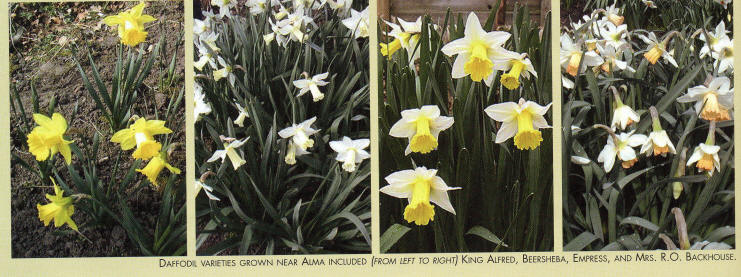
A Melon from Texas
When the Ross family moved back to Alma in 1885, they brought the melon seeds with them, and Uncle Billy planted half an acre to see if they would do well in Illinois. The first melons were shipped to Chicago in two old sugar barrels covered with burlap sacks. One restaurateur sliced a melon open, tasted it, and found the flavor so pleasant that he bought the entire barrel for $5.50. So began the cultivation of the renowned melon, the Alma Gem.
The following year, Uncle Billy planted 20 acres, and the year after that, 990 acres. The neighbors too, began planting melons, which reputedly added $70,000 a year to Alma's economy. During the melon harvest, all five roads leading into Alma would be lined with wagons loaded with melons to be shipped to Chicago on the Illinois Central's 1 o'clock train. On an average day, according to local historian James Hester, three or four freight cars would be shipped by rail. But at the peak of production, as many as 25 carloads of Alma Gems would be loaded aboard the Illinois Central. The melons were so famous they were served at the Waldorf Astoria in New York, and the local baseball team adopted the name the Alma Gems.
Melons Become Big News
In Sept. 1904, the ASt. Louis-Globe Democrat” sent a reporter to Alma to describe the Alma Gem phenomenon. His description is still worth quoting. AMen who were once so poor they had no windows in their houses, no linen on their tables, no tables or beds, and now prosperous. The whole plane of living has been raised. Land worth $10 per acre can be bought for $100. In some instances, an acre of land yields $350. From $100 to $200 return an acre is not uncommon. Through the whole month of August and into the first or second week in September the industry continues.
AEach morning there is a jam of wagons in the little town. The good wives come with their husbands and with the assurance of a neat check for their wagon loads, the wives shop industriously. The little restaurant close to the railroad is thronged with farmers by noon. The railroad agent has a busy time of it. And why not? With a few acres in melons - seldom more than 12 and often no more than four - the children's winter schooling is assured. Their books and clothing come easy. One merchant cashes and average of $1,000 worth of checks each day for the farmers. Several others do almost as much. The market is thought to be unlimited.
"At this time, 2000 acres are under cultivation and control of the Alma Shipper's Association. The first car shipped to Chicago cost the shipper $100. After the organization of the Association the cost was cut to about $20. The Illinois Central Railroad has made special provisions and each day a train of all refrigerator cars leaves Alma at 1 pm and has the melons on the market in six and a half hours. >Alma Gems' have found their way to the Waldorf Astoria in New York and other points in the East."
The writer continued, describing the throng of wagons heading towards the Illinois Central depot at harvest time. "As far as the eye can reach in every quarter of the compass, you behold long trains of wagons wending their way to town. The dust which they raise can be seen for miles. In this multitudinous procession are vehicles of every description - staunch farm wagons, ox carts and phaetons; anything that has wheels, and in the beds and boxes of these vehicles are bushels upon bushels of Alma Gem melons, one of the most luscious fruits ever evolved by the ingenuity and pains of man. By noon, 700 to 1,000 wagons have assembled in the little town where as fast as possible their loads are transferred to waiting fruit cars on the Illinois Central tracks."
There are several versions to explain the cause of the Alma Gem's eventual demise. Mrs. Weeks says that the farmers ruined the market themselves by shipping the melons while they were too green in order to get a better price early in the season. Others say farmers packed culls on the bottom layer of the baskets, which held a third of a bushel. It was probably the rust problem that really caused the failure of the melon crop and the fact that the farmers failed to rotate their crops to reduce the disease problem. By the early 1900s, the rust problem had become so severe that farmers were lucky to get one or two pickings before rust killed the vines.
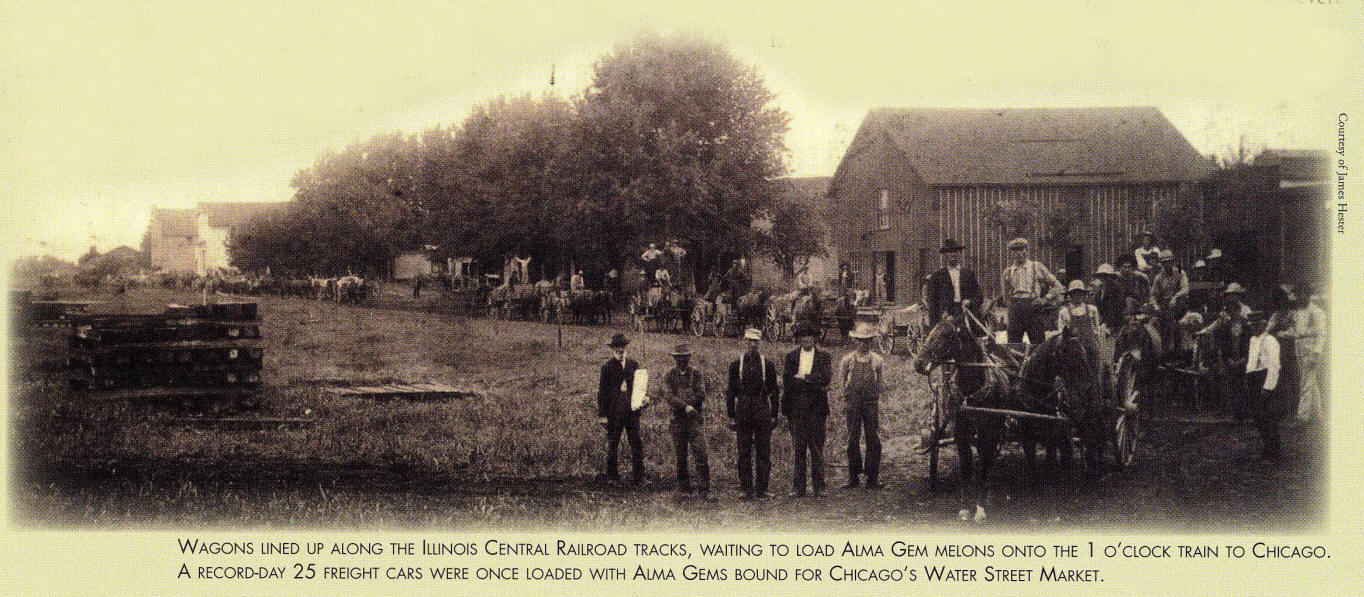
A Pear with Less Grit
With the failure of the melon business, Uncle Billy Ross and other farmers turned to planting Kieffer pears. The pear is named for its originator, Peter Kieffer of Roxborough, Pennsylvania, who produced the new variety from the seed of a sand pear about 1863. The Kieffer had fewer grit cells than the original sand pear and was less susceptible to fireblight, which killed most European pear varieties. Another advantage of the Kieffer was that harvest could be spread over a 6-week period, and the trees produced a prolific crop of 8 to 14 bushels per tree.
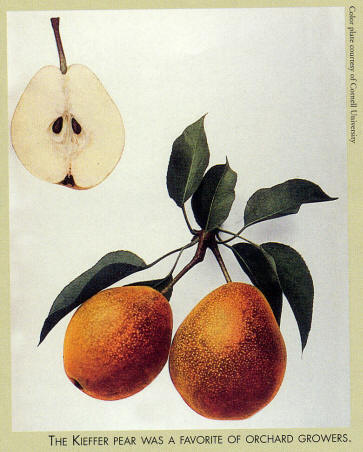
By 1908, between 200 and 300 cars of pears moved out of Alma at harvest time. James Hester, whose father, William Phipps Hester, was a fruit grower, said some of the trees his dad planted are still bearing fruit. At one time, says Hester, there were five fruit-packing sheds in Alma, and workers came from as far away as Ohio to harvest fruit. His own grandfather, William Hester, came from Brown county, Ind., and planted and planted an orchard of 14,000 pear trees, both Kieffer and the variety Garber, which was needed for cross pollination.
The pears did well until about the time of World War I when they, too, began to have problems with pests and diseases. By this time, however, farmers were more diversified and were also growing peaches and apples, as well as daffodils. Again, it was the remarkable Uncle Billy Ross who was responsible for the first planting of daffodil bulbs, a variety called Emperor, which he imported from Holland.
For many years, Uncle Billy and his son, Andrew, had a 40 acre field of daffodils southwest of town. At one time, 65 to 75 acres in Alma were devoted to daffodils; and during the picking season, the local payroll was between $1,500 to $2,000. In addition to the 40 or 50 children who picked daffodils each morning, 100 women sorted and packed the flowers in containers for shipment. Among those who grew daffodils were the Mazanek brothers, who shipped 40 to 50 boxes of daffodils each day during the season. John Mazanek and his family came from Bohemia in 1861, and today, the Mazaneks are the only family in Alma still in the fruit business.
Although the era of the Alma Gem was relatively short, the town still had a huge acreage in horticultural crops. In 1911, for example, there were 600 acres in apples, 400 in pears, 175 in peaches, plus additional acres of daffodils and tomatoes. During Prohibition, a man by the name of Laux came from St. Louis and purchased the cider mill. "They were going to make something called Ciderola," says Mary Weeks. "It was a concentrated type of cider, which was not fermented when they sold it, but it could be; so the government closed them down because it could be made into hard cider." Mrs. Weeks' brother, Eugene Winks, was one of Alma's last daffodil growers. In 1979, when I interviewed Winks about the decline of the business, he listed three reasons: "First," he said, "the high school kids today are too lazy to pick. Secondly, the Railway Express Company went out of business, and growers no longer had enough flowers for a complete truck load." The third reason, said Winks, is that there are "no more street peddlers, they're all on relief." For many years, Winks operated a small roadside market in Alma, and when he died in 1995, it was the end of an era."
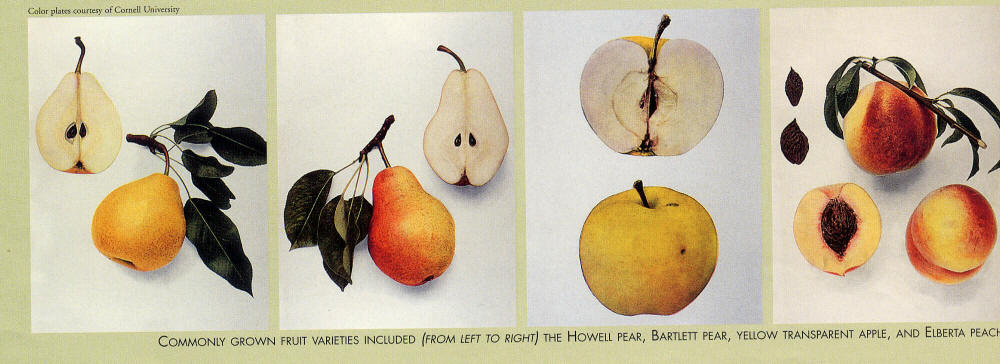
In Search of Gems
The question is sometimes asked, “What became of the Alma Gem?” Back in the 1970s, I received such an inquiry from the Seed Savers Exchange in Decorah, Iowa. The organization, which has a mission of preserving heirloom varieties, asked if I could locate seeds from the Alma Gem. I put a short article in the “Centralia Sentinel”, requesting seeds, but received no replies.
According to early descriptions, the Alma Gem was a heavily netted melon with green flesh. A “Centralia Sentinel” news story in 1948 recalled that a Chicago fruit broker, H. Woods & Company, handled Rocky Ford melons and wanted to find a melon the ripened at a different time. He is supposed to have obtained seeds of the Alma Gem and passed them on to the Burpee See Company, hoping to breed a new variety. James Hester said the story he heard was that Burpee bought out the rights to the Alma Gem and then retired the variety immediately, so that it wouldn’t compete with Burpee’s own varieties.
Seeds of two old Burpee varieties are still obtainable from Baker Creek Heirloom Seeds in Mansfield, Missouri. In their catalogue, the “Netted Gem” is described as “One of the most popular melons in the 1890’s. It was introduced by W. Atlee Burpee in 1886 and was famous for hits high quality and very spicy sweet flavor. It is round with netted skin, bright-green flesh and weighs 2 to 3 lbs.” Another variety, “Emerald Gem”, is also said to have been introduced by Burpee in 1886; but this melon has orange flesh, not green, and it is heavily ribbed like a muskmelon.
Sue Hulsey, James Hester’s sister, who lives in Kinmundy, called the Burpee Seed Company several years ago and asked if they had any information about the Alma Gem and was told they had no record of such a melon. This past spring, Hulsey ordered some seeds of a melon described as green fleshed with a heavily netted interior. Unfortunately, however, it was a dry summer and the vines never produced fruit. Despite last summer’s failure, Hulsey doesn’t plan to give up and is looking thru heirloom seed catalogues, hoping to find a close relative of the renowned Alma Gem.”
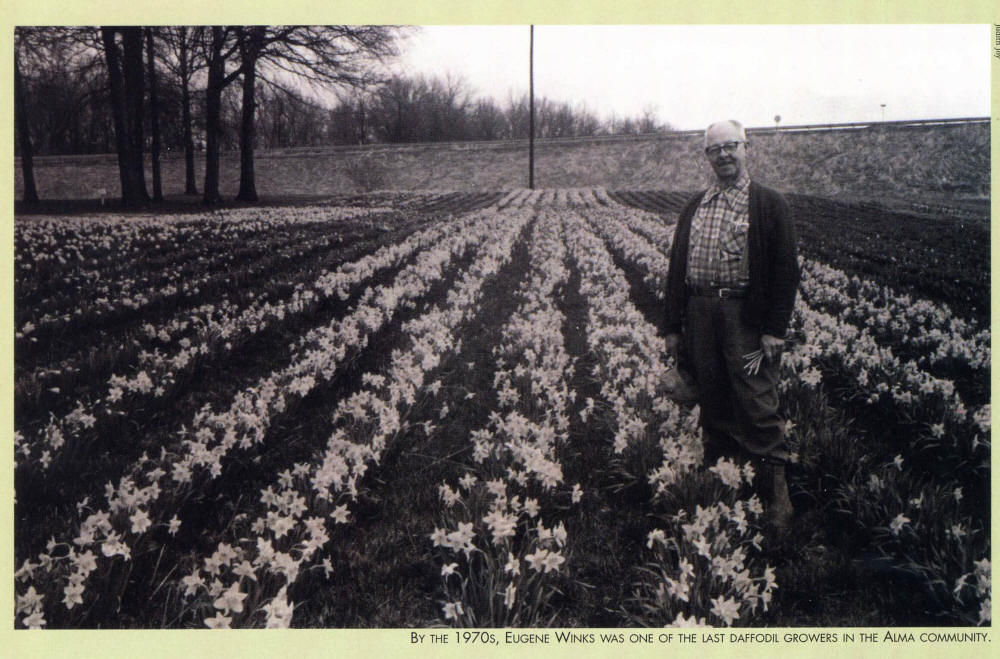
Judith Joy is the farm and feature editor of the “Centralia Sentinel”, Centralia, Illinois. This article is abridged from a feature story that appeared in the “Centralia Sentinel” on Apr. 23, 2006. The author would like to thank Mary Weeks, James Hester, Charlotte Mazanke, and Sue Hulsey for their help with this story.
“The Illinois Steward” would like to thank the American Daffodil Society for locating the photos of the historic daffodil varieties shown in this article. For more information on daffodils, including photos, go to the Web site http://daffodil.org/.
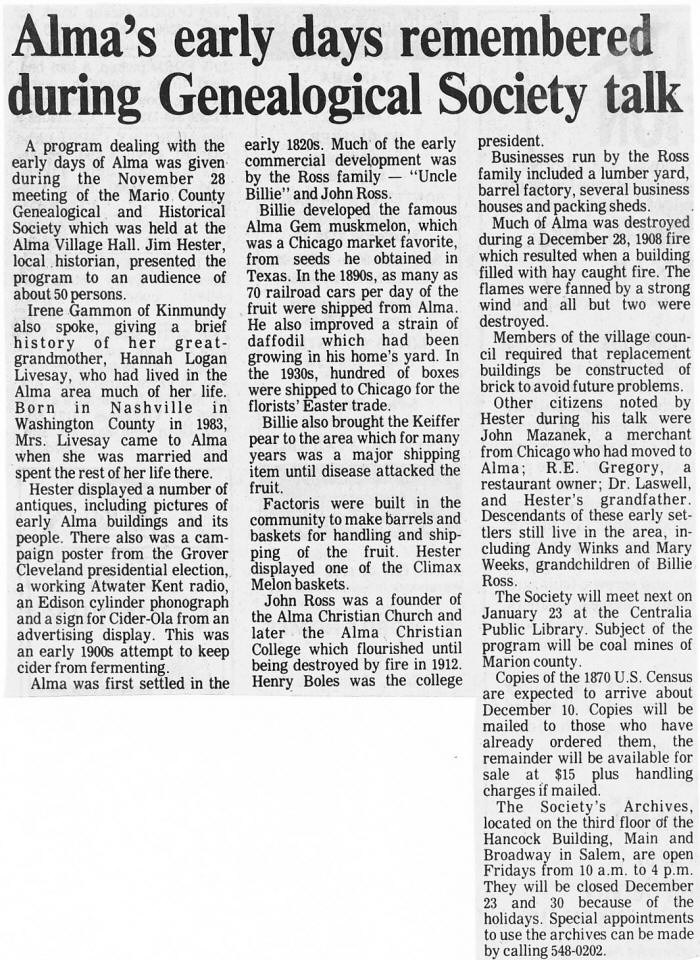
Alma history the subject at Marion County Genealogical & Historical Society meeting.
"Power Techniques installs, maintains conveyor systems for coal plants around country" - Cary Henken - April 28, 2010
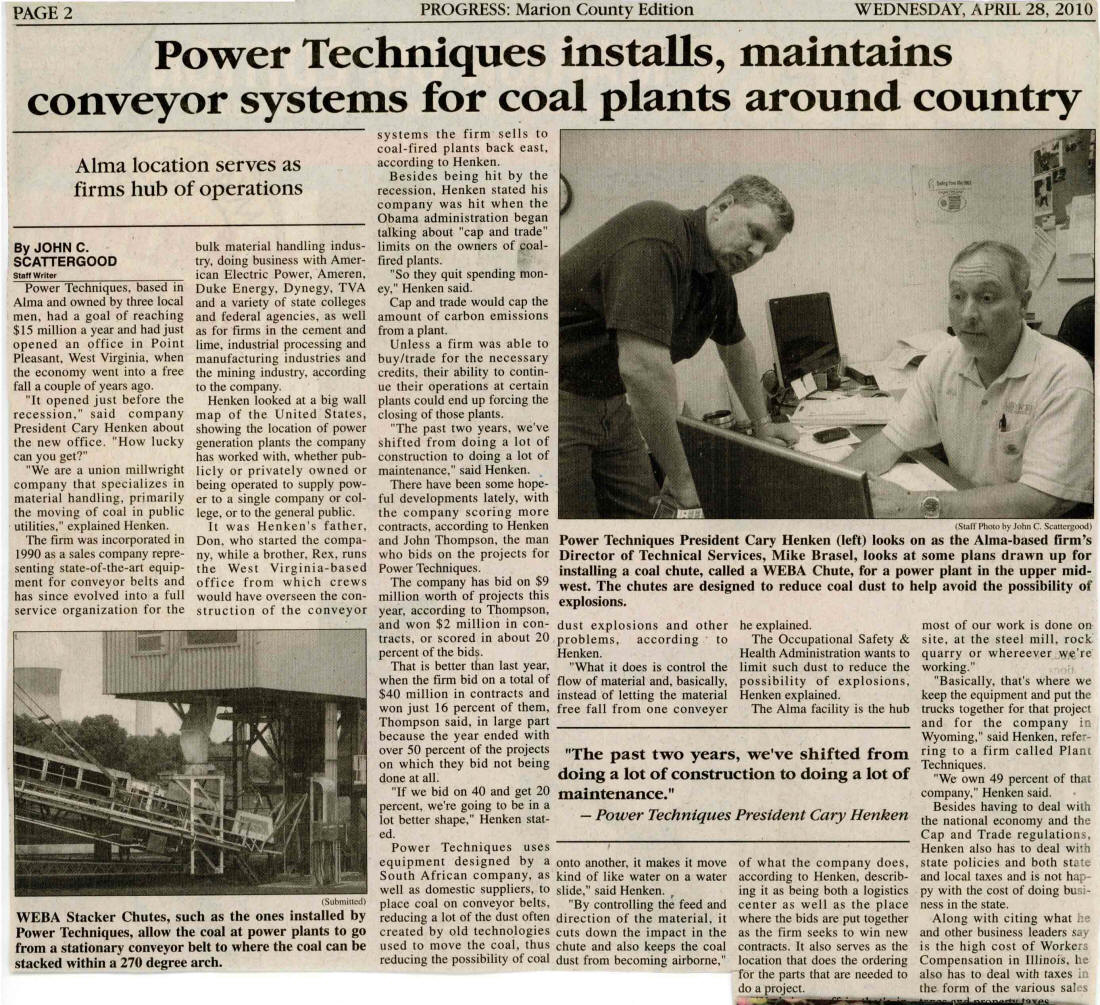
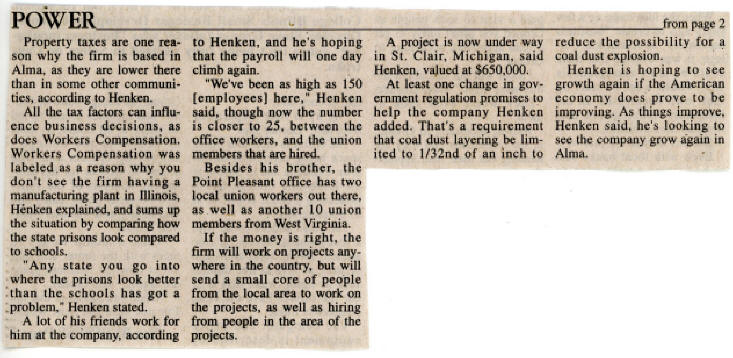
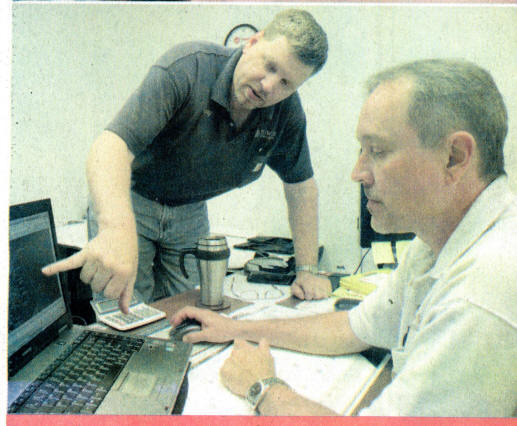
Cary Henken and Mike Brasel
"Dedicated group helping to revive activities on the streets of Alma" - "Salem Times-Commoner - Apr. 27, 2011
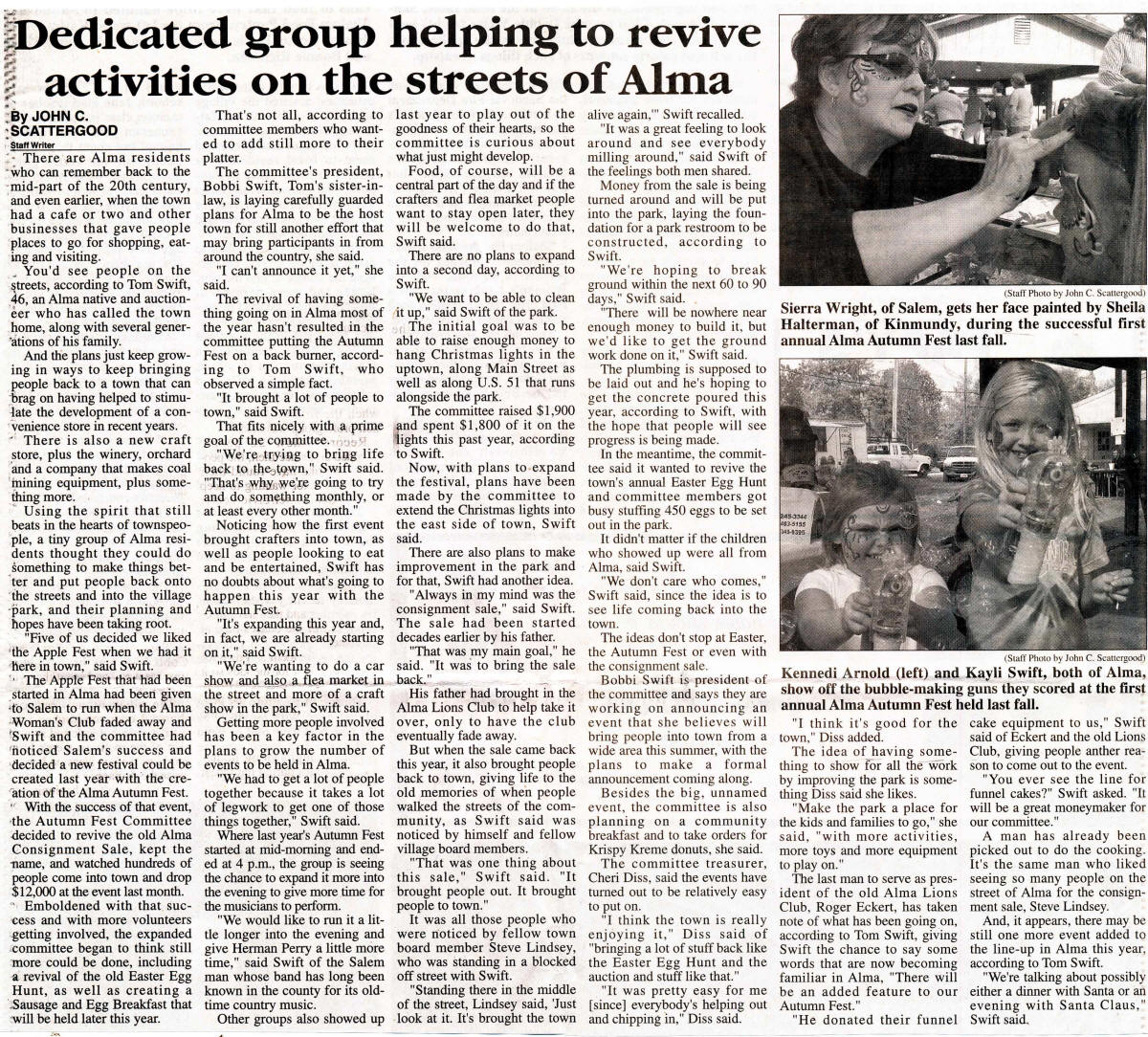
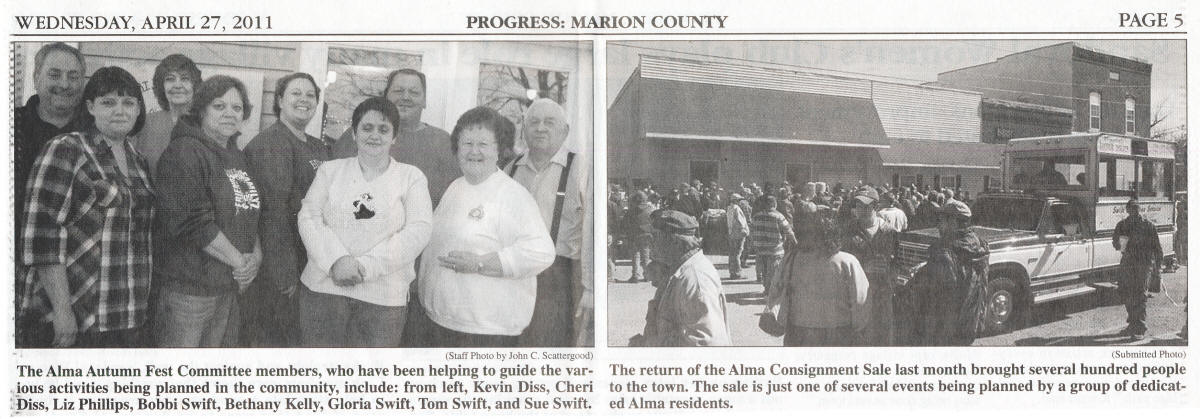
"The Sentinel" - Centralia, IL - Feb. 20, 2012

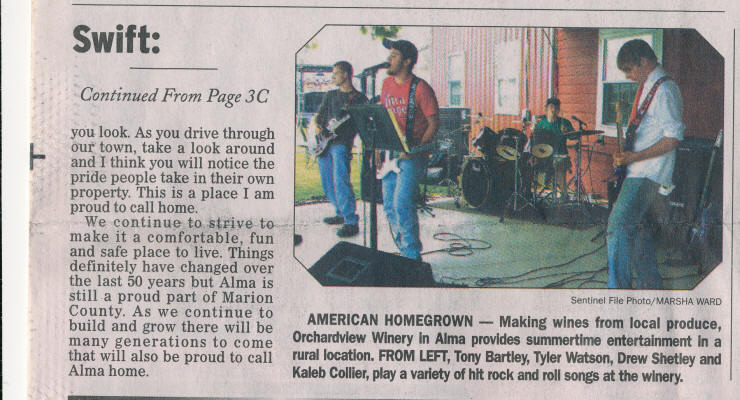
"The Salem Times-Commoner" - July 26, 2013
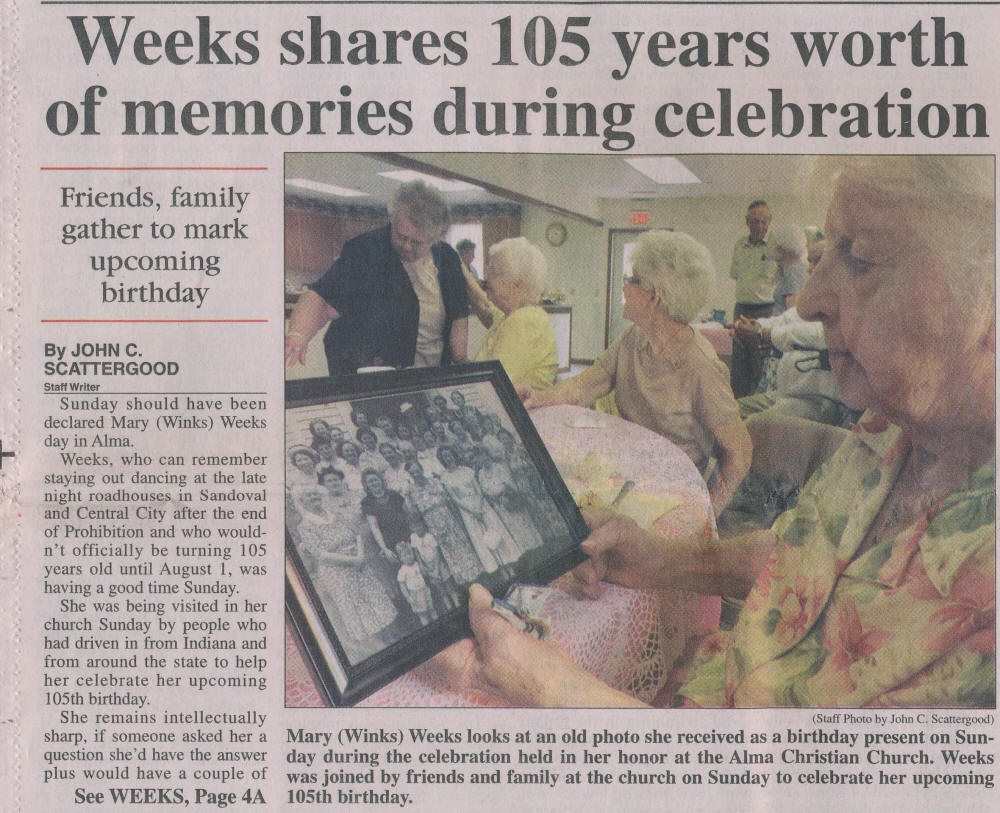
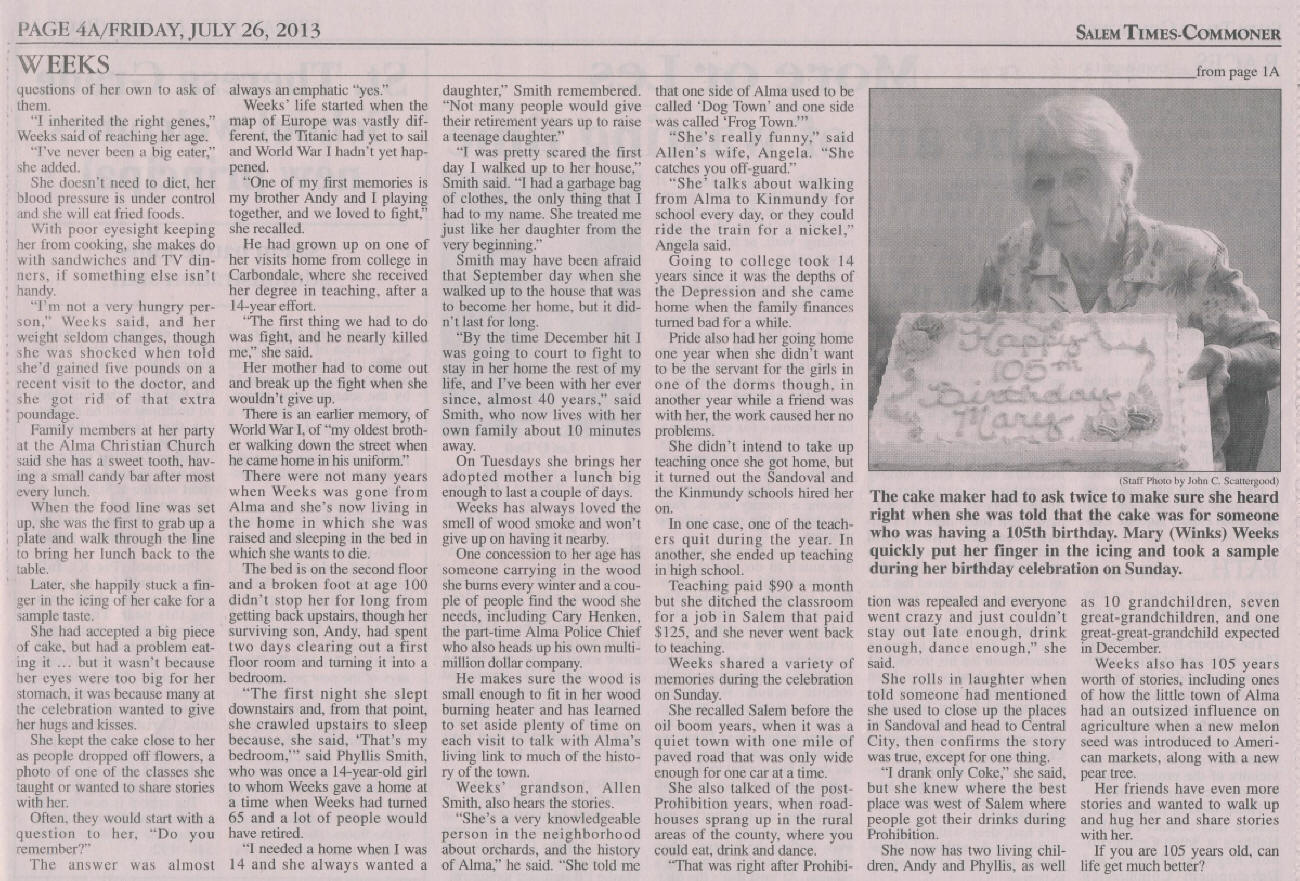
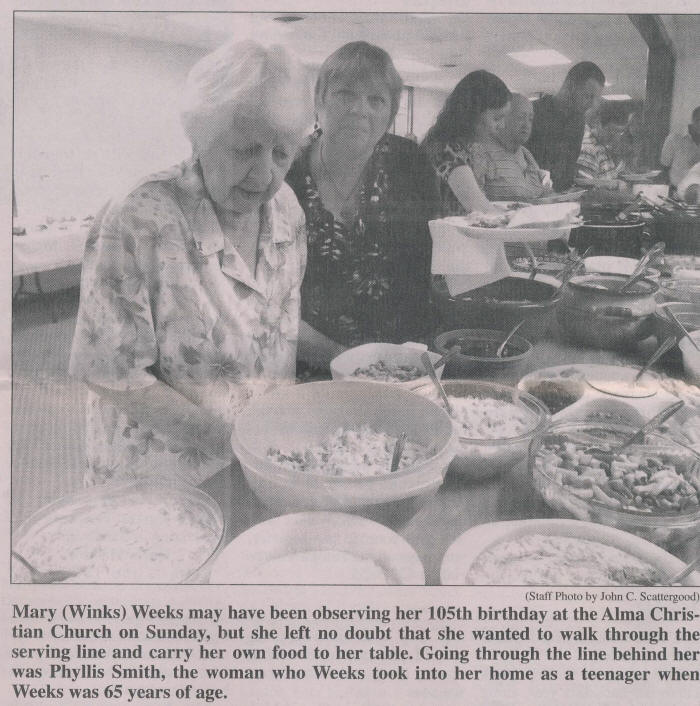
"Centralia Sentinel" - Feb. 12, 2017 - by Judith Joy
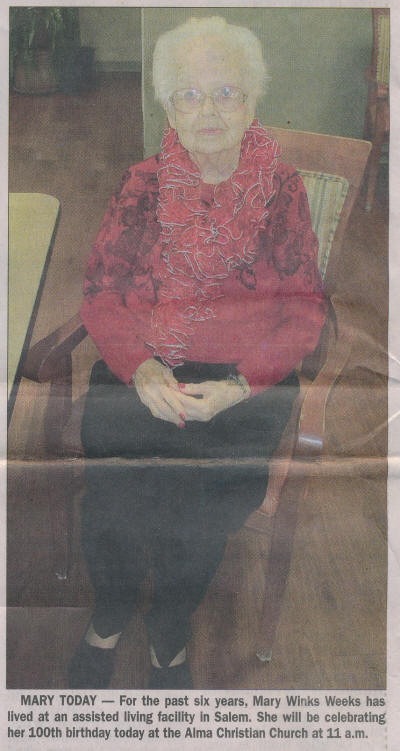
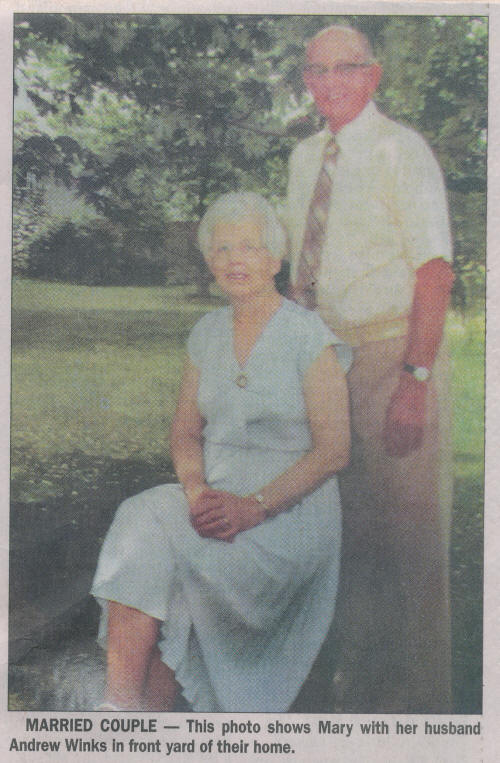
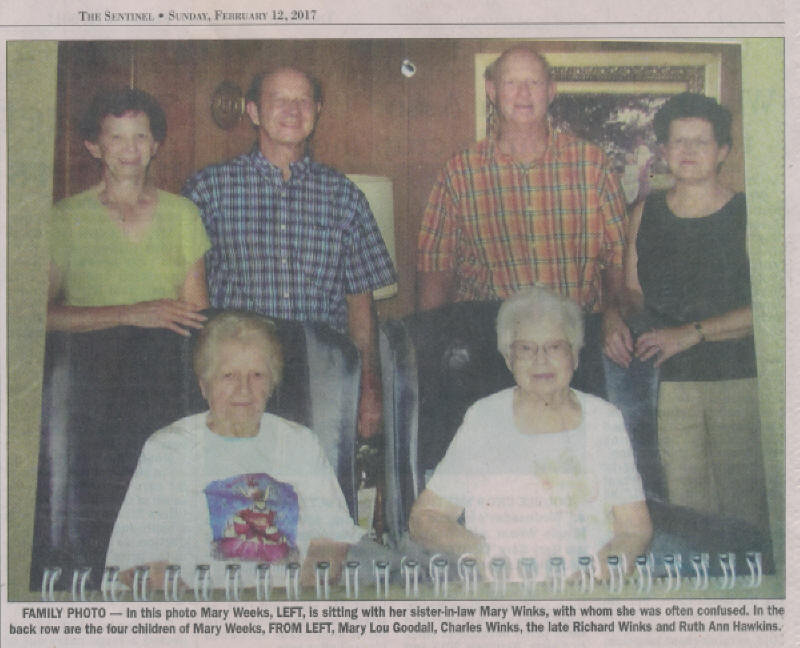
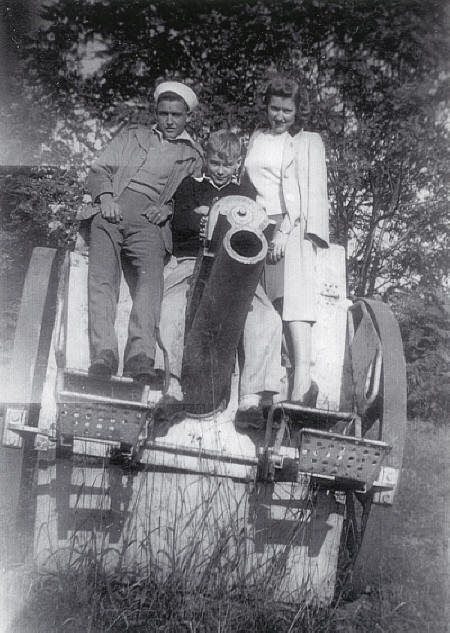

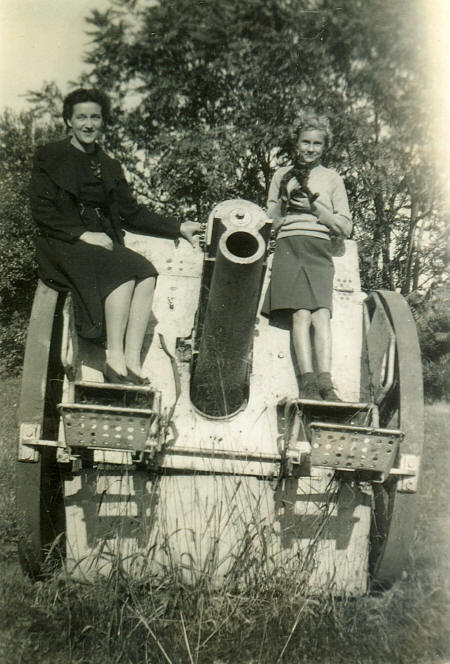
“The Cannon” according to Jim Hester:
“In 1921, when Tom McCarten was school principal at the Alma School, the school undertook an effort to raise funds to pay transportation costs to have a surplus artillery cannon shipped to the Village of Alma for display.
Students (Andrew Winks and Charles Pollard) sold popcorn balls (made by Andrew’s grandmother, Rosa) in downtown Alma on shopping day (Saturday) to the people who came to town weekly to shop. The details of the completion of the transaction and the arrival of the cannon to Alma have been lost to history. The cannon did arrive and was placed in the front yard of the Alma school. It stood there for several years until it was moved to the ICRR right of way on the north side of the 7th street crossing. It remained there in the same location where the signs and flag commemorating the veterans who had been in the various wars were displayed.
In the 1960’s the cannon was hauled to Kinmundy on a flatbed trailer by Bob Williams to be repaired by the Industrial Education Class of the Kinmundy-Alma High School. It languished in a heap of pieces at the side of the Industrial Education building due to a change of personnel at the school until Richard Pollard acquired it. Mr. Pollard took the wheels to Arthur to have them refurbished and then reassembled the cannon to place it in his front yard. The cannon resides at that spot to this day.
Several attempts have been made to have the cannon return to its original home. Two of the people who had campaigned for years for the return of the cannon were Alma residents Charles DeForde and Charles DeWeese, both veterans of WWII. Two other people who contacted Mr. Pollard were Mrs. Mary Weeks and Jim Hester. Mrs. Weeks was a newly joined member of the Senior Citizens group from Alma when she was persuaded to intervene on behalf of the town for the return of the cannon. Mr. Hester, a new town council member, was persuaded to intervene on behalf of the town for the return of the cannon. Mrs. Weeks said Mr. Pollard was polite, but adamant about retaining control of the cannon. Mr. Hester, a new town council member, was persuaded by Mr. DeWeese to intervene on behalf of the town to regain possession of the cannon. With the council’s sanction, Mr. Pollard was approached by Mr. Hester to see if a compromise might bring a settlement to the dispute. Mr. Pollard told Mr. Hester that if the council would reimburse him for the coast of repair ($400) to the wheels of the cannon he would allow the cannon to return to Alma. The message was returned to the council who collectively refused to pay any amount for an object that belonged to them in the first place. When this message was returned to Mr. Pollard, he informed Mr. Hester that his lawyer informed him that possession was the larger share of the law, and if the town intended to pursue the return of the cannon they would have to deal with his lawyer.”

Kelley Hulsey and restoration of cannon in Alma Park
Alma Cannon after it was brought back home to Alma again in the Gregory Park - April 2006
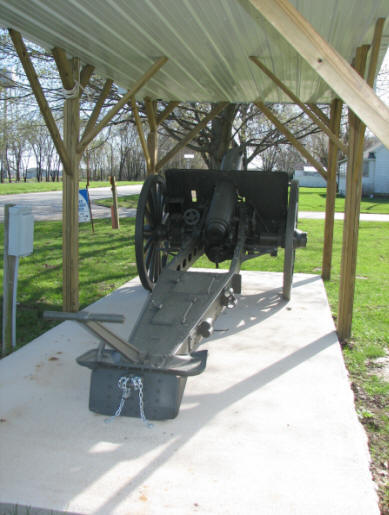
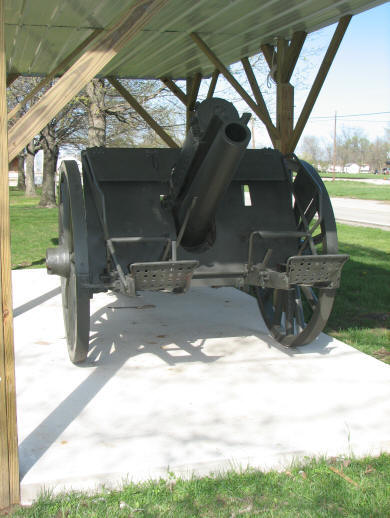
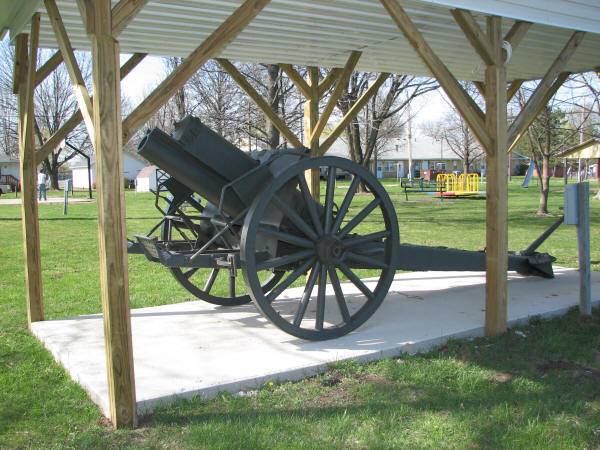
"Centralia Sentinel" - Sept. 14, 2019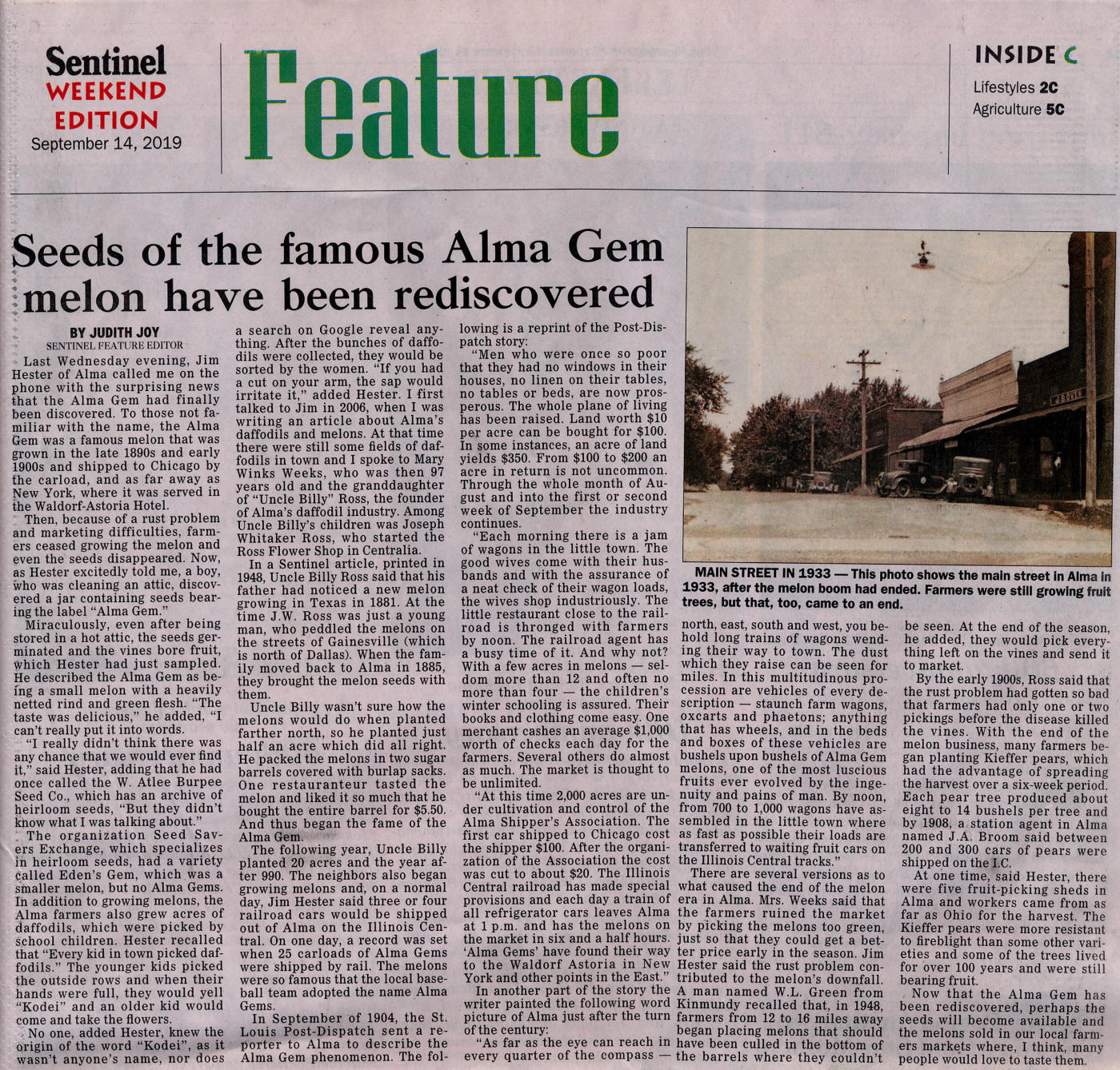
"Salem Times-Commoner" - July 29, 2020 - "Stan Jones looks back on early days of satellite television industry"
.jpg)
.jpg)
"The Sentinel" - Aug. 29, 2020 - "When not at home in Alma, Richard Day is in the Artic, watching polar bears"
.jpg)
.jpg)
"Salem Times-Commoner" - Dec. 4, 2020 - "Ronda (Swift) Yates completes 20 years of service as Marion County Circuit Clerk"
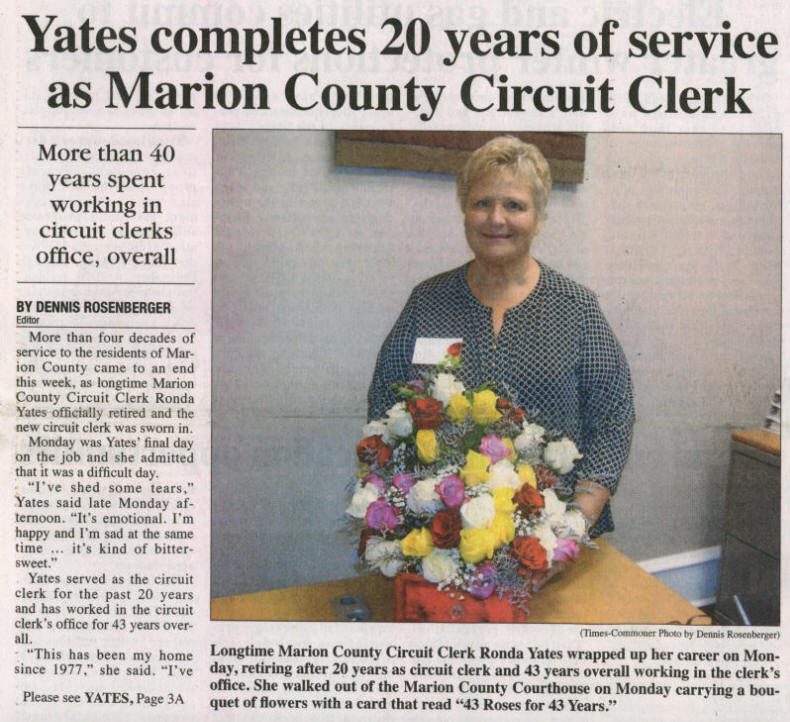
From previous writeup in newspaper:
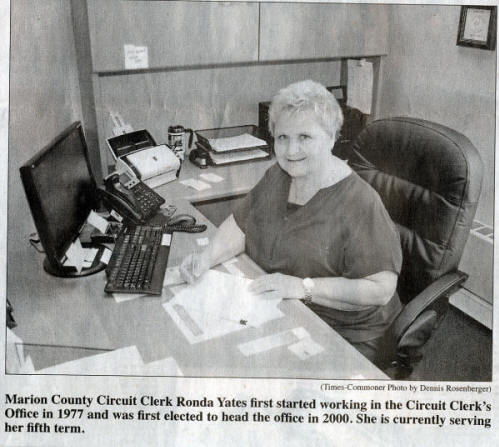
"Ronda (Swift) Yates completing 20 years of service as circuit clerk" - "The Sentinel" - Feb. 28, 2020
.jpg)
.jpg)
.jpg)
We welcome your suggestions, submissions, or any additions & corrections you can help us with! You can contact us at fordmobley@gmail.com Site and contents copyright - Kinmundy Historical Society, a nonprofit organization.
|